
The initial wave of industrial artificial intelligence, once characterized by the pursuit of ever-more-complex algorithms and the promise of massive data collection, has definitively given way to a new, more pragmatic era where the central challenge is no longer about creating a slightly better model but about deeply and sustainably embedding intelligence into the operational fabric of an enterprise. This critical evolution is being driven by the unforgiving realities of the industrial world: aging infrastructure, immense pressure to manage energy consumption, and the non-negotiable demands for absolute reliability, robust security, and long-term operational stability. The focus has decisively shifted from the novelty of AI technology itself to its practical application, where the true measure of success is not a conceptual breakthrough in a laboratory but an AI-driven solution that functions flawlessly for years within a complex, high-stakes environment. This maturation signals a significant pivot in the competitive landscape, where the ability to integrate wins out over the theoretical superiority of an algorithm. This industry-wide transformation is perfectly captured by Schneider Electric’s “Innovation Win Program,” an initiative that serves as a powerful case study demonstrating how a structured, collaborative approach can bridge the gap between a promising AI concept and a robust, commercially viable industrial solution, proving that the future belongs not to those with the best models, but to those who master the art of system integration.
The New Paradigm: Shifting from Hype to Hard-Wired Value
The Rise of Industrial Pragmatism
The industrial sector has moved decisively beyond the notion of artificial intelligence as a magic bullet, with industry leaders now understanding that a true “smart” factory transformation requires far more than just installing new software. Genuine progress is now measured by the delivery of solutions that can expertly navigate the intricate web of legacy Operational Technology (OT) and modern Information Technology (IT), delivering quantifiable improvements in efficiency, safety, and sustainability while operating under constant pressure. This shift toward pragmatism has significantly raised the bar for innovation. The conversation has evolved from discussing hypothetical capabilities to demanding demonstrable engineering credibility and a clear path to business viability. Any new AI application must prove its resilience and long-term stability in an industrial setting where failure can have catastrophic consequences, a standard that effectively filters out purely conceptual or unproven technologies. The industry now demands solutions that are not just intelligent but are also robust, secure, and engineered for the long haul, capable of withstanding the rigors of real-world deployment for years to come.
This newfound pragmatism is fundamentally reshaping the entire innovation lifecycle within the industrial domain. Unlike the fast-paced, iterative world of consumer technology where rapid development cycles are the norm, industrial AI demands a deliberate, methodical, and rigorous approach. The focus has moved from “speed” to “depth,” institutionalizing a process that prioritizes stability, security, and long-term operational feasibility above all else. This methodical vetting process is not a hindrance but an essential quality-control mechanism, born from the understanding that the cost of error in critical infrastructure—such as power grids, water treatment facilities, or advanced manufacturing plants—is astronomically high. Consequently, enterprises are no longer impressed by standalone AI models, regardless of their sophistication. They are actively seeking comprehensive, end-to-end solutions that are engineered from the ground up to integrate seamlessly with existing, complex systems. Any proposed innovation must therefore be evaluated not just on its algorithmic performance but on its ability to function as a reliable, secure, and fully integrated component of a much larger operational ecosystem. This stringent focus on real-world applicability and systemic value is the defining characteristic of the current, more mature phase of industrial digital transformation.
Redefining Competitive Advantage
The core battleground for industrial AI has fundamentally shifted from a contest of algorithmic superiority to a competition based on system-embedding capability. The race is no longer about which company possesses the most advanced algorithm or the most accurate predictive model in a controlled, laboratory environment. Instead, the ultimate prize will go to the organization that masters the complex and multifaceted art of seamlessly integrating intelligence into the core operational structures of power grids, manufacturing processes, and urban systems. This skill—the ability to embed AI deeply, reliably, and effectively—is now the primary determinant of success and market leadership. It requires a profound understanding that in the industrial world, the theoretical value of AI is not realized until it becomes a fully functioning, dependable part of the day-to-day workflow, enhancing operations without introducing new risks or complexities. This capability is what distinguishes true industry innovators from technology providers who offer only point solutions without considering the broader operational context or the long-term lifecycle of the deployment.
Achieving this high level of systemic integration demands a uniquely blended and sophisticated skill set that extends far beyond the confines of traditional data science. It requires a powerful fusion of algorithmic expertise with deep, domain-specific engineering knowledge, advanced organizational coordination, and an unwavering commitment to strict technological compliance and cybersecurity standards. This holistic capability is what creates a sustainable and defensible competitive advantage in the modern industrial landscape. Companies that can effectively bridge the chasm between the digital world of AI and the physical world of industrial operations are the ones that will thrive and lead the next wave of innovation. The new benchmark for excellence is not an isolated piece of intelligent software but a fully integrated system where AI enhances performance, improves safety, and drives efficiency without introducing new vulnerabilities. This redefinition of competitive advantage marks a critical maturation point for the entire “AI + Industry” space, signaling a move toward more practical, valuable, and enduring solutions.
Building the Future Through Collaborative Ecosystems
The “Innovation Win Program” as a Blueprint
Schneider Electric’s “Innovation Win Program” serves as a quintessential blueprint for this new collaborative model of industrial innovation, offering a clear alternative to isolated, in-house development. Far from being a traditional startup competition focused on short-term gains or flashy pitches, it is a structured, long-term co-creation mechanism meticulously designed for deep, systemic change. The program strategically fosters a symbiotic relationship, pairing Schneider’s extensive industry resources, real-world operational scenarios, and established technological platforms with the specialized expertise, novel engineering methodologies, and agile problem-solving capabilities of smaller, innovative partners. This partnership model is crucial for bridging the significant and often underestimated gap between a promising technological concept and a commercially viable, industrially robust solution. It operates on the core belief that no single entity, regardless of its size or resources, possesses all the necessary skills and insights to solve the complex, interconnected challenges of modern industry, making co-creation the most effective and sustainable path forward for meaningful innovation.
A core principle guiding the “Innovation Win Program” is the prioritization of “depth over speed,” a philosophy that stands in stark contrast to the rapid-fire, iterative cycles common in the consumer technology sector. The program’s methodical, multi-stage process—which includes an “Acceleration Camp” for initial 0-to-1 development, a “Growth Camp” for 1-to-N scaling and productization, and an “AI + Exploration Camp” for verifying cutting-edge concepts through rigorous proofs of concept—forms a complete, closed-loop system for innovation management. This deliberate structure ensures that every potential solution is thoroughly vetted for stability, security, and long-term operational feasibility before it is even considered for deployment within critical infrastructure. This institutionalized rigor is not a bottleneck but a necessary quality control measure in fields where failure can have severe economic, environmental, and safety consequences. By formalizing this deep-dive approach, the program provides a model for responsible and sustainable innovation that generates trust and ensures that new technologies are ready for the demands of the real world.
Real-World Applications in Energy Systems
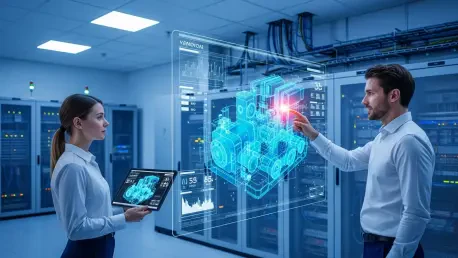
One of the most compelling examples to emerge from this collaborative ecosystem is the Digital Twin Power Distribution Room, a solution designed to tackle the pervasive problem of “invisible” and poorly documented power systems that often rely on fragmented, paper-based records. By creating a real-time, three-dimensional digital replica of the physical infrastructure, this technology converges all equipment status data, operational metrics, and maintenance workflows into a single, intuitive, and accessible interface. In large-scale projects like the Huairou Science City, this implementation has yielded remarkable and quantifiable results, including a 30% reduction in operations and maintenance (O&M) response time and a 50% improvement in the efficiency of training new personnel. This success demonstrates not just the power of digital twin technology itself, but also the tangible value of making complex, critical systems visible, manageable, and predictable, thereby enhancing both efficiency and safety.
The program has also produced significant breakthroughs in grid resilience, most notably with the Fast-Acting Distribution Network Fault Self-Healing application. Addressing the critical challenge of power outages and slow fault recovery times, this solution utilizes a powerful combination of optical differential technology, high-speed fiber optics, and 5G communication to enable millisecond-level fault location and automatic isolation. This effectively grants the power grid a self-repair capability, dramatically reducing downtime and improving overall reliability for end-users. What began as an advanced emergency response measure is now evolving into a fundamental piece of modern grid infrastructure, providing essential safety redundancy in an increasingly complex energy landscape. Furthermore, the Campus Power Intelligent Management System extends this intelligence to the consumption side, using AI-driven current fingerprint and load recognition algorithms to analyze and manage electricity usage in complex environments like universities. Beyond immediate energy savings, this project serves as a proof of concept for a future energy system: a decentralized network of countless intelligent nodes, each with its own perception and decision-making capabilities, signaling a move away from a traditional top-down dispatch model.
Embedding Intelligence Without Disrupting Operations
Practical Solutions for Modern Industry
In the demanding environment of the modern industrial sector, the greatest challenge is often implementing intelligent upgrades without disrupting continuous production processes that rely on heterogeneous and long-serving systems. Recognizing this critical constraint, the “Innovation Win Program” has focused on developing solutions that embed AI capabilities directly into existing workflows and equipment. This approach allows for a gradual, non-disruptive evolution rather than a risky, expensive, and often impractical “rip-and-replace” overhaul of entire systems. The emphasis is on creating smart, targeted interventions that enhance current operations without causing unplanned downtime or requiring extensive retraining. This strategy is essential for industries like manufacturing, pharmaceuticals, and logistics, where any interruption to production can lead to significant financial losses and supply chain disruptions. By designing AI to be an integrated enhancement rather than a disruptive force, these solutions ensure a smoother, more cost-effective, and ultimately more successful path to digitalization for established enterprises.
A prime example of this non-disruptive approach is the Industrial Zero-Trust solution. As digital transformation continues to blur traditional network perimeters by connecting OT systems to IT networks and the cloud, industrial control systems have become increasingly vulnerable to sophisticated cyber threats. This solution systematically applies the “zero-trust” security concept—where no user, device, or application is trusted by default, regardless of its location on the network—to the industrial domain. Through sophisticated mechanisms like granular identity authentication, least-privilege access controls, and network micro-segmentation, it provides refined, layered protection for critical assets without halting operations. Instead of relying on a single, hardened perimeter that can be breached, it secures the system from within, treating every connection and data request with suspicion until it is verified. This dynamic security model has become a vital underlying defense line for securing digitalized industrial processes, allowing companies to innovate and connect their systems with greater confidence and resilience against emerging threats.
Proactive Maintenance as a New Standard
Another critical innovation addressing the need for operational continuity is the Predictive Maintenance Platform for Transmission Systems, known as ATV Predict Plus. This platform directly tackles the high costs and significant operational risks associated with unplanned equipment downtime in industrial settings. Its strategic brilliance lies in its integration method: by embedding AI algorithms directly into the equipment layer, using devices like the frequency converter as a native data entry point, it can continuously monitor the health of critical systems such as motors, pumps, and fans in real-time. This embedded intelligence analyzes subtle variations in operational data—like temperature, vibration, and current draw—to detect signs of wear and predict potential failures long before they become catastrophic problems. The core advantage of this platform is its ability to fundamentally shift the entire maintenance paradigm from a passive, reactive repair model, where teams fix things only after they break, to a proactive, pre-intervention approach where issues are addressed during scheduled maintenance windows, before they can impact production.
The tangible benefits of this proactive maintenance model are substantial and have been clearly quantified. Pilot data from deployments of the ATV Predict Plus platform has shown a remarkable 17% increase in overall equipment utilization and a significant 25% reduction in maintenance-related costs. By providing early warnings and actionable insights, the system empowers maintenance teams to schedule repairs during planned downtime, thereby avoiding costly emergency shutdowns and extending the lifespan of valuable assets. This transforms operational reliability from an abstract organizational goal into a calculable, predictable, and manageable technical metric. The platform’s success demonstrates the profound impact of embedding AI at the edge, turning standard industrial components into intelligent sensors that safeguard the entire production line. It is a clear and powerful illustration of how targeted, deeply integrated AI can deliver concrete, measurable business value without requiring a complete and disruptive system overhaul.
The Engineering of Intelligence
The journey of industrial AI has clearly matured from a fascination with abstract potential to a focused discipline centered on concrete, engineered reality. The initial enthusiasm for artificial intelligence as a standalone technological force was tempered by the complex demands and uncompromising standards of real-world industrial and energy environments. The next phase of this transformation was ultimately defined not by the sophistication of an algorithm in a laboratory but by its proven ability to function as an integral, reliable, and secure component of a larger system for years on end. Schneider Electric’s “Innovation Win Program” served as a powerful testament to this new reality. By championing a collaborative ecosystem and prioritizing deep engineering rigor and long-term sustainability, the program created a repeatable and scalable mechanism for turning innovative concepts into systemic capabilities. The resulting case studies—from self-healing power grids and digital-twin-managed facilities to zero-trust industrial networks and predictive maintenance platforms—were not isolated technological marvels. They were foundational components of an emerging, more intelligent infrastructure, built piece by piece through deep, institutionalized collaboration. For all industry participants, the path forward was shown to lie in this deep coupling of AI with engineering logic and system architecture, which built a more stable, efficient, and intelligent foundation for the next generation of global industry.