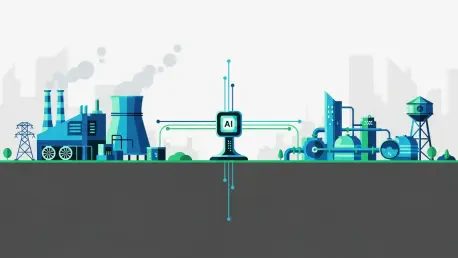

A fundamental transformation is underway across the global infrastructure landscape, driven by a confluence of unprecedented challenges that have rendered traditional operational models obsolete. Faced with the pressures of climate stress, exponential demand growth from new sources like data centers and electric vehicles, and persistent cybersecurity threats, the decades-old strategy of simply expanding physical assets is no longer economically viable or environmentally sustainable. Instead, a new competitive paradigm has emerged, one centered not on building more, but on operating existing systems more intelligently. The key to unlocking greater efficiency, enhancing resilience, and ensuring a sustainable future lies in the strategic use and sharing of industrial data through interconnected, AI-driven digital ecosystems that are breaking down long-standing sectoral silos.
The New Operational Paradigm
The Imperative to Do More with Less
The modern infrastructure operator is navigating a complex and volatile environment where the mandate is unequivocally to achieve more with fewer resources. The convergence of crises is forcing a strategic pivot away from capital-intensive expansion and toward operational excellence. Surging demand, coupled with the urgent need for decarbonization, places immense strain on grids and distribution networks that were not designed for such dynamic loads. In this context, the competitive advantage now belongs to organizations that can extract the maximum possible value from their existing systems. This involves leveraging vast streams of operational data to predict failures, optimize asset performance, and enhance decision-making in real time. By harnessing this intelligence, operators can improve efficiency and boost output without the enormous cost and environmental impact associated with new construction, fundamentally changing the economics of infrastructure management for the foreseeable future.
This strategic shift is not merely a cost-saving measure but a necessary adaptation for survival and growth in an increasingly constrained world. The ability to process and act upon shared intelligence allows utilities and other critical service providers to become more agile and responsive. For instance, predictive maintenance powered by AI can prevent costly outages by identifying potential equipment failures before they occur, while real-time load balancing can accommodate the intermittency of renewable energy sources. This data-driven approach fosters a culture of continuous improvement, where insights gleaned from one part of the system can be applied to enhance performance across the entire network. Ultimately, the imperative to “do more with less” is redefining what it means to be a successful infrastructure operator, placing a premium on digital fluency and collaborative innovation over sheer physical scale.
Breaking Down Silos Through Radical Collaboration
For decades, critical infrastructure sectors such as power, water, transportation, and telecommunications have operated in distinct, self-contained silos, each managing its own assets and data with little to no interaction. This fragmented model is now proving to be a significant liability, as a failure in one system can trigger a cascade of disruptions across others. True resilience and large-scale efficiency can only be achieved through a new model of “radical collaboration,” where sectors work in concert, sharing data and insights to optimize performance at a systemic level. This is no longer a conceptual ideal but a pressing business imperative, facilitated by the emergence of secure, neutral data platforms that enable the exchange of valuable operational intelligence without compromising security or proprietary control. This interconnectedness allows for the creation of a “system of systems,” a holistic framework where actions in one domain can be fine-tuned based on real-time data from another.
This collaborative paradigm unlocks profound new opportunities for optimization and risk mitigation that are impossible to achieve in isolation. By viewing interconnected infrastructures as a single, dynamic entity, operators can anticipate and prevent cascading failures, manage resources more effectively, and develop more robust contingency plans. For example, a power utility can share load forecasts with a water utility to help it schedule energy-intensive pumping operations during off-peak hours, reducing costs for the water provider and lessening strain on the grid. This level of coordination is made possible by digital platforms that act as a common operating picture, translating disparate data sets into actionable intelligence. The move away from siloed thinking and toward a collaborative, system-of-systems approach represents a fundamental evolution in infrastructure management, promising a more resilient, efficient, and sustainable future.
Key Technological Enablers
The Rise of Secure, AI-Infused Data Platforms
The cornerstone of this collaborative transformation is the rapid adoption of secure, AI-infused cloud data platforms that function as “data highways” between once-disparate industries. These platforms are the technological backbone enabling the evidence-based cooperation required to tackle complex, multifaceted challenges like ensuring energy security, mitigating environmental risk, and bolstering national resilience. By providing a unified, holistic view of interconnected systems, they empower operators to move beyond reactive problem-solving and proactively prevent system-wide failures. This capability is becoming increasingly essential as governments worldwide tighten requirements for cybersecurity and cross-sector reporting. Furthermore, these platforms are crucial for managing the growing complexity of behind-the-meter technologies, such as rooftop solar, battery storage, and smart appliances, by integrating them into sophisticated “digital twins” that mirror the real-world grid in a virtual environment for simulation and optimization.
The economic and operational potential of this global data-sharing ecosystem is immense, with some estimates suggesting it could unlock a global dividend of up to three trillion dollars annually through enhanced efficiency and new service creation. These platforms are designed for neutrality and security, allowing different entities to share critical operational insights without exposing sensitive proprietary data. This creates a trusted environment for collaboration between public utilities, private companies, and regulatory bodies. As these data highways become more prevalent, they will not only improve the day-to-day performance of existing infrastructure but also serve as the foundation for developing next-generation smart grids, intelligent water networks, and fully integrated smart cities, transforming how society manages its most critical resources.
The Maturation of Artificial Intelligence
Artificial Intelligence has definitively moved beyond the experimental phase and is now an indispensable, practical tool delivering tangible results across the infrastructure sector. No longer confined to the specialized domain of data scientists, AI capabilities are increasingly being embedded directly into the hardware and software that operations teams use every day. This democratization of AI, powered by accessible cloud platforms and intuitive software, is enabling predictive maintenance, real-time operational optimization, and enhanced strategic decision-making on an unprecedented scale. According to a 2025 survey from McKinsey, 88% of companies already utilize AI in some capacity, with early adopters reporting significant productivity gains. This widespread adoption is accelerating as AI proves its value in a diverse range of applications, from forecasting harmful algae blooms in municipal water reservoirs to optimizing the flow of renewable energy across national power grids.
The deployment of AI in these critical and highly regulated sectors is being streamlined by new tools, sometimes referred to as “Industrial Accelerators,” which provide pre-configured templates, data models, and workflows designed for specific use cases. These solutions lower the barrier to entry, allowing organizations to implement sophisticated AI applications more quickly and with less risk, thereby accelerating their path to more resilient and efficient operations. This trend is set to continue, with Gartner forecasting that 40% of all enterprise applications will feature embedded conversational AI agents by 2026. This integration signifies a profound shift where AI is not just a supplementary analytics tool but a core component of the operational technology that runs the world’s essential services, empowering human teams with predictive insights and automated controls.
Cross-Sector Synergy in Action
Optimizing the Critical Water-Energy Nexus
The increasingly interdependent relationship between water and power utilities serves as a prime example of where cross-sector collaboration is yielding tremendous value. Historically managed as entirely separate entities, these two sectors are now widely viewed as a joint optimization problem, a perspective that is expected to become standard practice by 2026. The logic is compelling: water utilities are frequently the single largest consumer of electricity on any given power grid, using immense energy for treating and pumping water across vast distribution networks. Consequently, inefficiencies within a water system—such as leaks or suboptimal pump scheduling—result in a massive waste of both water and the energy used to transport it. The explosive growth of data centers, which are projected to more than double their electricity demand by 2030, acts as a powerful catalyst for this integration, as these facilities require vast quantities of both power for processing and water for cooling.
By adopting a “system of systems” approach enabled by shared data, utilities can create a powerful win-win scenario. Real-time data exchange allows a water utility to reduce its operational costs significantly by improving its energy efficiency—for instance, by scheduling pumping during times of low electricity demand and cost. This, in turn, directly benefits the power utility by reducing peak demand and lessening the overall strain on the grid, which enhances grid stability and can defer the need for costly infrastructure upgrades. This symbiotic optimization of the water-energy nexus demonstrates the tangible benefits of breaking down traditional silos. It showcases a model where intelligent, data-driven collaboration not only improves the bottom line for individual operators but also contributes to greater resource security and sustainability for the entire community they serve.
Transforming Core Utilities
The digital shift is having a profound and far-reaching impact on the core utility sectors responsible for delivering power and water. The power industry is currently navigating a “twin transition,” simultaneously grappling with a surge in electricity demand from electric vehicles, heat pumps, and data centers, while also facing aggressive government mandates for decarbonization. A significant investment gap persists, with spending on grid modernization lagging far behind investments in new generation capacity. To bridge this gap and manage an increasingly complex energy landscape, technologies like smart grids, microgrids, and AI-powered digital twins have become essential. These tools are critical for balancing the volatile output from renewable sources like wind and solar with fluctuating consumer loads, with the International Energy Agency noting that AI could unlock up to 175 gigawatts of additional capacity from existing transmission lines alone through enhanced orchestration.
Meanwhile, the water and wastewater sector faces its own set of formidable challenges, including aging and deteriorating infrastructure, heightened stress from climate change-induced droughts and floods, and significant cybersecurity vulnerabilities. With reports indicating that over 70% of U.S. water utilities fail to meet basic cybersecurity standards, the need for digital transformation has become urgent. In response, utilities are rapidly modernizing their legacy SCADA systems, deploying networks of IoT sensors to monitor system health in real time, and using AI for critical tasks like leak detection and water quality monitoring. Central to this modernization effort are secure, cloud-connected intelligence platforms that facilitate the seamless and secure sharing of operational and compliance data with regulators, government agencies, and other strategic partners, ensuring the safety and reliability of this essential public service.
Building a Connected Future
From Smart Cities to Connected Nations
The principles of shared intelligence and cross-sector collaboration are now being applied at an ever-expanding scale, moving beyond individual utilities to create fully integrated, data-driven, and climate-resilient urban environments. Within these emerging smart cities, AI-optimized systems are delivering remarkable efficiency gains; for example, intelligent HVAC systems in commercial buildings can reduce energy consumption by up to 25%. Cities are increasingly deploying comprehensive digital twins—virtual replicas of their physical infrastructure—for the real-time management of traffic flows, utility networks, and emergency response services, a development that has been shown to slash critical incident response times by as much as 60%. The technological foundation for this evolution is the use of hybrid-cloud platforms that can unify and analyze disparate data streams from building management, energy grids, and environmental sensors into a single, cohesive operational view.
This vision of integration is also being realized at a macro level, as governments and entire industries invest in unified digital platforms that function as national or regional digital twins. These ambitious “connected country” frameworks are designed to integrate data across all critical sectors—including energy, water, transport, and manufacturing—to enable a new level of real-time collaboration and co-optimization. By leveraging sophisticated hybrid-cloud architectures, these platforms transform millions of distributed assets, from wind turbines to traffic lights, into a single coordinated and intelligent network. This holistic approach not only enhances national resilience and economic competitiveness but also dramatically accelerates decarbonization efforts by providing the insights needed to manage national resources with unprecedented precision and efficiency.
The Dual Role of Data Centers
Now officially designated as critical infrastructure in many jurisdictions, data centers occupy a unique and complex position within this evolving ecosystem. On one hand, they represent a primary source of new and rapidly growing strain on power and water systems, with electricity consumption in the U.S. alone projected to triple by 2028. This voracious demand places immense pressure on local utilities and has become a key driver for greater cross-sector planning and resource management. On the other hand, data center operators have become pioneers in the very digital transformation that is reshaping infrastructure, moving decisively away from siloed IT facilities and toward highly integrated and predictive operational models. AI has become central to their operations, used to meticulously optimize cooling systems, power usage effectiveness, and system uptime to maximize efficiency and reliability.
The immense resource footprint of data centers has also made sustainability a top business priority, driven by a combination of tightening regulations, investor demands, and community pressure. In response, operators are increasingly investing in self-reliance and circular economy principles, implementing on-site renewable energy generation, advanced battery storage systems, and innovative heat reuse projects that capture waste heat to warm nearby buildings or industrial processes. This journey revealed that data centers were not just consumers but also catalysts for change. Their unique demands pushed the boundaries of operational efficiency and sustainability, creating models and technologies that were then adopted by the broader infrastructure community, ultimately accelerating the transition toward a more integrated, intelligent, and resilient future for all.