
After a period marked by the striking paradox of record-breaking venture capital investment set against stagnant industrial robot installations, the robotics industry is now entering a new phase of maturation. The year 2026 is defined not by speculative hype but by a firm grounding in pragmatism, where the tangible metrics of real-world performance, financial viability, and operational resilience are the primary catalysts for automation adoption. This shift is driven by a complex interplay of economic necessity and geopolitical realignments, forcing businesses to move beyond theoretical potential and focus on solutions that deliver immediate and demonstrable value. As companies navigate persistent supply chain fragilities and intense global competition, the conversation around robotics is evolving from what is technologically possible to what is economically essential for survival and growth.
The New Economic and Geopolitical Landscape
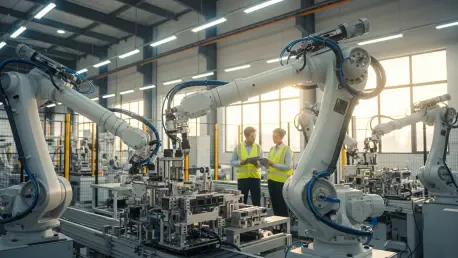
Manufacturing is decisively reclaiming its position as the foremost driver of automation adoption, a trend particularly pronounced within the United States. This resurgence is less a technological evolution and more a strategic response to a powerful confluence of macroeconomic and geopolitical forces. The accelerating movement toward “nearshoring” and rebuilding domestic manufacturing capabilities stands as the primary catalyst, fueled by a widespread recognition of the vulnerabilities exposed by fragile global supply chains, an unpredictable international climate, and the economic friction of tariffs. Unlike the retail and warehousing sectors, which can delay capital investments amid economic uncertainty, manufacturers designing and constructing new domestic plants face an unavoidable imperative. With high operational costs and a chronic labor shortage exceeding one million open positions, automation has become the only feasible pathway to achieving the productivity levels required to compete with lower-cost economies, transforming robotics from an optional upgrade into a foundational necessity.
Simultaneously, geopolitics is beginning to influence the robotics industry as profoundly as technological innovation itself, leading to a splintering of the global supply chain into two distinct and progressively diverging ecosystems: one aligned with the United States and its allies, and the other centered around China. This division is a direct consequence of the immense pressure on Western manufacturers to mitigate their deep-seated dependence on China, which currently supplies an estimated 90 percent of key robotics components. This strategic decoupling will inevitably increase costs in the short term as companies invest in new facilities and establish alternative supplier relationships. However, the long-term benefit is a significant enhancement in supply chain resilience and a reduction in vulnerability to geopolitical shocks. Companies are increasingly demanding dual-sourcing strategies as a form of operational insurance, accepting higher initial expenses to safeguard their production lines. This monumental effort to rebuild a domestic robotics supply chain is a decade-long endeavor, not a swift transition.
Evolving Business Models and Operations
The financial model for acquiring automation is undergoing a significant transformation, with the Robots-as-a-Service (RaaS) model rapidly gaining traction. This approach allows companies to pivot from the traditional method of large, upfront capital expenditures (CapEx) to a more flexible, operational expense-based subscription. Through RaaS, businesses pay a recurring monthly fee that conveniently bundles the hardware, software, ongoing maintenance, and support services into a single, predictable package. This shift effectively lowers the financial barrier to entry, making advanced automation accessible to a much wider range of businesses, especially smaller manufacturers and third-party logistics (3PL) providers who are cautious about committing heavy capital during periods of economic uncertainty. The RaaS model not only reduces financial risk for the buyer but can also accelerate the payback period on the investment. As the pace of robotics innovation continues to quicken, RaaS is also emerging as a practical, low-risk method for companies to pilot and deploy unproven solutions in real-world settings.
The long-held vision of fully automated, human-free “lights-out” warehouses is finally becoming a tangible reality, albeit in an initial, hybrid form. While true 24/7 autonomous operations remain on the horizon, clear evidence shows the transition is well underway through the emergence of a new operational model where robots manage all core workflows autonomously during specific periods, such as overnight shifts, without any on-site human supervision. A prime example of this trend is The Feed, an e-commerce retailer that utilizes robots to run a fully autonomous night shift. These robots independently pick and buffer customer orders throughout the night, staging them to be ready for immediate packing and dispatch the moment human staff arrive in the morning. This innovative approach dramatically increases the warehouse’s overall throughput while shortening order fulfillment and delivery times. This hybrid model, combining autonomous robotic shifts with human-supervised peak-hour operations, is expanding rapidly and serves as a crucial stepping stone for operators as they lay the groundwork for fully automated facilities in the future.
The Future of Form Factors and Fulfillment
Humanoid robots will continue to capture significant media attention and public imagination, but their actual impact on real-world operations will remain limited. The activity surrounding humanoids will be concentrated in demonstrations, pilot programs, and data collection initiatives rather than production-grade, at-scale deployments, as companies are still in the very early stages of identifying practical, economically viable roles for these advanced machines. The primary obstacles to widespread adoption remain their prohibitively high cost, limited functional capabilities in complex environments, and unproven reliability, all of which make it exceedingly difficult for businesses to achieve a positive return on investment. With market valuations currently running far ahead of tangible technical progress, it is highly probable that at least one high-profile humanoid startup will face major setbacks or even closure. While testing humanoids now is a necessary step for the sector’s long-term growth, they are still several years away from addressing genuine operational needs at scale.
A significant comeback is underway for micro-fulfillment centers (MFCs), especially within the e-grocery segment. After a period of stagnation following post-pandemic normalization, the e-grocery market is once again experiencing booming growth, with year-over-year figures in the United States reaching 30 to 50 percent. As order volumes surge, major players are revisiting the strategy of using small, localized fulfillment sites strategically placed in urban areas. The primary goal of this model is to significantly reduce last-mile delivery costs and drastically accelerate delivery times to meet consumer expectations for speed and convenience. The initial wave of e-grocery MFCs was ahead of its time; however, the conditions are now ripe for their success. This is due to the alignment of two key factors: a business model driven by sustained consumer demand and the maturation of the technology itself. A new generation of robotics systems, characterized by lower costs, smaller footprints, and higher throughput, is finally making the compact MFC model economically viable and creating the ideal conditions for a new wave of profitable, highly automated centers.