
In an increasingly volatile global economy where supply chain disruptions can obliterate nearly half of a company’s annual profits over a decade, the American manufacturing sector’s revitalization hinges on a fundamental operational shift. The traditional warehouse, once a static cost center for storing goods, has been reimagined as a dynamic and strategic nerve center, actively driving production efficiency and resilience. This transformation is not merely an upgrade but a complete redefinition of the warehouse’s role, turning it into a critical engine of growth. The key to unlocking this potential lies in the convergence of three powerful technological pillars: robotics, digital twins, and data intelligence. Together, these technologies are creating intelligent, adaptive logistics hubs that provide the speed, accuracy, and reliability necessary for modern manufacturing to thrive and compete on a global scale. This evolution is crucial, as the success of production lines is now inextricably linked to the performance of these sophisticated supply chain nodes.
The Three Pillars of the Modern Warehouse
Robotics: The Foundation of Operational Resilience
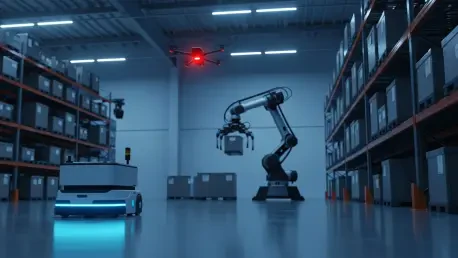
The integration of advanced robotics has become the bedrock of operational resilience within the modern manufacturing supply chain, moving far beyond the rudimentary automated guided vehicles of the past. Today’s robotic systems are intelligent, autonomous solutions capable of handling complex and nuanced tasks that were previously the exclusive domain of human labor. These technologies include sophisticated robotic arms for picking and packing diverse items, autonomous mobile robots (AMRs) for facilitating a continuous and uninterrupted flow of materials to assembly lines, and drone-based systems for automated inventory scanning. By deploying such robotics, manufacturers realize a significant increase in operational throughput. This directly translates into faster, more reliable access to raw materials and components, which in turn drastically reduces the frequency of costly production stoppages. The result is a smoother, more predictable workflow between warehouse facilities and the factory floor, establishing a stable and efficient foundation for all subsequent manufacturing processes.
Furthermore, robotics provides a multifaceted solution to some of the most persistent challenges facing the logistics sector. The chronic labor shortages that have plagued warehouses are effectively mitigated by automation, which can operate around the clock with consistent precision, filling critical gaps in the workforce. This technological intervention also introduces an unprecedented level of scalability. As market demand fluctuates, a robotics-powered warehouse can ramp up or scale down its operations with an agility that is simply not possible when relying on a human workforce alone. This eliminates the lengthy and expensive process of hiring and training new staff to meet surges in demand. Consequently, manufacturers gain the flexibility to adapt to changing economic conditions without a proportional increase in labor costs, transforming a traditionally rigid operational component into a highly responsive and economically efficient asset that supports sustainable growth and competitive advantage in a dynamic marketplace.
Digital Twins: The Blueprint for Predictive Control
Serving as the second pillar of this transformation, the digital twin introduces a profound layer of real-time operational intelligence and predictive capability. A digital twin is a dynamic, high-fidelity virtual replica of the entire physical warehouse environment, encompassing its structural layout, all its assets from forklifts to conveyor belts, the precise location of every piece of inventory, and the intricate operational processes that govern its function. This technology revolutionizes how organizations plan, manage, and optimize their logistics. Warehouse managers can run complex simulations to test new layouts or workflows in the virtual space before committing to expensive and disruptive physical changes. This virtual sandboxing allows for data-driven decision-making, ensuring that any modifications are optimized for maximum efficiency. According to a Capgemini study, organizations that have implemented digital twins have achieved an average 15% improvement in key metrics like sales, turnaround time, and overall operational efficiency, underscoring the tangible benefits of this predictive technology.
The strategic value of a digital twin extends far beyond planning and into the realm of proactive operational management and disruption mitigation. This technology enables the real-time tracking of every single item and piece of equipment within the facility, providing a level of granular visibility and control that was previously unattainable. More importantly, by continuously analyzing data from sensors on machinery, the digital twin can accurately predict maintenance needs, allowing for scheduled repairs that prevent catastrophic equipment failures and unplanned downtime. This capability is mission-critical for manufacturers, as it ensures the steady flow of materials to production lines. Looking ahead, the adoption of this technology is set to become widespread; a Gartner forecast predicts that over 70% of large enterprises will utilize digital twins for process optimization by 2027. For manufacturers, this means disruptions can be anticipated and their impacts modeled, inventory is precisely located when needed, and strategic operational changes can be validated without risk.
Data Intelligence: The Engine of Accuracy and Efficiency
Data intelligence stands as the third and final pillar, acting as the powerful analytical engine that synthesizes the vast streams of information generated by robotics and digital twins to drive unparalleled accuracy and operational continuity. Warehouses are immense data generators, but this information is only valuable when it is effectively processed, analyzed, and converted into actionable insights. Modern data intelligence platforms excel at this, integrating disparate data from warehouse management systems (WMS), robotic fleets, and environmental sensors into a single, cohesive view of the entire operation. This holistic perspective allows for real-time monitoring and immediate adjustments. The impact of these systems is profound, as illustrated by a Forrester Total Economic Impact report, which found that organizations leveraging such platforms can achieve an astonishing 99.9% inventory accuracy. This near-perfect precision significantly reduces errors, minimizes stock discrepancies, and can decrease the need for full-time manual cycle counters by as much as 80%, freeing up human capital for more value-added tasks.
The strategic application of data intelligence is particularly crucial for supporting the lean manufacturing principles that are vital to modern production. These principles depend on precision, just-in-time inventory management, and the relentless elimination of waste. By ensuring an uninterrupted and accurately forecasted supply of materials, data intelligence allows manufacturers to minimize the substantial costs associated with overstocking while simultaneously preventing the stockouts that can bring a production line to a grinding halt. The same Forrester report highlighted that these systems can shorten stockholding times by an average of 30%, further enhancing capital efficiency. Moreover, advanced analytics can proactively identify potential bottlenecks in the supply chain, from an underperforming piece of equipment to a supplier delay, allowing managers to intervene before a minor issue escalates into a major disruption. This proactive stance ensures that the factory floor is consistently supplied, enabling manufacturers to operate with greater agility and efficiency.
The Synergistic Impact on Manufacturing
Creating a Unified, Adaptive Ecosystem
While each of these three technological pillars delivers significant value independently, their true transformative power is unleashed through their synergistic integration. The combination of robotics, digital twins, and data intelligence creates a sophisticated, closed-loop ecosystem where the warehouse can intelligently and autonomously adapt to ever-changing conditions. In this unified system, robotics provides the physical efficiency and automation, carrying out the hands-on tasks with speed and precision. The digital twin offers the predictive and simulative insight, creating a virtual environment to test strategies and foresee potential issues. Finally, data intelligence serves as the connective tissue, linking the physical and virtual worlds with real-time, actionable visibility and analysis. This creates a continuous feedback loop: the robots and sensors collect data, the digital twin models scenarios, and the intelligence platform analyzes the outcomes to optimize robotic workflows and operational strategies in real time, enabling the warehouse to respond seamlessly to sudden shifts in customer demand, unforeseen supply disruptions, or dynamic changes in production schedules.
This integrated approach yields a collection of compounded benefits that fundamentally enhances a manufacturer’s competitive position. The synergy between automation and intelligence enables higher throughput without a corresponding increase in operational costs, breaking the traditional link between volume and expense. Predictive maintenance, driven by insights from the digital twin and data analytics, dramatically reduces unplanned downtime, ensuring that the supply of materials to the production line remains constant and reliable. This ecosystem also provides for seamless scalability; as an operation grows, the technological framework can be expanded without the logistical headaches of a massive hiring and training initiative. Perhaps most importantly, this system builds a powerful layer of resilience against the global supply chain volatility that has become the new normal. By creating a warehouse that is not just efficient but also intelligent and adaptive, American manufacturers are better equipped to navigate uncertainty, maintain continuity, and secure a leadership position in an increasingly complex and competitive global economy.
A New Foundation for American Competitiveness
The strategic redevelopment of warehouses into intelligent, automated hubs became the cornerstone upon which the revitalization of U.S. manufacturing was built. This shift represented a move away from simply constructing new factories and toward the more critical task of engineering smarter, more resilient supply chains. The warehouse of the future—powered by the integrated technologies of robotics, digital twins, and data intelligence—was central to this vision. By transforming these facilities from static cost centers into dynamic, strategic drivers of competitiveness, the manufacturing sector ensured that production lines were consistently supplied, operations remained agile in the face of uncertainty, and American industry was well-equipped to lead. This evolution ultimately proved that the path to a stronger manufacturing base was paved not just with steel and concrete, but with data and intelligence.