
The intricate, often hidden internal structures of high-performance components are rapidly evolving from simple space-fillers into highly engineered, functional architectures. For years, the challenge has been to move beyond uniform patterns and create internal geometries that can intelligently manage forces, fluids, and heat. With the release of its V3 software, Zürich-based Spherene has introduced a suite of tools designed to give engineers direct, granular control over these internal systems, potentially unlocking new levels of efficiency in additively manufactured parts.
Beyond the Gyroid Directing Internal Structures with Intelligence
The central challenge in advanced manufacturing has long been the creation of internal geometries that do more than simply reduce weight. While structures like the gyroid offer excellent strength-to-weight ratios, their uniform, repeating nature presents significant limitations in applications with complex thermal and fluid dynamic requirements. These standardized patterns often fail to address localized needs, leading to suboptimal performance where flow or heat transfer is critical.
This limitation becomes particularly apparent when designing components like heat exchangers or manifolds. A uniform internal structure can create uneven flow distribution, high-pressure drops, and inefficient heat dissipation, forcing engineers to compromise on performance or component size. The demand has grown for a method to intelligently direct these internal structures, tailoring them to the specific physical demands of their environment rather than applying a one-size-fits-all lattice.
The Quest for Ultimate Control in Additive Manufacturing
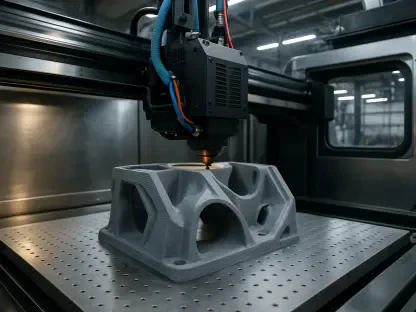
This need for hyper-optimized components is especially acute in the aerospace, automotive, and energy sectors, where every gram of weight and every watt of energy saved has a compounding impact. As these industries push the boundaries of performance, the components they rely on must become smaller, lighter, and more efficient. Additive manufacturing provides the means to build these complex parts, but the design software must enable their creation.
Foundational technologies like Adaptive Density Minimal Surfaces (ADMS) have provided a significant leap forward, allowing for the creation of lightweight yet robust structures. However, true optimization requires a deeper level of control. The ability to precisely manipulate the internal architecture is directly linked to achieving real-world goals, such as reducing the energy needed to pump fluids, improving the efficiency of thermal systems, and ultimately designing more powerful components within a smaller footprint.
A Deeper Dive into V3s New Geometry Toolkit
Spherene V3 directly addresses this need with a new geometry toolkit, headlined by “Flow ADMS,” a paradigm designed specifically for fluid applications. This feature confronts the core problems of unbalanced pressure and high flow resistance inherent in many conventional minimal surfaces. By employing an energy-optimized geometry, Flow ADMS facilitates more efficient fluid movement, which in turn reduces the energy requirements for pumping systems.
Further enhancing this capability is the “Flow Direction” feature, which allows engineers to use vector fields to define preferred, low-resistance pathways for fluids. The software then adapts the internal geometry to align with these vectors, effectively guiding the flow. In a compelling demonstration of its efficacy, a CFD simulation of a Spherene-designed heat exchanger showed an approximately 20% lower pressure drop compared to an equivalent gyroid structure, all while maintaining comparable thermal performance.
For mechanical applications, the “Scatter Vector” feature introduces the ability to engineer anisotropy. Using vector fields, designers can stretch and orient the geometry along specific axes to create controlled directional strength. This process allows for the tailoring of mechanical properties to resist specific loads, all while preserving the continuous, monolithic nature of the ADMS structure, avoiding the stress concentrations that can occur in joined lattice struts.
SphereneHEX Putting Advanced Geometry to the Test
To showcase the practical power of these new tools, the SphereneHEX proof-of-concept was developed. This advanced heat exchanger, designed entirely within Spherene V3, serves as a direct demonstration of the software’s capabilities. It integrates the “Flow ADMS” and “Flow Direction” features to precisely manage internal fluid flow and optimize heat dissipation within a single, complex part intended for additive manufacturing.
The project highlights the tangible benefits of this new level of design control. By sculpting the internal pathways for both function and manufacturability, the SphereneHEX concept illustrates a clear path toward enhanced thermal performance and significant potential for component consolidation and size reduction. It moves the design of such components from an assembly of simpler parts to a holistic, functionally integrated system.
A Practical Framework for Next Generation Design
Ultimately, the release of these advanced controls empowers engineers by giving them direct and intuitive command over previously inaccessible design variables. This marks a fundamental shift in the design process itself. Instead of merely selecting a pre-defined lattice from a library to fill a volume, engineers can now actively sculpt an internal architecture optimized for a specific, multi-physics function.
This new framework enables designers to solve for mechanical, thermal, and fluid-dynamic objectives simultaneously within a unified environment. The ability to embed directional strength, guide fluid flow, and manage thermal loads within a single, continuous geometry represents a significant step forward. The release of Spherene V3 provided a toolkit that moved the industry closer to creating components where the material structure itself became an active part of the functional system.