
In the relentless pursuit of perfection, manufacturers have long grappled with the elusive goal of zero-defect production, a challenge where even minor flaws can lead to significant financial losses and reputational damage. Responding to this critical industry need, Techman Robot has introduced a groundbreaking suite of AI-powered solutions designed to eliminate manufacturing defects, downtime, and latency. Presented at the recent International Robot Exhibition (iREX), the company unveiled a comprehensive ecosystem that seamlessly integrates high-speed collaborative robots (cobots), advanced artificial intelligence vision, and sophisticated digital twin technology. This strategic move signals a fundamental shift away from traditional, sample-based quality checks toward a continuous, data-driven assurance process, offering a production-ready blueprint for the next generation of smart factories.
Key Technological Pillars Driving the Revolution
Next-Generation In-Motion Inspection
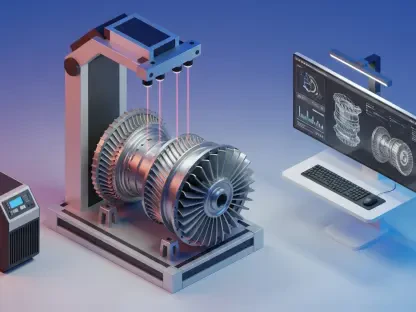
The centerpiece of this industrial evolution is the High-Speed AI Flying Trigger Inspection System, a technology that fundamentally redefines how quality control is performed on the modern assembly line. Unlike conventional methods that require production to halt for static inspection, this system enables real-time defect detection on components while they are still moving. This is achieved through the precise synchronization of collaborative robot control with an advanced AI vision system. The innovative “flying-trigger” architecture captures high-resolution images with zero latency, allowing the integrated camera to analyze complex geometries and surfaces at full production speed. The immediate impact of this in-motion capability is a dramatic reduction in inspection time, with reported gains of up to 50%. This efficiency directly translates into significantly shorter manufacturing cycle times and a substantial increase in overall factory throughput, addressing a primary bottleneck that has long constrained productivity in high-volume manufacturing environments.
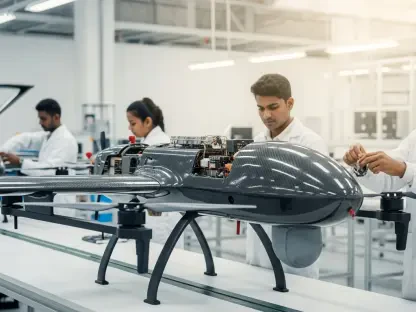
The practical applications of this advanced inspection system are particularly crucial in sectors where quality standards are exceptionally high and human error must be virtually eliminated. Industries such as automotive component manufacturing, where the integrity of every part is critical for safety, and server assembly, where precision ensures reliability, stand to benefit immensely. The system’s robustness and repeatability provide the consistency needed to achieve the rigorous “Japanese-level zero-defect quality” standard, a benchmark for manufacturing excellence worldwide. By automating these meticulous checks, the technology not only enhances accuracy but also frees human operators from repetitive and straining inspection tasks. This allows factories to deploy a reliable, autonomous quality assurance process that operates continuously, ensuring that every product leaving the line meets the most stringent specifications without compromising the speed and flow of production.
Empowering the Factory Floor
Techman Robot directly confronts a major barrier to widespread AI adoption in manufacturing: the historically complex, time-consuming, and expert-dependent process of developing and deploying AI models. The new Auto AI Training Platform is engineered to democratize industrial artificial intelligence by placing powerful tools directly into the hands of frontline factory operators, rather than reserving them for specialized AI engineers or data scientists. This intuitive platform streamlines the entire workflow, enabling operators to label images, train sophisticated inspection models, and refine their performance in real-time directly on the factory floor. The result is a revolutionary reduction in AI setup time—by as much as 90%—which drastically shortens deployment cycles and accelerates the time-to-value for automation investments. This approach transforms AI from a complex, external technology into an integrated and accessible tool for daily operations.
The strategic advantage of this democratization extends far beyond initial setup, fostering unprecedented levels of operational agility and adaptability. By empowering the workforce closest to the production process, factories can respond with remarkable speed to changing market demands, such as introducing new product variants, adapting to different materials, or updating inspection criteria for evolving quality standards. This capability eliminates the traditional reliance on external specialists or dedicated internal AI teams, which often creates significant delays and operational bottlenecks. This newfound autonomy allows for a much more dynamic and responsive manufacturing environment where quality control systems can be modified and optimized in hours instead of weeks. Consequently, this shift fosters a culture of continuous improvement and innovation, making the factory more resilient and competitive in a rapidly changing industrial landscape.
The Virtual-First Approach to Deployment
Simulation and Validation with Digital Twins
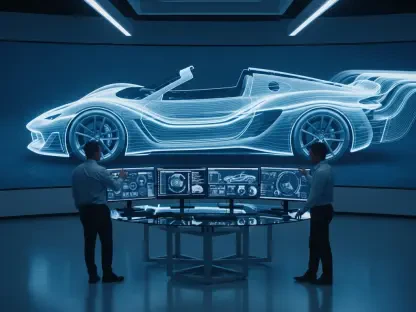
In a strategic collaboration with NVIDIA, Techman Robot is leveraging the Omniverse platform to pioneer a virtual-first methodology that perfects automation systems before a single piece of hardware is installed on the factory floor. This “zero-touch deployment” approach is centered on the creation of high-fidelity digital twins, which are complete and photorealistic virtual models of the entire production workflow. Within this risk-free digital environment, engineers can meticulously simulate, validate, and optimize every aspect of the proposed system. This includes verifying critical parameters such as robot reachability to ensure all tasks can be performed, optimizing camera positioning for ideal inspection angles, confirming cycle-time feasibility to meet production targets, and fine-tuning robot trajectories and vision detection timing for maximum efficiency. This comprehensive virtual verification process effectively de-risks the traditionally complex and unpredictable process of automation integration.
The tangible outcomes of implementing this digital twin strategy are transformative for manufacturers. The most significant benefit is the near-total elimination of the costly and time-consuming physical trial-and-error that has long plagued automation projects during installation and commissioning. By resolving potential issues in the virtual world, the process minimizes the need for extensive on-site adjustments, leading to drastically reduced physical installation time and associated production downtime. This virtual commissioning process ensures that the system’s performance is highly predictable and reliable from the moment it goes live. Manufacturers gain the confidence that the automated cell will operate precisely as designed, accelerating the path to full-scale production and ensuring a much faster return on investment. This turns a historically uncertain integration phase into a streamlined, efficient, and highly dependable deployment.
Overcoming Data Challenges
A classic and persistent hurdle in developing effective AI vision models is the data bottleneck. Acquiring a large, diverse, and accurately labeled dataset of real-world product defects can be impractical, prohibitively expensive, or, in the case of new products, simply impossible. Techman Robot elegantly circumvents this challenge by utilizing its digital twin platform to generate vast quantities of high-quality synthetic data. Within the NVIDIA Omniverse environment, engineers can simulate an exhaustive array of potential fault cases with photorealistic accuracy. This includes creating virtual examples of common and uncommon defects, such as misaligned cables in an electronics assembly, incorrect LED indicator states, subtle fan displacement in a server chassis, or improper tray insertion. By programmatically generating these scenarios, the system can build robust and comprehensive datasets that cover a far wider range of variations than could ever be collected from physical production lines.
The impact of leveraging synthetic data for AI training is profound, fundamentally accelerating the entire development and deployment lifecycle. With access to a rich and diverse dataset from the outset, AI inspection models are effectively deployment-ready from day one, eliminating the lengthy waiting period typically required to accumulate sufficient real-world defect examples. Models trained on this synthetic data have demonstrated exceptionally high stability and accuracy, as they are prepared for a multitude of potential failures before encountering them in a live environment. This method also dramatically reduces the time and cost associated with manual data collection, labeling, and annotation. As a result, the development of sophisticated and reliable AI vision systems becomes significantly more efficient and economically feasible, opening the door for advanced quality inspection to be implemented across a broader range of products and industries.
A New Blueprint for Smart Manufacturing
The suite of innovations unveiled by Techman Robot signified more than an incremental product upgrade; it established a cohesive, end-to-end ecosystem for the modern factory. The integration of high-speed AI-powered cobots, a democratized training platform, and a virtual-first deployment methodology driven by digital twins and synthetic data provided a comprehensive and field-validated blueprint for large-scale manufacturing modernization. This strategic convergence confirmed the company’s evolution from a collaborative robot manufacturer into a holistic automation solutions provider. The presented platform positioned AI-enabled robotics not as a peripheral tool but as the central nervous system of the next industrial revolution, paving a clear path for industries to achieve superior quality and efficiency. This integrated approach promised to lead a fundamental shift toward more agile, predictive, and data-rich manufacturing operations.