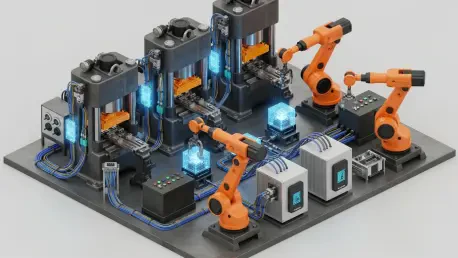

The global automotive manufacturing sector is currently navigating a period of profound structural change as traditional mechanical assembly lines give way to the sophisticated architecture of the software-defined factory. This transition is not merely a superficial upgrade of existing machinery; it represents a fundamental reimagining of the factory floor as a living, data-driven ecosystem powered by 5G connectivity and high-density sensor networks. By integrating advanced artificial intelligence into the core of production, manufacturers are shifting away from the rigid, linear processes of the past toward highly flexible and precise environments where every movement is tracked and optimized in real-time. This digital nervous system allows for unprecedented levels of transparency and control, turning raw data into a primary driver of industrial value. However, the path to this high-tech future is strictly governed by the cold reality of financial metrics, meaning that every technological leap must be backed by a compelling business case to justify the significant capital expenditure required for such a transformation.
Financial Prerequisites and Infrastructure Hurdles
The ROI Imperative: Justifying the Digital Shift
For modern automotive executives, the decision to greenlight a digital overhaul hinges almost entirely on a clear and quantifiable return on investment that addresses specific operational pain points. In an industry where margins are often thin, high-level software suites and complex data analytics packages are viewed as dormant assets unless they can prove their worth by reducing defects, improving worker safety, or cutting energy consumption. The strategic focus has shifted from adopting technology for its own sake to identifying high-priority problems where digital intervention offers a measurable financial payoff. Consequently, the deployment of artificial intelligence and machine learning is increasingly targeted at predictive maintenance and quality assurance, where the cost of a single hour of downtime or a batch of faulty components can run into millions of dollars. This pragmatic approach ensures that innovation remains anchored to the bottom line, preventing the “pilot purgatory” that often plagues experimental industrial projects.
The economic viability of these systems is also tied to their ability to scale across multiple production lines and facilities without requiring a complete redesign of the underlying software architecture. As manufacturers seek to maximize the utility of their digital investments, they are prioritizing modular platforms that can be updated and refined as production needs evolve. This modularity allows for a phased rollout, where a successful implementation in one area of the plant provides the financial justification and technical blueprint for expansion elsewhere. By focusing on incremental gains that accumulate into significant cost savings, companies can manage the financial risks associated with large-scale digital transformation. This steady, results-oriented strategy allows manufacturers to build a sustainable digital infrastructure that supports long-term growth while maintaining the fiscal discipline necessary to survive in a volatile global market where competition from emerging electric vehicle startups remains fierce.
Bridging the Gap: Integrating Legacy Systems
A significant challenge in the journey toward the software-defined factory is the reality that most established automakers do not have the luxury of starting with a blank slate in a new facility. Instead, they must manage a complex patchwork of legacy infrastructure, where heavy machinery installed decades ago must somehow be coaxed into communicating with cutting-edge digital platforms. This requirement to retrofit existing assets creates a massive integration hurdle, as older hardware often lacks the sensors or connectivity protocols necessary for real-time data capture. Without a reliable way to bridge the gap between mechanical history and digital future, the sophisticated analytics required for autonomous decision-making remain entirely out of reach. Engineers must develop custom middleware and edge computing solutions that can translate analog signals into digital data, ensuring that every piece of equipment on the floor contributes to the broader factory intelligence.
The process of modernizing these “brownfield” sites requires a deep understanding of both mechanical engineering and data science, as the goal is to create a unified data layer that ignores the age of the underlying hardware. Achieving this level of integration is the first critical step in building a software-defined environment, as it allows for the synchronization of workflows across disparate systems. Once the data flow is established, manufacturers can begin to apply advanced algorithms to optimize production speeds and reduce waste across the entire facility. This effort to harmonize old and new technology is not just a technical necessity but a strategic imperative that prevents existing capital assets from becoming obsolete. By extending the life of current machinery through digital enhancement, automakers can achieve the benefits of Industry 4.0 without the prohibitive cost of replacing every physical asset on the assembly line, thereby smoothing the financial transition to a fully digitalized production model.
Leading Strategies in Digital Production
Real-World Applications: Innovation in Action
Industry leaders like Audi have already begun to demonstrate the practical power of the software-defined model by decoupling control software from physical hardware to create a more agile production environment. By utilizing an “Edge 4 Cloud” platform, Audi processes massive amounts of sensor data locally at individual workstations, which drastically reduces latency and allows for instantaneous quality adjustments without relying on a centralized server. This localized processing power enables the factory to respond to minute variations in parts or environment, potentially boosting overall productivity by as much as 50% through AI-driven optimizations. This shift toward localized, high-speed computing marks a departure from traditional centralized control systems, providing the flexibility needed to handle the increasing complexity of modern vehicle configurations. The ability to update the “brain” of the factory via software patches rather than physical hardware changes allows for a level of adaptability that was previously impossible.
Similarly, Nissan has effectively utilized real-time data monitoring at its major manufacturing hubs to drive down operational overhead and improve sustainability. By closely tracking energy consumption and machine performance, the company has managed to reduce its power usage by 20%, proving that digital transformation is as much about resource efficiency as it is about speed. Furthermore, the use of digital twin technology allows Nissan to simulate the entire assembly process for new models like the Leaf in a virtual environment before a single physical component is moved. This simulation ensures that every robot and conveyor belt is perfectly calibrated, reducing the time required for trial-and-error during the physical setup phase. By identifying potential bottlenecks and mechanical conflicts in the digital realm, Nissan can move from development to full-scale production with much greater confidence and significantly lower risk, demonstrating how software can provide a buffer against the traditional costs of industrial trial and error.
Virtual Planning: De-Risking Capital Investment
The use of digital twins has reached its most advanced form at BMW, where the company utilizes the Nvidia Omniverse platform to construct entire factories in a virtual space long before construction crews arrive on-site. For its recent facility projects, this virtual-first approach allowed planners to validate complex infrastructure layouts and intricate human-robot workflows in a completely risk-free digital environment. By simulating every aspect of the plant, from the movement of logistics vehicles to the precise reach of a robotic arm, BMW can identify and resolve potential design flaws that would be incredibly expensive to fix once the physical structures are in place. This proactive methodology transforms factory design into an iterative software process, where different configurations can be tested and discarded at virtually no cost. This digital validation serves as a powerful shield for the massive capital expenditures associated with new automotive plants, ensuring that every dollar spent is backed by verified data.
Beyond the initial construction phase, these virtual environments continue to provide value as a living reference for ongoing factory optimizations and future expansions. If a production manager wants to introduce a new vehicle variant or change the sequence of an assembly line, they can first run the scenario in the digital twin to see how it affects overall throughput and efficiency. This capability allows for continuous improvement without the risk of disrupting active production, making the factory more resilient to changes in market demand. The ability to predict the outcome of a change before it happens is a significant competitive advantage, as it allows for a more aggressive pursuit of efficiency gains. By treating the physical factory as the execution layer for a digital plan, BMW and other innovators are effectively eliminating the “guesswork” that has historically characterized industrial engineering, leading to more stable operations and more predictable financial outcomes in an increasingly complex manufacturing landscape.
Human-Centric Innovation and Scalability
Democratizing AI: Empowering the Modern Workforce
Mercedes-Benz has pioneered a unique path toward digitalization by focusing on making advanced technology accessible to the entire workforce rather than keeping it locked away in IT departments. Through its MO360 AI Factory initiative, the automaker is developing intuitive tools that allow floor workers to interact with complex machinery using natural language interfaces and simple digital dashboards. For example, a specialized chatbot allows technicians to ask questions about machine performance or troubleshoot errors in real-time, effectively bridging the gap between high-level data science and daily operational tasks. This democratization of AI ensures that the people closest to the production process can leverage digital insights to make better decisions, fostering a culture of innovation that permeates every level of the organization. By empowering workers with data, Mercedes-Benz is turning its entire staff into a force for continuous improvement and operational excellence.
This human-centric approach to technology is not just about employee engagement; it is a calculated strategy to drive down production costs and increase the speed of problem-solving on the shop floor. When a line worker can identify a potential equipment failure or a quality drift using an AI-powered tool, the issue can be resolved before it escalates into a major production stoppage. Mercedes-Benz expects that this widespread adoption of digital tools will lead to a 10% reduction in overall production costs over the coming years, proving that the human element remains a critical component of the software-defined factory. By designing technology that complements and enhances human skill rather than simply replacing it, the company is creating a more flexible and resilient manufacturing model. This strategy highlights a shift in the industry toward “augmented” manufacturing, where the synergy between human intuition and machine intelligence becomes the primary driver of long-term profitability and competitive advantage in the global market.
Scaling the Digital Nervous System
As these human-centric tools become more integrated into the daily routine of the factory, the focus shifts toward the scalability of these digital solutions across a global network of production sites. The true value of a software-defined approach is realized when a successful AI model or a workflow optimization developed at one plant can be instantly deployed to dozens of other facilities around the world. This “copy-paste” capability for industrial efficiency allows large automakers to rapidly standardize best practices and ensure a consistent level of quality regardless of geographical location. The digital nervous system of the factory thus expands into a global network, where data from one continent can inform the operations on another. This level of connectivity requires robust cybersecurity measures and standardized data protocols to ensure that information flows securely and accurately across the entire corporate infrastructure, protecting the intellectual property that now resides in the software rather than just the physical designs.
The expansion of this digital architecture also enables a more responsive supply chain, as the factory can communicate its needs directly to suppliers in real-time based on actual production data. This integration reduces the need for large safety stocks and minimizes the impact of supply chain disruptions, as the software-defined factory can adjust its schedules and configurations on the fly to account for missing parts or changing priorities. This high level of operational elasticity is becoming a requirement for survival in a market characterized by rapid shifts in consumer preferences and geopolitical instability. By building a scalable digital foundation, manufacturers can move more quickly than their traditional competitors, adapting to new challenges with the speed of a software update. This ability to scale and adapt marks the final stage of the transition from a mechanical assembly line to a truly software-defined enterprise, where the digital and physical worlds are inextricably linked in a single, high-performance system.
Market Trends and External Demands
Economic Projections: The Cost of Remaining Competitive
The financial momentum behind the smart factory movement is undeniable, with the global market projected to grow from approximately $104 billion in 2025 to nearly $170 billion by 2030. This massive influx of capital is driven by the decreasing cost of high-performance sensors and the increasing availability of specialized industrial AI models that make automated systems more accessible than ever before. For many manufacturers, the question is no longer whether they can afford to modernize, but whether they can afford to fall behind as their competitors achieve massive gains in efficiency and speed. The rapid growth of this market suggests that we are entering a “winner-take-all” phase of industrial competition, where those who master the digital realm will have a significant cost advantage that can be used to squeeze out less efficient rivals. This economic pressure is acting as a powerful catalyst, accelerating the adoption of technologies that were considered experimental just a few years ago.
Beyond the internal drive for efficiency, external pressures from government regulators and major clients are increasingly forcing the industry’s hand toward total digitalization. For instance, major original equipment manufacturers like General Motors are now setting strict requirements for their suppliers to demonstrate “lights out” manufacturing capabilities as a condition for winning future contracts. These mandates are designed to ensure that the entire supply chain is as resilient and efficient as the primary assembly plants, pushing smaller suppliers to adopt digital twins and automated quality systems or risk being cut out of the market entirely. This top-down pressure is creating a ripple effect across the entire industrial landscape, making digital upgrades a necessity for survival rather than an optional luxury. As these external standards continue to rise, the ability to operate within a software-defined framework is becoming a baseline requirement for doing business in the modern global automotive industry.
The Shift Toward Industrial Inevitability
As the industry moves deeper into this decade, the software-defined factory is rapidly transitioning from a high-tech experiment into an absolute industrial requirement for anyone wishing to maintain a market presence. The initial “nudge” toward digitalization, which was once driven by curiosity and a desire for incremental gain, has been replaced by a powerful “push” from market forces, regulatory bodies, and shifting consumer expectations. Manufacturers are finding that the integration of digital twins and AI-driven analytics is the only way to meet the increasingly complex demands for vehicle customization and rapid production cycles. The successful companies of the future will be those that have successfully shed their identity as purely mechanical engineers and embraced their new role as data-intensive technology firms. The ability to manage the “digital nervous system” of a global manufacturing network will ultimately determine who leads the market and who becomes a footnote in the history of industrial evolution.
The transition to a software-defined factory model was ultimately characterized by a pragmatic focus on measurable results and the successful integration of legacy assets with modern digital platforms. By leveraging virtual planning tools to de-risk investments and democratizing AI to empower the workforce, leading automakers transformed their production facilities into agile, data-driven ecosystems. This evolution allowed for significant reductions in energy consumption, substantial gains in productivity, and a more resilient response to global supply chain disruptions. As external pressures for automation and efficiency continued to mount, the shift toward a software-centric manufacturing paradigm became an inevitability for the entire industry. The lessons learned during this period of transformation highlighted the critical importance of bridging the gap between historical manufacturing expertise and the high-speed requirements of the digital era, ensuring that those who successfully navigated the change were well-positioned for continued growth and innovation.