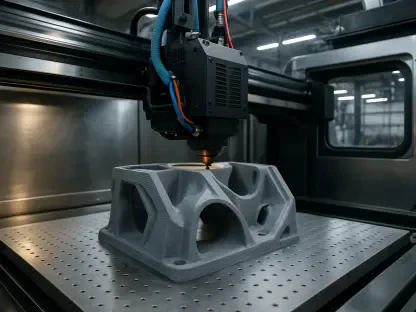

Evolution of Manufacturing Management: From Data Storage to Intelligence
The manufacturing industry currently stands at a technological precipice that mirrors the dramatic shift from manual lathes to computerized numerical control several decades ago. For a generation, Enterprise Resource Planning (ERP) systems served as the primary method for organizing production, yet these tools have largely remained digital filing cabinets rather than active participants in the shop floor. In contrast, modern AI computation platforms are transforming the manufacturing landscape by moving beyond simple data organization into the realm of autonomous operation. While CNC technology revolutionized the physical act of cutting metal, Large Language Models (LLMs) and sensor technologies like Bluetooth Low Energy (BLE) beacons are now revolutionizing the management of the process itself.
This shift represents a fundamental transition from human-led interpretation to machine-driven action, where the software no longer just stores information but actively executes tasks. Traditional ERPs were built for a world where paper records were simply moved into a digital space, keeping the human as the sole decision-maker. AI computation, however, acts as an autonomous operator that can synthesize vast amounts of data to provide real-time guidance. As the manufacturing environment becomes increasingly complex, the relevance of a system that merely stores data is fading in favor of platforms like Fulcrum, which leverage intelligence to drive the entire production cycle.
Key Technical and Functional Distinctions
Passive Storage vs. Active Computation and Autonomy
Traditional ERP architectures function essentially as pull systems that require a human operator to initiate every query and interpret every result. A manager must decide to run a report, analyze the variance in material costs, and then manually determine if a specific job was profitable or if the schedule requires adjustment. This reliance on human intervention creates a bottleneck, as insights are only as good as the person looking for them. In this legacy model, the software is a passive tool that waits for instruction, often resulting in delayed responses to production inefficiencies or market shifts.
AI computation disrupts this static model by establishing a push system that surfaces critical insights without being asked. Instead of waiting for a user to find a problem, an AI-native system identifies lagging jobs in real-time and suggests immediate corrective actions. It can pinpoint which jobs are unprofitable and determine how a schedule should be reconfigured to maximize throughput. In many cases, the software can carry out these adjustments automatically, functioning as an invisible supervisor that ensures the human staff remains focused on physical production rather than data analysis.
Manual Data Entry vs. Automated Passive Collection
The reliability of any management system has historically been limited by the “garbage in, garbage out” dilemma inherent in manual data entry. Conventional ERPs depend on employees to remember to clock into jobs, update inventory counts, and log scrap rates, all of which are prone to human error and delay. When data is entered hours or days after the fact, the system’s view of the shop floor is perpetually outdated. This lag makes it nearly impossible for a manufacturer to make agile decisions based on the current state of operations.
AI-driven platforms bypass these manual hurdles by utilizing passive data collection through integrated video feeds in CNC machines and BLE beacons that automatically trigger job clocks as workers move through the facility. By capturing data directly from the physical environment, platforms like Fulcrum ensure a level of data integrity that human input simply cannot match. This elimination of manual entry not only improves accuracy but also frees workers from administrative burdens. In an AI-native world, the system gathers information through constant observation, providing a granular, second-by-second view of the operational reality.
Administrative Organization vs. Real-Time Operational Execution
Administrative tasks that once consumed hours or days are now being compressed into seconds through the power of intelligent automation. In a legacy ERP environment, creating a quote or a purchase order involves manual data extraction from drawings and tedious communication with vendors. These steps are inherently slow and limit a company’s ability to respond to high volumes of inquiries. The traditional process is focused on organization and documentation, which, while necessary, does not directly contribute to the speed of the production line.
AI computation, however, can instantly extract a comprehensive bill of materials (BOM) from a technical drawing and automatically generate purchase orders (PO) for the most appropriate suppliers. Furthermore, these systems can calculate market values, expected profit margins, and win rates with a speed that human staff cannot replicate. This shift from manual administrative organization to real-time operational execution provides a massive competitive advantage. By automating the front-end office work, manufacturers can commit to lead times and pricing with a degree of confidence that was previously unattainable.
Implementation Challenges and Practical Considerations
Despite the clear technical advantages, the transition to autonomous systems faces a significant trust gap among veteran manufacturers. Many shop owners remain hesitant to relinquish control to an algorithm, even when the technology is capable of making more accurate decisions than a human coordinator. There is a psychological barrier to trusting a system to buy materials or schedule machines without a final human signature. Overcoming this hesitation requires a shift in mindset, viewing AI not as a replacement for expertise but as an enhancement of it.
To prepare for this shift, companies must first commit to a total digital transformation, which includes the elimination of paper travelers and the destruction of departmental data silos. High-quality, connected data is the essential fuel for AI computation, and without a fully digitized operation, the most advanced models cannot function effectively. The transition from familiar, legacy software to a dynamic, AI-driven workflow often reveals deep-seated technical difficulties, particularly in how data is structured. Manufacturers must ensure their information is not just stored, but is accessible and clean enough for an autonomous system to interpret.
Strategic Recommendations for Modern Manufacturers
The historical shift to CNC machines demonstrated that technology offering superior speed and precision always becomes the industry standard. Manufacturers today face a similar choice: continue relying on the storage-heavy limitations of a traditional ERP or embrace the computational power of AI to remain competitive. For organizations that require rapid quoting and precise lead times, prioritizing an AI-native approach is a strategic necessity. The goal is no longer just to keep records, but to use those records to drive capacity and efficiency across the entire organization.
Companies looking to increase capacity without adding headcount should evaluate their current data maturity and consider moving toward platforms like Fulcrum. These systems allow for a level of scalability that traditional software cannot support. It is recommended that manufacturers begin by digitizing every touchpoint of their process to create a foundation for future AI integration. By choosing computation over simple storage, businesses positioned themselves to lead the next phase of industrial evolution, ensuring they can deliver parts faster and more accurately than those stuck in the era of manual data interpretation. This transition ultimately proved that the winners in the modern market were those who prioritized intelligence over mere organization.