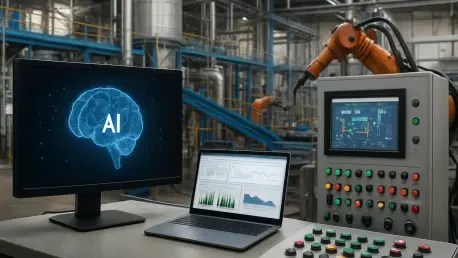

For decades, the hum of the factory floor was governed by the rigid, deterministic logic of programmable logic controllers, but today, that mechanical heartbeat is being augmented by a cognitive layer that thinks, learns, and reacts in real-time. This transition represents far more than a simple software update; it is a fundamental intelligence shift that moves manufacturing beyond basic automation toward truly cognitive industrial systems. The convergence of Artificial Intelligence and Operational Technology stands as the most significant industrial evolution since the invention of the microchip, fundamentally altering how physical assets are managed. As global industries lean into this transition, the roadmap for success involves navigating complex adoption trends, implementing rigorous safety standards, and preparing for a future where plants might one day heal themselves.
The Current Landscape of Industrial AI Adoption
Market Dynamics and Growth Indicators
The industrial world has witnessed a rapid transition from centralized, cloud-based analytical tools to decentralized edge-based intelligence. In earlier iterations, data was shipped to distant servers for processing, but the demand for split-second decision-making has forced intelligence directly onto the factory floor. This shift is driven by the realization that latency is the enemy of safety; an autonomous robot or a high-speed turbine cannot wait for a round-trip to the cloud to avoid a collision or a catastrophic failure. Consequently, capital expenditure is migrating away from traditional “dumb” hardware toward AI-integrated industrial software that offers native machine learning capabilities at the point of execution.
Current investment patterns suggest that the demand for predictive maintenance and automated quality inspection is reaching a fever pitch. Statistics from major industrial hubs indicate that the majority of new installations now include some form of embedded AI, signaling that the technology has moved from the experimental phase to a standard requirement. Companies are no longer asking if they should implement AI, but rather how quickly they can integrate these systems without disrupting existing production cycles. This massive reallocation of resources underscores a broader economic realization that data-driven efficiency is the only way to remain competitive in a landscape of rising energy costs and fluctuating supply chains.
Real-World Applications and Deployment Successes
Predictive asset management has emerged as the primary use case for machine learning on the plant floor, allowing leading manufacturers to virtually eliminate unplanned downtime. By training models on years of historical vibration, heat, and acoustic data, these systems identify subtle signatures of wear long before a mechanical component actually fails. For instance, in heavy industries like steel or paper milling, these early warnings allow for “just-in-time” maintenance during scheduled breaks, preventing the multi-million-dollar losses associated with a total line stoppage. This proactive approach turns maintenance from a reactive cost center into a strategic operational advantage.
Beyond maintenance, automated quality vision systems have revolutionized high-speed assembly lines, particularly in the semiconductor and automotive sectors. Modern AI-driven cameras can detect microscopic defects in silicon wafers or identify imperfect welds on a car chassis at speeds that far exceed human capability. These systems do not just flag errors; they feed data back into the production line to adjust parameters in real-time, effectively preventing the next defect from occurring. Similarly, in chemical processing, AI algorithms now tune complex thermal and pressure variables simultaneously to maximize throughput, managing multi-dimensional equations that were previously too complex for traditional control logic.
Expert Perspectives on Safety, Security, and Governance
A significant tension exists between the high-speed iteration typical of the software world and the uncompromising safety requirements of industrial environments. Industry leaders often point to a “reliability gap,” where the unpredictability of certain AI models conflicts with the “five-nines” of uptime required by plant managers. While a chatbot can hallucinate without causing physical harm, an AI controlling a high-pressure boiler must be right every single time. This has led to a growing demand for explainable AI, or XAI, over opaque deep learning models. Engineers require a clear audit trail to understand why a machine made a specific decision, ensuring that the logic aligns with established thermodynamic and mechanical laws.
The integration of AI into critical infrastructure has also drawn the attention of national security agencies, including guidance from organizations like CISA and the NSA. Protecting AI-driven industrial control systems is no longer just about firewalls; it is about ensuring the integrity of the data that trains the models. Experts warn that a human-in-the-loop remains a non-negotiable necessity to prevent “model drift,” a phenomenon where an AI’s performance degrades because the physical environment has changed. Maintaining human agency ensures that if a model begins to act erratically due to a sensor failure or an unforeseen environmental shift, a qualified operator can intervene before a catastrophic failure occurs.
The Future Outlook: Risks and Evolution of Autonomous Systems
The trajectory of industrial evolution points toward the rise of the self-healing plant, where AI moves from a purely advisory role to taking fully autonomous corrective actions. In such an environment, the system would not only detect a failing valve but would automatically reroute flow, order a replacement part, and reschedule the maintenance crew without any human input. However, this level of autonomy introduces the invisible threat of model decay. As physical equipment ages and its tolerances shift, an AI model trained on “new” machinery may provide suboptimal or dangerous commands, making the long-term monitoring of model health as important as the maintenance of the machines themselves.
Cybersecurity in this new era will face unprecedented challenges, particularly regarding adversarial manipulation and data poisoning. Future attack vectors may not involve crashing a system, but rather subtly altering the training data so the AI “learns” to accept dangerous operating temperatures as normal. This type of sabotage is difficult to detect and could lead to long-term structural damage or safety breaches. Furthermore, the role of the industrial operator will continue to evolve. Instead of performing manual interventions, the workforce will transition into high-level system orchestrators, requiring a new set of skills that blend traditional mechanical engineering with data science and algorithmic oversight.
Conclusion: Balancing Innovation with Operational Rigor
The shift toward cognitive industrial systems was characterized by a fundamental realization that intelligence must be as robust as the steel it controls. It was observed that while the promise of AI-driven efficiency was vast, the most successful implementations were those that prioritized disciplined engineering over rapid iteration. Organizations discovered that treating AI as a core mechanical asset, subject to the same rigorous validation and monitoring as a turbine or a generator, was the only way to ensure long-term stability. The industry eventually moved away from “black box” solutions, favoring transparent models that allowed human operators to maintain ultimate authority over the plant’s physical integrity.
The strategic imperative for industrial leaders became the establishment of a lifecycle management framework for every model deployed on the floor. This meant that the true potential of the next industrial revolution was unlocked not by the algorithms themselves, but by the safety protocols and governance structures built around them. By focusing on explainability and cybersecurity, manufacturers secured their infrastructure against both model drift and malicious actors. Ultimately, the successful integration of AI into operational technology proved that innovation did not have to come at the expense of reliability, provided that the transition was governed by transparency and a commitment to operational rigor.