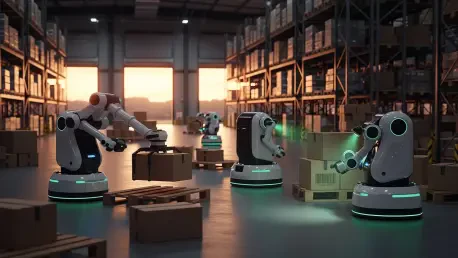

Picture a sprawling warehouse where robots glide effortlessly among shelves, identifying and sorting thousands of unique products in real time, adapting to chaos without missing a beat. This isn’t science fiction—it’s the reality Tutor Intelligence is building with a freshly secured $34 million in Series A funding. Based in Watertown, MA, and born from MIT’s Computer Science and Artificial Intelligence Laboratory (CSAIL), this robotics innovator is poised to transform the gritty world of logistics and manufacturing. With supply chains under constant strain, the question looms: can AI-driven robots truly revolutionize how goods move from factory to consumer?
Why This Funding Matters for Industrial Automation
The $34 million injection, led by Union Square Ventures and pushing Tutor Intelligence’s total capital to $42 million, isn’t just a financial win—it’s a signal of trust in a vision to solve one of industry’s thorniest problems. Warehouses and manufacturing plants, the unsung heroes of global commerce, face relentless pressure from labor shortages and rising costs. This funding underscores a critical shift toward smarter automation as a lifeline for Fortune 50 and 500 companies managing everything from packaged foods to consumer tech. It’s not merely about replacing human hands; it’s about creating systems that amplify efficiency in spaces where delays can ripple across entire economies.
Moreover, the significance extends beyond immediate cash flow. The investment positions Tutor Intelligence to scale its fleet across North America, addressing a glaring need for adaptability in environments where unpredictability reigns. As supply chains grow more complex, this capital empowers a leap toward technology that can keep pace with real-world demands, setting a new benchmark for what automation can achieve.
The Tech Edge: Visual Intelligence in Action
At the core of Tutor Intelligence’s mission lies a groundbreaking approach to robotics: visual intelligence that allows machines to see and react like never before. Traditional robots, bound by rigid programming, falter when faced with the messiness of live operations. In contrast, Tutor’s robots are trained on real-world visual and motor data, enabling them to handle thousands of stock-keeping units (SKUs) in dynamic settings. This means a robot can identify a misplaced toy or a mislabeled beauty product and adjust on the fly—an edge case mastery that redefines reliability.
What sets this apart is the continuous learning loop. Each task feeds data back into a centralized engine, sharpening the AI with every interaction. For industries where precision and speed are non-negotiable, this technology promises not just solutions but a competitive advantage. Imagine a warehouse where errors drop by double-digit percentages while throughput soars—this is the tangible impact of such innovation.
Speed and Scale: A Deployment Revolution
Beyond clever tech, Tutor Intelligence tackles another pain point: deployment timelines. Picture a robotic fleet arriving at a facility and becoming fully operational in a single day, with delivery-to-deployment cycles as short as 30 days. This rapid integration, offered through a Robot-as-a-Service (RaaS) model, aligns costs with traditional labor budgets, making automation accessible for co-packers and logistics providers without the burden of ownership or lengthy ROI waits.
This efficiency isn’t a gimmick—it’s a response to urgent industry needs. With the new funding, plans to expand the fleet and introduce diverse robotic forms signal an ambition to cover even more ground. For businesses racing to meet consumer demands, this model offers a seamless bridge to automation, ensuring operations don’t just keep up but surge ahead.
Leadership Vision: Robots with Human Intuition
Leadership at Tutor Intelligence brings clarity to this technological push. CEO Josh Gruenstein speaks of a future where robots don’t just follow commands but exhibit human-like intuition, navigating complex tasks with finesse. “The goal is to enhance human capabilities, not replace them,” Gruenstein has emphasized, pointing to a collaborative ethos that resonates with trends in automation. His perspective highlights a balance—merging cutting-edge AI with practical impact for workers on the ground.
Industry voices echo this sentiment. Recent discussions around robotic learning underscore how real-world data, as opposed to simulations, is setting new standards. Tutor Intelligence’s commitment to this approach positions it as a frontrunner, with insights from major supply chain players suggesting that adaptable robots could redefine productivity metrics in warehouses over the next few years.
A Blueprint for Businesses to Embrace Automation
For companies in logistics and manufacturing, the path to adopting robotics doesn’t need to be a labyrinth. Tutor Intelligence offers a practical framework through its RaaS subscription, allowing firms to integrate automation without overhauling budgets or workflows. Start by assessing specific pain points—be it SKU diversity or throughput bottlenecks—and align these with robotic capabilities that adapt in real time.
Additionally, preparing for rapid deployment means streamlining internal processes to accommodate a 30-day integration window. Partnering with innovators like Tutor Intelligence ensures access to a growing fleet backed by a data engine that evolves with industry demands. For decision-makers, the takeaway is clear: automation isn’t a distant goal but a present-day strategy to stay competitive in a landscape where efficiency is king.
Reflecting on a Milestone with Eyes on Tomorrow
Looking back, the $34 million funding round for Tutor Intelligence marked a pivotal moment in the journey of warehouse robotics. It validated a vision where AI and real-world adaptability converged to address critical industrial challenges. The strides made in visual intelligence and rapid deployment redefined what was possible, offering a lifeline to sectors burdened by complexity.
As the dust settled, the focus shifted to actionable next steps. Businesses were encouraged to explore partnerships that prioritized scalable, data-driven solutions. Industry watchers anticipated that the evolution of robotic forms and intelligence platforms would continue to reshape logistics. The legacy of this investment was not just in the numbers but in the blueprint it provided—a roadmap for harmonizing technology with human ingenuity to build more resilient supply chains.