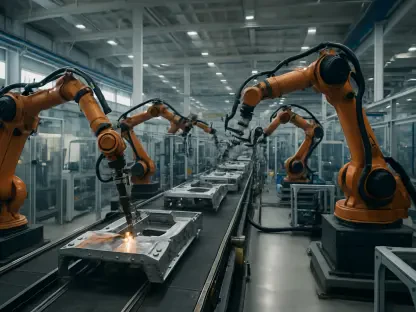

The global fashion industry is currently facing a reckoning as the traditional model of offshore mass production results in billions of dollars in unsold inventory and massive environmental waste every year. For decades, the reliance on long-distance supply chains forced brands to predict consumer trends months in advance, often leading to significant inaccuracies and financial losses. However, the emergence of AI-enabled 3D weaving technology is now offering a viable alternative by allowing manufacturers to bypass the labor-intensive “cut-and-sew” methods that necessitated overseas production. By utilizing a proprietary system that converts yarn directly into semi-finished garments in a matter of minutes, the startup unspun is attempting to fundamentally reorganize how clothing is made. This transition is not merely a technical upgrade but a structural shift that enables brands to move away from speculative manufacturing and toward a demand-driven model that prioritizes efficiency and local relevance over sheer volume.
Strategic Partnerships and Economic Viability: The Micro-factory Model
The momentum behind this technological shift is being amplified by formal support from retail giants like Walmart and REI, which are increasingly prioritizing domestic production to mitigate logistics risks. These major entities, alongside supply chain partners such as Bethel Industries and PDS Ltd, recognize that the ability to manufacture goods within the United States allows for a much more agile response to market fluctuations. Supported by over $50 million in venture capital, the initiative is currently focused on identifying and establishing commercial-scale hubs across several states to serve as the blueprint for future American textile manufacturing. This decentralized “micro-factory” approach minimizes the carbon footprint associated with international shipping while simultaneously insulating companies from the geopolitical instabilities that frequently disrupt traditional trade routes. By focusing on high-tech, automated workflows, these facilities aim to prove that domestic production can be economically competitive with low-cost labor markets abroad.
Advanced Automation and the Evolution of Domestic Labor
As the apparel sector transitions toward these highly automated environments, the nature of textile employment is undergoing a significant transformation from manual assembly to technical oversight. The integration of artificial intelligence and 3D weaving hardware eliminates dozens of traditional manufacturing steps, condensing a complex multi-stage process into a singular, streamlined operation that requires a specialized workforce. This evolution suggests that the future of American reshoring will depend heavily on the continuous training of technicians who can manage sophisticated robotic systems and real-time data analytics. Industry leaders, including those from The North Face, have noted that the goal is to create a sustainable ecosystem where technological precision meets local craftsmanship. Moving forward, the success of this initiative will likely hinge on the industry’s ability to scale these micro-factories rapidly and integrate them into existing retail infrastructures. Stakeholders should prioritize investments in workforce development and regional supply chain integration to ensure that the shift toward demand-driven manufacturing remains both permanent and profitable.