
The familiar hum of robotic arms on the factory floor is giving way to a more profound and intelligent symphony of machinery, one where machines are beginning to think, predict, and collaborate in ways previously confined to science fiction. This evolution is not merely an incremental improvement in speed or precision; it represents a fundamental transformation in the very nature of automation. Driven by sophisticated software, novel mathematical models, and interconnected data ecosystems, physical artificial intelligence is endowing robots with the ability to perceive, reason, and act in the physical world with unprecedented autonomy, heralding a new era of industrial productivity and human-robot partnership.
The significance of this technological leap extends far beyond the production line. As robots become more intelligent and adaptable, they are poised to tackle challenges once considered insurmountable for automated systems, from intricate assembly tasks to dynamic logistics and even consumer-facing services. This transition from pre-programmed tools to thinking partners necessitates a strategic shift for industries worldwide, compelling leaders to rethink their approach to automation, data management, and workforce development to harness the full potential of this intelligent revolution.
Beyond the Assembly Line: Why Today’s Robots Are on the Verge of a True Intelligence Leap
For decades, the story of robotics has been one of hardware—stronger arms, faster actuators, and more precise sensors. While these physical advancements were crucial, the intelligence driving them remained largely static, confined to rigid, pre-programmed instructions. Robots excelled at repetitive tasks in structured environments but faltered in the face of variability and the unexpected. The current inflection point in automation is defined by a pivotal shift in focus from the robot’s body to its mind.
The true intelligence leap is being fueled not by gears and motors but by advancements in software, predictive mathematics, and data utilization. The hardware has become a capable, commoditized platform; the software is now the primary differentiator, unlocking cognitive capabilities that allow robots to move beyond simple reactions. This software-centric approach enables machines to process complex sensory input, understand context, and make decisions that optimize for future outcomes, transforming them from automated laborers into dynamic problem-solvers.
The Next Revolution: From Pre-Programmed Machines to Thinking Partners
The evolution of physical AI is fundamentally reshaping the role of robots in the workplace, moving them from isolated tools executing repetitive commands to integrated partners capable of intelligent collaboration. Unlike their predecessors, which followed a strict script, these emerging systems can learn, adapt, and even anticipate needs within a shared human-robot workspace. This transition marks the move from mere automation to genuine autonomy, where machines can handle complex and variable tasks with minimal human intervention.
This new paradigm is built on the principle of synergy. Instead of replacing human workers, intelligent robots are designed to augment their capabilities, taking on tasks that are dangerous, tedious, or require a level of precision and endurance beyond human limits. As robots become thinking partners, they can be taught new skills through demonstration, coordinate their actions with human colleagues in real time, and contribute to a safer, more efficient operational environment. This collaborative model is unlocking new possibilities for productivity and innovation across a multitude of industries.
The Four Pillars of Robotic Evolution
The current transformation in physical AI is not a singular event but a convergence of four powerful technological trends. Together, these pillars are creating a new foundation for automation that is predictive, collaborative, specialized, and continuously improving. From forecasting the consequences of an action before it is taken to learning complex tasks by observation, these advancements are collectively pushing the boundaries of what is possible.
The first of these pillars is the dawn of anticipatory robotics. The current paradigm has been dominated by reactive systems that respond to immediate sensor feedback. The future, however, is being shaped by predictive mathematics. Leveraging advanced computational methods like “dual numbers and jets,” robots can now forecast the ripple effects of an action before it is executed. This allows them to run millisecond-long simulations to determine the optimal path or movement, enabling smarter, smoother, and more efficient operations that appear almost intuitive.
Second is the rise of collaborative learning. Historically, robots have operated as isolated units or in rigidly scripted collaborations. This is rapidly changing with the adoption of imitation learning, which allows robots to dynamically learn from observing humans or other “master” robots. This capability fosters the creation of adaptive teams that can be deployed and reconfigured with unprecedented speed. A workflow can be taught to one robot, which then shares that knowledge across the fleet, enabling fluid and resilient teamwork without the need for extensive reprogramming.
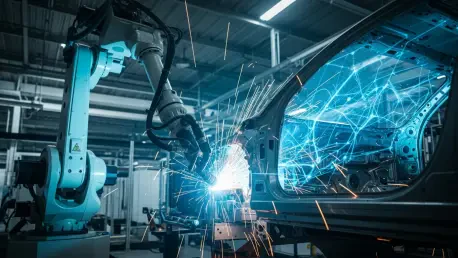
Third is the era of purpose-built AI. The days of generic AI platforms requiring costly and time-consuming customization are numbered. The market is shifting decisively toward specialized, “vertical” AI applications that are pre-trained for complex tasks like welding, finishing, and intricate assembly. These purpose-built solutions come integrated with the necessary hardware and are ready to deliver immediate value out of the box, significantly lowering the barrier to entry for automating processes once deemed too complex or variable.
Finally, the emergence of a data-driven ecosystem is serving as the fuel for this entire revolution. In the past, valuable operational data from sensors, vision systems, and force-torque profiles remained siloed within individual facilities, creating a bottleneck for AI development. Now, secure, opt-in data exchanges are being established, allowing anonymized data from thousands of robots to fuel a virtuous cycle of continuous improvement. This shared knowledge base allows developers to train next-generation AI models on vast, real-world datasets, ensuring that every robot deployed contributes to making the entire ecosystem smarter.
Insights from the Forefront: An Expert’s Vision for Physical AI
Industry leaders are confirming that this technological convergence is not a distant vision but an active and accelerating reality. According to Anders Billesø Beck, VP of AI Robotics Products at Universal Robots, the next revolutionary leap is being driven less by hardware innovation and more by these deep advancements in software, mathematical modeling, and data utilization. This shift in focus is what separates the robots of today from the intelligent systems that will define the industrial landscape of tomorrow.
The power of imitation learning, in particular, stands out as a transformative force. “Real-world deployments of physical AI models trained via imitation are transforming how robotic teams are managed and deployed,” Beck notes, emphasizing how this capability dramatically accelerates setup times and enhances operational flexibility. Furthermore, he asserts that the transition to predictive intelligence using advanced mathematics “will define the next generation of automation,” making robots appear almost intuitive in their decision-making. This foresight allows for a level of operational smoothness and efficiency previously unattainable.
This entire evolution is underpinned by a collaborative spirit that extends beyond the robots themselves. Beck foresees a “mutually beneficial ecosystem” where customers, manufacturers, and AI developers collaborate through data sharing. This model ensures that every robot deployed contributes to making the next generation smarter. By pooling anonymized performance data, the entire industry can accelerate the development of more robust and capable AI, creating a powerful cycle of innovation where shared knowledge drives collective progress.
Preparing for the New Age of Automation
Navigating this new era of automation requires a strategic framework that moves beyond traditional thinking. The first step is to shift the organizational mindset from automation to intelligence. When evaluating opportunities, leaders should look beyond simply replacing a manual task and consider its potential for predictive optimization and collaborative workflows. The goal is no longer just to automate but to integrate intelligent systems that can learn and adapt.
Next, it is crucial to prioritize a forward-thinking data strategy and connectivity. The future of AI is built on data, and organizations should begin planning the infrastructure needed to securely capture and potentially share anonymized operational data. Preparing for this data-driven ecosystem now will position a company to benefit from the continuous improvements and advanced AI models that will emerge from collective intelligence.
As part of this strategic shift, organizations should invest in vertical AI solutions over general platforms. Purpose-built applications designed to solve specific industrial challenges will offer a faster and higher return on investment than generic systems that require extensive customization. Seeking out these specialized solutions allows for quicker deployment and immediate gains in productivity for complex tasks.
Finally, a successful transition hinges on championing human-robot collaboration. The workforce must be prepared for a future of synergistic teams where humans teach, supervise, and work alongside robots that learn dynamically through observation. Fostering a culture that embraces this partnership is essential for unlocking the full potential of physical AI and ensuring a smooth integration of these intelligent systems into daily operations. This focus on collaboration ensures that human ingenuity remains at the center of the technological revolution.