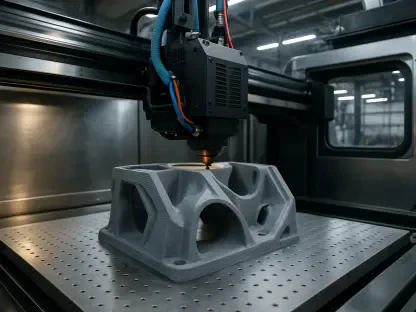

In a decisive move that reshapes the future of defense manufacturing, the United States has begun to treat the national origin of 3D printing technology not merely as a supply chain detail but as a critical component of national security. This profound strategic pivot is underscored by the recent convergence of a landmark Department of Defense (DoD) contract with American innovator Velo3D and the implementation of sweeping new legislative mandates. These developments signal a clear and urgent response to growing concerns over supply chain vulnerabilities and the cybersecurity risks posed by hardware and software from geopolitical adversaries, forcing a rapid onshoring of critical advanced manufacturing capabilities. The era of choosing industrial equipment based solely on performance and price is over; for the U.S. military, the question of where a 3D printer comes from has become as important as what it can do.
From Bottlenecks to Breakthroughs: The DoD’s New Playbook
Addressing Critical Supply Chain Vulnerabilities
The U.S. military’s operational readiness has long been hampered by a reliance on traditionally manufactured components, many of which are tied to aging weapons platforms and increasingly fragile supply chains. The production of these essential metal parts often involves casting or forging processes that are slow, expensive, and dependent on a shrinking base of specialized suppliers. This reality creates severe bottlenecks, stretching lead times for critical components from months to years and significantly constraining the military’s ability to scale production rapidly in response to a national emergency. This vulnerability is not a theoretical risk; it directly impacts the capacity to repair existing equipment, produce new systems, and maintain a credible surge capacity, thereby posing a tangible threat to national security and the stability of the defense industrial base. The challenge is compounded by the fact that many of these legacy parts are for systems that will remain in service for decades, making a sustainable, modern solution imperative.
This dependency on outdated manufacturing methods and diminishing supply sources represents a strategic Achilles’ heel for the armed forces. When a critical part for a combat vehicle or a naval vessel is no longer in mass production, the DoD is often forced into a costly and time-consuming process of recertification or reverse engineering, further delaying the return of vital assets to the field. Moreover, the geographic dispersal of the remaining suppliers, some of whom may be located in regions of geopolitical instability, adds another layer of risk to an already precarious system. The inability to quickly source or manufacture replacements for damaged or obsolete parts jeopardizes the military’s ability to sustain operations during a prolonged conflict. Recognizing this, defense planners have actively sought innovative solutions that can break this cycle of dependency, enhance industrial resilience, and provide the agility needed to meet the demands of a rapidly evolving global security landscape, paving the way for advanced technologies like additive manufacturing to step in.
Project FORGE: A Landmark Investment in Domestic Tech
In a direct effort to sever this dependency on problematic supply chains, the DoD’s Defense Innovation Unit (DIU) has launched “Project FORGE,” a strategic initiative solidified by a $32.6 million contract awarded to Velo3D. This project represents a significant investment in American-made additive manufacturing technology as a viable solution to the military’s most pressing production challenges. The core objective of Project FORGE is to leverage Velo3D’s sophisticated metal 3D printing capabilities to develop, test, and qualify additively manufactured components that can serve as direct, one-to-one replacements for traditionally made parts that are difficult to source. This collaboration, which also involves the U.S. Navy and a major defense prime contractor, is focused on a key weapons program where manufacturing bottlenecks have become a critical liability. The initiative is designed to prove that additive manufacturing can not only match the performance of legacy parts but also drastically reduce production timelines and enhance supply chain security.
The success of Project FORGE is poised to establish a new blueprint for the defense industrial base, demonstrating a clear path to modernizing sustainment and production. By successfully qualifying 3D printed metal components for critical military applications, the project will validate additive manufacturing as a mainstream solution, encouraging its broader adoption across the DoD. This shift would empower the military to produce parts on-demand, closer to the point of need, thereby mitigating the risks associated with long, complex global supply chains. Velo3D’s role is pivotal, as its advanced technology is capable of producing the complex geometries and high-performance metal alloys required for demanding defense applications without the need for extensive redesigns. Ultimately, Project FORGE is more than just a contract; it is a calculated investment designed to build a more agile, resilient, and technologically sovereign manufacturing ecosystem capable of supporting the nation’s defense needs well into the future.
The New Rules of the Game: Legislation and a Paradigm Shift
The NDATurning Policy into Law
The strategic investment in domestic technology is now reinforced by a powerful legal framework established by the most recent National Defense Authorization Act (NDAA). For the first time, this influential legislation explicitly codifies additive manufacturing as a critical element of defense infrastructure, elevating its importance from a technological advantage to a national security necessity. The most impactful provision within this new law is a strict and unambiguous ban preventing the DoD and its extensive network of contractors from procuring or utilizing 3D printers that are manufactured in, have software developed in, or are digitally networked through China, Russia, Iran, or North Korea. This prohibition is not a mere policy preference; it is a binding legal mandate that extends to the renewal of existing contracts, compelling a swift and comprehensive transition away from any systems with ties to these designated nations. This action effectively transforms supply chain security from a long-discussed guideline into a non-negotiable requirement for participation in the defense market.
The NDAA’s influence extends beyond its restrictive measures, as it also contains expansionist mandates designed to actively foster the growth of a domestic additive manufacturing ecosystem. The legislation sets an ambitious goal for the DoD to qualify up to one million additively manufactured parts for use in its systems by 2027. This directive is not arbitrary; it specifically targets components for critical platforms such as unmanned aerial vehicles, ground combat vehicles, and logistical support equipment, particularly those parts that are notorious for long lead times or are sourced from a diminishing supplier base. This dual-pronged strategy creates a powerful, government-driven incentive structure. On one hand, it closes the door to potential adversaries, while on the other, it opens up a vast market for U.S.-based companies that can meet the new, stringent security and production requirements. The law effectively acts as both a shield and a catalyst, simultaneously protecting the defense supply chain and accelerating its modernization.
The Rise of the American OEM: Velo3D’s Strategic Position
In this newly defined and highly regulated defense landscape, Velo3D’s identity as a U.S.-based Original Equipment Manufacturer (OEM) has become a decisive strategic asset. The company is uniquely positioned to thrive under the NDAA’s stringent rules, as it offers domestically developed Laser Powder Bed Fusion (LPBF) technology, a critical capability for producing high-quality metal parts. Its flagship Sapphire series of printers are assembled in the United States, a key qualifier that immediately aligns with the new legislative requirements. This domestic pedigree ensures that defense contractors who partner with Velo3D can confidently meet the NDAA’s sourcing mandates without the risk of non-compliance. By controlling both the hardware and software development processes within the U.S., the company provides an end-to-end solution that mitigates the security risks associated with foreign-sourced technology, making it an ideal partner for the DoD’s modernization efforts.
Beyond its American manufacturing base, Velo3D’s technology is engineered to meet the rigorous cybersecurity standards essential for integration into sensitive military networks. The ability to securely connect a 3D printer to the DoD’s digital infrastructure is a critical requirement, as it prevents potential vulnerabilities that could be exploited by adversaries to steal intellectual property or sabotage production. This focus on cybersecurity, combined with its domestic origins, has transformed Velo3D’s market position. What was once a competitive advantage has now become a fundamental prerequisite for doing business with the Department of Defense. This new reality signals a broader shift in the defense industry, where technological sovereignty and a secure, verifiable supply chain are no longer secondary considerations but are instead central pillars of a company’s value proposition. Velo3D exemplifies the new model of a trusted technology partner for the U.S. military in the 21st century.
A New Calculus for Defense Manufacturing
The convergence of strategic investment and legislative mandate established a fundamentally new calculus for defense procurement. In the past, the selection of advanced manufacturing equipment like a 3D printer might have been determined primarily by its technical specifications, performance metrics, and cost. However, the paradigm definitively shifted; questions regarding a machine’s country of origin, the nationality of its software developers, and the security of its data pathways became paramount. This change was not merely procedural but represented a deep-seated reevaluation of risk and a commitment to technological sovereignty. The Velo3D contract, viewed through the lens of the NDAA’s requirements, was the first major validation of this new approach. It signaled to the entire defense industrial base that the U.S. government was prepared to invest substantial resources to build a secure, domestic additive manufacturing ecosystem, free from the influence of potential adversaries. This initial action set a clear precedent, ensuring that the security of the digital and physical supply chain would be a core component of national security strategy for years to come.