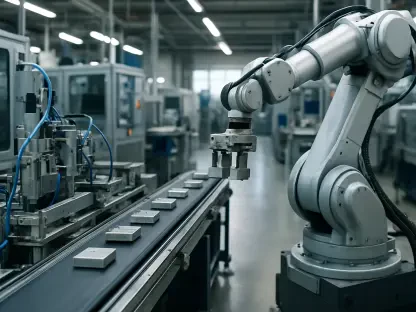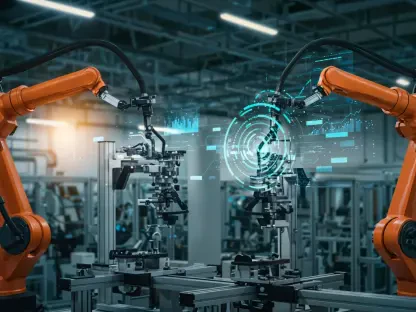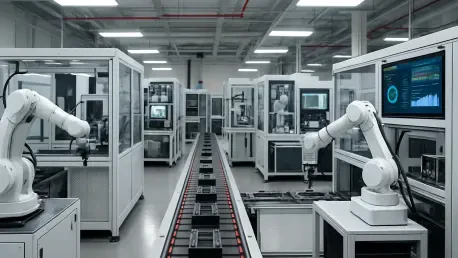

The manufacturing industry is undergoing a profound transformation, moving away from colossal, centralized production facilities toward nimble, intelligent, and distributed smart microfactories that promise unprecedented agility. While the gleaming robotics and sophisticated automation systems capture the spotlight, the true determinant of success for these next-generation facilities operates behind the scenes. The ultimate potential of this new manufacturing paradigm is not unlocked by the machinery itself, but by a modern data infrastructure capable of unifying a complex web of disparate systems in real-time. Traditional data architectures, built for a slower, more predictable era of production, have become a significant bottleneck. It is the adoption of a more agile approach, specifically logical data management, that provides the essential enabling layer to transition from automated production to truly intelligent manufacturing.
The Paradigm Shift to Agile Production
Contemporary manufacturing is no longer a conversation centered solely on automation; it has evolved to prioritize intelligence, operational resilience, and market agility. This shift has catalyzed the emergence of the microfactory, a small-scale, hyper-automated, and highly modular manufacturing model strategically positioned near end markets. This concept is gaining significant momentum across diverse sectors, including automotive, aerospace, and medical devices, as a direct answer to modern business challenges. The increasing volatility in market demand requires production environments that can be reconfigured rapidly, a core competency of the microfactory’s modular design. Furthermore, recent global disruptions exposed the fragility of long, intricate supply chains, making localized production not just a competitive advantage but a necessity for business continuity and risk mitigation. This localized model also aligns perfectly with sustainability goals by dramatically shortening logistics chains and reducing the carbon footprint associated with transportation.
It is a critical mistake, however, to perceive microfactories as merely scaled-down versions of their larger predecessors, as they function based on a radically different set of operational principles. These principles place immense pressure on legacy data architectures that were never designed to support them. In a smart microfactory, data is not processed in slow, periodic batches but is a constant, real-time, and often transient stream of information from countless sources. Production is not a rigid, linear sequence but a flexible and adaptive process that can change on a moment’s notice to accommodate high-mix, low-volume orders. Consequently, decision-making authority is not top-down and centralized; it is distributed across the facility, empowering both human operators and autonomous systems to act on immediate, localized insights. This distributed intelligence model is fundamentally incompatible with data systems that introduce latency and centralize information away from the point of action.
The Hidden Bottleneck of Monolithic Data Systems
The vast majority of manufacturers today are operating with data strategies conceived for a different era of production, creating a hidden bottleneck that stifles the very agility they seek to achieve. Foundational systems like data warehouses and data lakes, while valuable for long-term historical reporting and business intelligence, were not architected for the high-velocity, low-latency, and multi-system environment of a modern smart factory. Data warehouses store structured data in a rigid, hierarchical format optimized for planned queries, while data lakes emerged as a more flexible alternative, offering a centralized repository for vast amounts of raw data in its native format. This flat architecture allows data lakes to handle unstructured data like images and video, making them crucial for training machine learning models and performing advanced analytics by consolidating an organization’s data into a single, versatile resource for a wide range of applications.
Even the more recent evolution toward the data lakehouse, which attempts to bridge the gap between these two systems, shares a fundamental flaw in the context of a microfactory. The lakehouse architecture combines the low-cost scalability of data lakes with the robust data management and transactional integrity features of data warehouses, aiming to create a unified platform for both business intelligence and machine learning on the most current data. Despite this advancement, it remains a monolithic system at its core. To integrate operational data from the factory floor—such as machine telemetry from IoT sensors, status updates from a Manufacturing Execution System (MES), specifications from Product Lifecycle Management (PLM), or orders from an Enterprise Resource Planning (ERP) system—it relies on physically replicating and moving that data into the central repository. This ingestion process is complex, costly, and, most critically, introduces a time delay, rendering insights stale before they can be acted upon and creating a significant “visibility gap” between real-time events and the data available to decision-makers.
A Cohesive Digital Ecosystem Through Logical Management
Overcoming this pervasive data bottleneck requires a fundamentally new approach: logical data management. This modern strategy employs a virtualized, real-time data access layer that functions as a universal data hub. Instead of physically moving data from disparate systems, this logical layer connects to them directly, allowing information to be queried in place, regardless of whether it resides on-premises, in the cloud, or at the network edge. This method creates a unified, logical view of all enterprise data without the need for costly and time-consuming data replication. This data orchestration layer is the critical component that enables a smart microfactory to operate as a cohesive, insight-driven environment. Its key capabilities include enabling teams to access and analyze data across diverse systems like PLM, MES, and IoT in real-time, without the inherent delays of traditional data pipelines. This approach is what transforms a collection of siloed systems into a truly integrated and intelligent operation.
The power of this approach is best illustrated with a practical example from a highly regulated industry. In a medical device microfactory, environmental sensors might detect a minor but potentially critical spike in humidity on the production line. With a logical data management layer, this transient edge data is instantly available for analysis and can be cross-referenced in real-time with the current production batch data from the MES and machine diagnostic information from the OT network. This composite, contextualized insight can then be fed into a digital twin of the production line, which immediately flags the deviation and alerts operators to recalibrate the equipment before the entire batch is compromised and must be scrapped. Crucially, this valuable data is not lost after the event. It is archived with its full context and lineage for future audits and quality control analysis, all achieved without the friction, cost, and latency of physically moving data into a centralized repository.
Forging the Future of Intelligent Manufacturing
The implementation of logical data management was pivotal in dismantling the long-standing information silos that separated operational technology (OT), information technology (IT), and engineering departments. This integration was particularly transformative for the role of Product Lifecycle Management (PLM) systems. Traditionally viewed as static archives for design specifications, PLM systems were unlocked to become dynamic hubs for cross-functional collaboration. The logical data layer created a live, bidirectional flow of information, federating PLM data into operational systems while simultaneously feeding live production data back into the PLM. This established a powerful closed-loop feedback mechanism that created virtual joins between design, production, and quality data, turning the PLM into a vital, dynamic node in the factory’s digital nervous system. This seamless integration ensured that every part of the organization operated from a single, consistent, and up-to-the-minute source of truth.
Ultimately, the foundational technologies of Industry 4.0—including AI for predictive maintenance, digital twins for real-time simulation, and robust systems for compliance and ESG reporting—were all fundamentally dependent on data. Their effectiveness proved to be directly proportional to the quality, timeliness, and accessibility of the information they consumed. Logical data management acted as a powerful accelerator for these initiatives by providing a consistent, governed, and real-time multi-source data feed without requiring the construction of new data pipelines or the replication of sensitive information into yet another silo. It became clear that the competitive advantage in modern manufacturing was determined not just by automation, but by what a manufacturer knew and how fast it could act on that knowledge. The success of these agile, intelligent operations depended entirely on a modern data foundation that transcended the limitations of older, monolithic architectures.