
Industrial robots have long been celebrated as the tireless workhorses of modern manufacturing, capable of executing the same motion with microscopic consistency millions of times over. This high level of repeatability has been the bedrock of mass production for decades, but a more subtle and critical challenge lurks beneath the surface: a significant disparity between a robot’s ability to repeat a task and its ability to accurately reach a specific, absolute coordinate in space. This gap is no longer a minor technicality; it has become a major bottleneck that hampers efficiency, stifles flexibility, and slows the adoption of next-generation manufacturing paradigms like offline programming, forcing industries to confront the reality that mere repetition is no longer enough.
The Accuracy vs. Repeatability Dilemma
Defining the Core Concepts
The fundamental distinction between repeatability and absolute accuracy lies at the heart of many modern automation challenges. Repeatability is the measure of a robot’s capacity to consistently return to a previously taught point. In this domain, industrial robots are exceptional, often boasting precision values within 0.1 millimeters or even better. This characteristic is perfectly suited for traditional, high-volume manufacturing where a robot is programmed to follow a specific path and then executes that exact sequence for thousands of cycles. For tasks like picking and placing identical parts from a fixed location, high repeatability ensures that the process remains stable and predictable over long production runs. It is this reliability that has made robotics an indispensable tool in industries from automotive to electronics, where consistency is paramount. However, relying solely on repeatability limits a robot’s utility to highly structured and unchanging environments, a significant drawback in an era of increasing product customization and dynamic production demands.
In stark contrast, absolute accuracy describes how precisely a robot’s end-effector can navigate to a specific set of spatial coordinates within its base coordinate system, independent of any previous movements. While repeatability is about consistency, accuracy is about correctness. This is where the performance of standard industrial robots often falters, with typical accuracy values falling within a much wider range of 0.5 to 1.5 millimeters. This discrepancy means that while a robot can reliably return to an incorrect point, it struggles to go directly to the correct point defined in a digital model. This gap between repeatability and accuracy, while inconsequential for simple, taught applications, becomes a critical limiting factor in more complex, flexible, and high-precision industrial processes. For advanced manufacturing, where robots must interact with variable parts or perform tasks defined entirely in a virtual environment, this lack of absolute accuracy presents a formidable and costly obstacle that must be overcome.
The Real-World Impact of Poor Accuracy
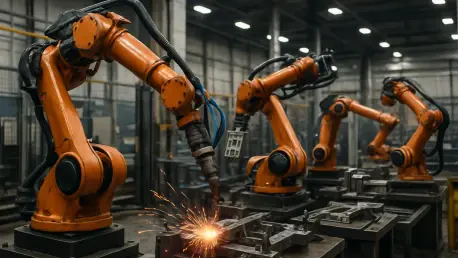
The economic consequences of poor absolute accuracy are significant and far-reaching, particularly in the growing sector of high-mix, low-volume manufacturing. In these dynamic environments, processes are not repeated identically over long periods, making the robot’s ability to accurately execute a newly programmed path essential. In a process like robotic welding, for example, the precise positioning of the wire tip at the center of the weld seam is paramount for creating a high-quality joint that meets stringent industry standards. Deviations of even a few tenths of a millimeter, which are common with poor absolute accuracy, can severely compromise the structural integrity of the weld, leading to product rejections, costly rework, and potential safety liabilities. This critical need for precision extends across a wide array of other applications, including robot-based drilling and deburring, where hole locations must be exact, and overspray-free painting, where path accuracy is essential to avoid material waste and ensure a flawless finish.
Furthermore, a major disadvantage of inaccurate robots is their inability to fully leverage the benefits of offline programming (OLP). OLP is a highly efficient methodology where a robot’s program is created and simulated in a virtual environment while the physical robot continues its operational tasks on the factory floor. This parallel workflow is designed to maximize uptime and productivity by minimizing programming-related downtime. However, the success of OLP hinges on the digital twin—the virtual simulation—perfectly matching the real-world robot. If the physical robot suffers from low absolute accuracy, the program generated in the simulation will not translate correctly to the factory floor. The robot’s actual path will deviate from the programmed path, necessitating time-consuming and manual on-site corrections, a process often referred to as “re-teaching” or “touching up” points. This manual intervention directly negates the primary benefits of OLP, leading to unexpected machine downtime and a reduction in overall production efficiency.
Uncovering the Root of the Problem
Identifying the Sources of Inaccuracy
The root causes of poor absolute accuracy in robotics are diverse and complex, stemming from a combination of hardware-related, software-related, and externally related factors. On the hardware front, deficiencies can originate from the robot’s fundamental design and construction. The use of inferior-quality encoders or gears, for example, can introduce measurement and positioning errors that accumulate through the robot’s articulated structure. Insufficient structural rigidity in the robot’s arms or joints is another common culprit; whether it is an articulated arm, a SCARA robot, or a gantry system, any deflection under the load of the end-effector or process forces will lead to inaccuracies. Even the most robust mechanical designs can be compromised by small, compounding errors in manufacturing and assembly, creating a disconnect between the robot’s intended geometry and its actual physical form, which directly impacts its ability to accurately map its position in space.
On the software side, a primary cause of inaccuracy is a poorly calibrated kinematic model. This model is the core mathematical representation of the robot’s geometry, including the exact lengths of its links and the precise angles of its joints. Any errors or generalizations in this model will result in systemic and predictable inaccuracies in positioning across the entire workspace. Additionally, the performance of the robot’s controller can be a limiting factor. An insufficient controller may struggle to precisely execute the commanded motions, leading to path deviations and positioning errors, especially during high-speed or complex movements. These software-based issues are often invisible to the naked eye but have a profound impact on the robot’s ability to translate digital commands into precise physical actions, effectively creating a barrier between the virtual programming environment and real-world execution.
A Methodical Approach to Diagnosis
For sophisticated “cognitive” or closed-loop robotic systems, which use sensors to perceive their environment and adjust their paths in real-time, the potential sources of error multiply. In these advanced applications, poor quality sensor data can provide a flawed view of the environment, leading the robot to make incorrect adjustments. Similarly, a low-performing controller that cannot process incoming sensor information and react quickly enough can introduce significant lag and inaccuracy into the system. A suboptimal interaction between the various components within the robotic cell—including sensors, the controller, and the robot itself—can also degrade performance. Finally, external factors in the operational environment can have a significant negative impact. Fluctuations in ambient temperature, for instance, can cause thermal expansion and contraction of the robot’s mechanical components, altering its geometry and affecting its accuracy over the course of a production shift.
Faced with this complex web of potential causes, automation specialists now act as neutral project partners to conduct methodical and comprehensive root-cause analyses. The diagnostic process begins by establishing a solid, empirical database of the robot’s actual performance. Using high-precision metrology equipment, which can record a robot’s position anywhere in its workspace with an accuracy of just a few micrometers, teams can meticulously map the robot’s behavior under various conditions. From this wealth of recorded data, they calculate special performance indicators and examine the characteristics of the robot’s movements to pinpoint anomalies and determine the system’s true performance level. This data-driven approach moves beyond speculation and provides a clear, quantitative picture of where and why the inaccuracies are occurring, forming the foundation for targeted and effective corrective actions.
Crafting a Path to Precision
To address the unique challenges of modern cognitive systems, research institutes have developed novel closed-loop benchmarks that go beyond the scope of traditional performance standards, which often focus solely on the robot in isolation. This innovative approach is designed to evaluate the performance of the entire closed-loop controlled process as a single, integrated system. It uses a reference-giving device, sometimes likened to a “metronome,” to provoke specific behaviors from the robot, allowing for a holistic assessment of the entire robotic cell. This includes the sensor technology, the controller software, and the intended process itself. By testing the system’s ability to react to dynamic inputs, this benchmark provides a much more realistic and application-relevant measure of a system’s true accuracy and performance in a real-world scenario. This type of comprehensive evaluation is crucial for deploying reliable robotic systems in applications that require adaptability and high precision.
Ultimately, the analysis and correction of a robot’s absolute accuracy offered substantial added value and a strong return on investment. A robot with sufficient absolute accuracy increased operational flexibility, minimized or eliminated the need for manual rework and program corrections, and in some cases, even replaced more expensive, specialized equipment. By closing the gap between the virtual and physical worlds, companies enabled more seamless integration of advanced manufacturing technologies like offline programming, which in turn boosted overall productivity and reduced time-to-market for new products. Achieving high precision and reliability through a methodical investigation of accuracy anomalies provided a distinct economic advantage and enhanced a company’s overall competitiveness. The strategic decision to invest in accuracy correction yielded significant long-term benefits, paving the way for a more agile and efficient manufacturing landscape.