
The industrial polymer additive manufacturing market is currently navigating a period of profound transformation, characterized by a fundamental tension between established high-performance systems and the disruptive force of increasingly capable low-cost desktop printers. For incumbent original equipment manufacturers (OEMs) and service bureaus, the current landscape represents a crucial window to make strategic decisions before an anticipated competitive shift fundamentally alters the market dynamics in 2027. This period, seen by some as a “year of grace in disguise,” is forcing industry leaders to confront whether professional-grade desktop systems will cannibalize the lower end of the industrial market or if the two sectors will evolve on separate, diverging paths. The strategic choices made now will likely determine the key players in the next era of digital manufacturing.
The Maturing Industrial Landscape
Cementing Value in High-Performance Sectors
A strong consensus is emerging among industry leaders that industrial polymer additive manufacturing is solidifying its position as a primary growth engine within the most demanding sectors. Experts from leading firms like EOS and HP have identified defense, aerospace, and specialized medical fields such as orthotics and prosthetics as key markets where the technology is not just viable but essential. These industries are driven by an uncompromising need for rapid iteration, dependable part throughput, and the ability to produce complex geometries that deliver superior performance. The inherent advantages of AM align perfectly with these requirements, allowing for the on-demand production of components that are both lightweight and robust. For example, the rapid expansion in the use of unmanned aerial vehicles is being significantly accelerated by technologies like Selective Laser Sintering (SLS), which can deliver the required part performance for mission-critical applications.
The successful adoption within these high-stakes environments serves as more than just a revenue stream; it acts as a powerful validation of the technology’s capabilities and reliability. When a 3D printed part is certified for use in a defense system or a medical implant, it builds immense credibility and trust across the entire manufacturing ecosystem. This success creates a positive feedback loop, where the challenges posed by high-performance applications drive innovation in materials science, process control, and software development. These advancements, born from the need to meet the most stringent standards, eventually trickle down to benefit the broader industrial market, improving the quality and lowering the cost for all users. This continuous cycle of innovation cements the role of industrial AM as a leader in creating next-generation products, securing its position at the high end of the market where performance is paramount.
The Economic Push to Mainstream Production
Beyond the specialized world of high-performance applications, the single most significant factor driving the expansion of polymer AM is the relentless decline in the cost-per-part. This crucial economic shift is not the result of a single breakthrough but rather the cumulative effect of steady gains in process efficiency, increased machine throughput, and the growing maturity of the materials supply chain. Industry analysts have pointed to this trend as a critical inflection point that will unlock a new wave of production adoption. As the total cost of ownership continues to decrease, AM is transitioning from an experimental technology, often reserved for prototyping or highly specialized parts, into a commercially rational choice for mainstream production. This evolution is making it increasingly competitive with traditional manufacturing methods like injection molding for small to medium-sized production runs.
This economic pragmatism is enabling the deeper integration of additive manufacturing into conventional supply chains, a vision actively pursued by industry players. The rise of digital inventories and connected manufacturing workflows is allowing companies to move away from centralized production and warehousing toward a more agile, distributed model. Manufacturers can now localize production, printing parts on-demand where and when they are needed, which dramatically shortens lead times, reduces shipping costs, and builds more resilient global operations that are less vulnerable to disruption. This transition signifies that the industrial polymer market is well-positioned to return to double-digit growth, driven not by novelty but by its increasing practicality and ability to solve tangible business challenges related to cost, agility, and supply chain management.
The Central Conflict: Desktop vs. Industrial
The Nature of the Desktop Disruption
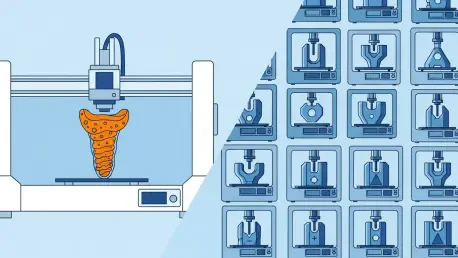
The most significant challenge to the established industrial AM landscape arises from the widespread adoption of professional-grade desktop material extrusion (FFF/FDM) systems within enterprise environments. These machines are no longer confined to the role of simple prototyping tools on a designer’s desk; they are now being deployed in scalable print farms to produce a rapidly growing number of functional, end-use parts. This movement represents a direct assault on the business case for more expensive industrial machines, particularly for applications where the absolute peak of material performance or dimensional accuracy is not a strict requirement. The pressure from this lower-cost alternative is already being felt and is widely expected to fundamentally alter the competitive dynamics of the market by 2027, forcing incumbents to re-evaluate their product positioning and business models.
The primary drivers behind this enterprise-level adoption of desktop systems are accessibility, significantly lower capital expenditure, and the delivery of “good enough” performance for a vast array of applications. For many companies, investing in a high-end industrial system represents a significant financial commitment and often provides capabilities that are overkill for their needs. A fleet of professional desktop printers, by contrast, offers a much lower barrier to entry, greater production flexibility, and the ability to scale capacity incrementally. This user-centric value proposition is compelling for businesses seeking to produce jigs, fixtures, manufacturing aids, and even final parts without the overhead associated with traditional industrial hardware. As these desktop machines continue to improve in reliability, material compatibility, and ease of use, they are carving out a substantial and expanding segment of the market that was once the exclusive domain of industrial players.
Divergence or a Direct Collision Course
Opinions within the industry are sharply divided on the long-term outcome of this growing tension. One school of thought, often articulated by established industrial OEMs, posits that the low-cost and high-end sectors will continue to diverge onto separate paths. In this scenario, industrial AM will increasingly focus on highly specialized, performance-driven applications that demand custom-engineered materials, tightly controlled and certified processes, and tailored machine parameters. This specialized niche, characterized by high barriers to entry and extreme performance requirements in sectors like aerospace and medical, would remain a protected space that desktop systems simply cannot penetrate due to technological limitations. This strategy effectively cedes the lower end of the market while consolidating control over the most valuable and demanding applications.
In stark contrast, another perspective predicts a more direct and disruptive collision. This argument, presented by market analysts and emerging players, envisions a scenario where companies that have successfully integrated in-house FFF printers eventually reach the limits of their internal capacity or performance needs. When these companies look to outsource production, they will seek external service providers. Herein lies the vulnerability for incumbents: established service bureaus built around expensive powder bed fusion technologies may hesitate to offer low-cost FFF services for fear of cannibalizing their primary, high-margin business. This reluctance creates a critical market vacuum, opening the door for a new generation of agile service bureaus to emerge. These new competitors, built on lean, low-investment FFF print farm models, can offer significantly lower part costs, creating a new class of competition with a fundamentally different and more aggressive cost structure.
Evolving Strategies for a Competitive Future
Industrial Pathways to Scale: The Broad Approach
In response to these evolving market pressures and opportunities, established industrial players are pursuing distinct strategies to achieve production at scale. The first is a broad, scalable approach primarily focused on supply chain optimization. This model, championed by companies like HP, leverages additive manufacturing to produce digital equivalents of existing parts, enabling the global, on-demand production of MRO (Maintenance, Repair, and Operations) components and spare parts. The core value proposition is the creation of digital inventories, which decouples the part from a physical warehouse and allows for localized manufacturing. This strategy aims to integrate AM seamlessly into existing global operational frameworks, making supply chains more agile, resilient, and cost-effective by reducing inventory costs and shortening lead times.
The successful implementation of this broad strategy requires more than just capable hardware; it depends heavily on the development of robust software platforms, stringent standardization protocols, and the formation of strategic alliances to manage a distributed production network. The primary focus is less on pushing the absolute boundaries of part performance and more on ensuring consistency, reliability, and cost-effectiveness across a global footprint. It is fundamentally a volume play, aimed at displacing the inefficiencies inherent in traditional supply chains for a wide range of components. By proving its value in logistics and operational efficiency, this approach seeks to embed AM as an indispensable tool for modern, resilient manufacturing on a massive scale.
Industrial Pathways to Scale: The Deep Approach
The second major strategy being pursued is a deep, specialized approach that prioritizes value over volume. Advocated by firms like EOS, this path involves drilling down into specific, high-value applications to create highly optimized and customized solutions from the ground up. This method goes beyond simply providing a machine; it often involves the co-development of tailored machines, unique process parameters, and proprietary engineered materials designed to meet the exacting requirements of a single part or a niche industrial sector. The value proposition here is not cost reduction but the achievement of maximum performance, enabling the creation of components with capabilities that were previously unattainable through any other manufacturing method.
This deep approach is fundamentally different from the broad, supply-chain-focused model. While it is narrower in its application focus, it delivers significantly higher value per application by enabling true innovation rather than mere replacement. It is less about substituting existing parts and more about designing entirely new classes of products with enhanced functionality, such as consolidated assemblies, topology-optimized structures, and patient-specific medical devices. The most successful long-term strategies will likely involve a hybrid of both the broad and deep approaches. By balancing a wide-reaching supply chain solution with deep, application-specific expertise, companies can capture diverse market segments, leveraging the scale of the former to fund the innovation of the latter, creating a resilient and comprehensive market presence.
Key Enablers and Future Models
Technology-Specific Advancements
Within the industrial sector, core technologies are continuing to mature, enhancing their value proposition for end-use production. Powder Bed Fusion, particularly SLS, remains an industry workhorse for functional polymer components, with PA12 as the established material of choice. A key trend fueling its growth is the increasing sophistication and adoption of advanced finishing processes. Techniques like automated dyeing and vapor smoothing are becoming crucial for producing parts that are not only mechanically robust but also visually and texturally indistinguishable from their injection-molded counterparts. This aesthetic parity is unlocking a wider range of business cases, especially in consumer-facing products. Furthermore, there remains significant potential for a resurgence of high-performance materials like PEEK, provided that persistent technical challenges related to the thermal degradation of unused powder can be overcome.
Meanwhile, Vat Polymerization technologies such as SLA and DLP are expanding beyond their traditional strongholds in the dental, jewelry, and hearing aid industries. Experts predict a meaningful shift toward higher-volume consumer applications, moving from niche offerings to broader product lines in areas like athletic footwear and customized protective gear. This expansion is being driven by two key factors: market consolidation among major players, which brings greater resources to bear on development, and the diligent work of smaller, specialized suppliers who are building market trust by securing critical material certifications. These certifications for applications like food contact, medical biocompatibility, and flame retardancy are essential for gaining entry into highly regulated consumer markets and are paving the way for wider adoption.
The Power of the Integrated Solutions Model
Ultimately, one of the most compelling business models that gained traction was the “systems integrator” approach, which provided a comprehensive, one-stop shop uniting design, software, hardware, and materials into a complete, de-risked solution for a specific application. This model, successfully demonstrated in products ranging from high-performance bike saddles to next-generation military helmets, proved its power by offering customers a faster and less risky path to industrialization. By taking on the complexity of process development and system integration, these providers enabled brands to focus on product innovation rather than manufacturing hurdles.
In retrospect, the strategic imperative for industrial OEMs and service bureaus was clear: forming alliances and adopting a similar integrated model was the most effective response to the dual pressures of market commoditization and the demand for true innovation. This framework, which expertly married deep application development with seamless system integration, was identified as the key to unlocking millions of novel AM applications. It provided the strategic depth necessary to create high-value solutions while simultaneously building a formidable defense against the growing competitive pressure from the increasingly capable and cost-effective desktop 3D printing market. The players who embraced this holistic approach were the ones who successfully navigated the industry’s critical inflection point.