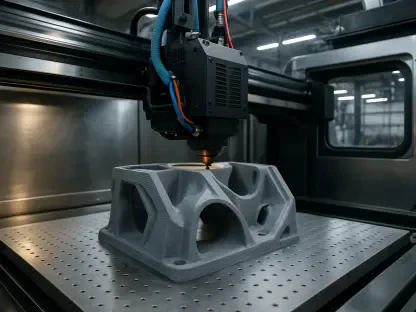

A microscopic flaw in a single jet engine turbine blade, invisible to the naked eye, can ground an entire fleet, highlighting the immense pressure on material science and manufacturing to achieve absolute perfection. To address this critical challenge and accelerate innovation, America Makes has launched a landmark $8 million initiative aimed at revolutionizing how advanced materials are developed and certified. This dual-pronged investment targets the core obstacles in additive manufacturing: the creation of robust new alloys and the intelligent, AI-driven validation of their performance, signaling a major push to secure the nation’s manufacturing future.
When a 3D-Printed Part Fails Who is to Blame
The question of accountability for a failed 3D-printed component in a critical system extends far beyond legal liability; it strikes at the heart of the manufacturing qualification process. For industries like aerospace and defense, where failure is not an option, the integrity of every part is paramount. The current paradigm relies on an exhaustive and often prohibitively expensive series of physical tests to create a material “allowables” database, a process that can take years and millions of dollars for a single new material, thereby creating a significant barrier to innovation.
This meticulous, data-intensive approach has become a critical bottleneck, slowing the adoption of advanced materials and manufacturing techniques. While additive manufacturing offers unprecedented design freedom and supply chain agility, its potential is constrained by the very methods designed to ensure its safety. Each new alloy or minor process variation traditionally requires a near-complete requalification, stifling the rapid iteration that is a hallmark of 3D printing and delaying the deployment of superior components.
The Race for Manufacturing Dominance
At the forefront of the national strategy to overcome these hurdles are America Makes and its parent organization, the National Center for Defense Manufacturing and Machining (NCDMM). These institutions serve as a vital nexus between government, industry, and academia, marshaling resources to bolster U.S. manufacturing competitiveness. The Pentagon’s significant investment in this area reflects a strategic pivot toward additive manufacturing as a cornerstone of national security, essential for maintaining technological superiority and ensuring military readiness.
This focus is driven by the urgent need for a more resilient and responsive defense industrial base. Additive manufacturing offers the ability to produce complex, high-performance components on-demand, drastically reducing reliance on fragile global supply chains and lengthy procurement cycles. However, the slow and costly certification of new materials remains the primary obstacle preventing this technology from reaching its full strategic potential, a gap this new funding directly aims to close.
A Two Pronged Strategy Breaking Down the Investment
The $8 million initiative is strategically divided into two complementary project calls that tackle both material development and qualification efficiency. The larger portion, a $6 million project named Powder Alloy Development for Additive Manufacturing (PADAM) 2.0, is funded by the Air Force Research Laboratory. Its mission is to advance the performance and manufacturability of high-temperature refractory alloys—materials crucial for extreme environments like hypersonic flight and advanced propulsion systems. This funding is further broken down, with up to $4 million allocated to improve existing alloys, $1.7 million to pioneer novel material systems, and $300,000 to conduct a comprehensive supply chain assessment.
The second initiative, Artificial Intelligence for Material Allowables in Additive Manufacturing (AIM-4AM), is a $2 million project supported by the Office of the Under Secretary of Defense. This project seeks to build an AI-driven framework to slash the time and cost associated with the material allowables process. Initially focusing on 17-4PH stainless steel, a widely used workhorse alloy, the program will use machine learning to model the intricate relationships between printing processes, material structures, and final properties. The ultimate goal is to intelligently guide physical testing, safely reducing the number of required trials by creating a probabilistic understanding of material performance.
From the Top Perspectives on a New Era
Leaders at America Makes have emphasized that this dual-project approach is intentionally synergistic, creating a powerful feedback loop between material innovation and qualification. By developing advanced alloys and simultaneously creating a faster, smarter way to certify them, the initiative aims to fundamentally change the economics and timeline of deploying new manufacturing technologies. This holistic strategy is seen as essential for breaking the current cycle of incremental progress.
Commentary from Department of Defense partners underscores the direct link between this funding and urgent national security needs. Officials have noted that the ability to rapidly qualify and deploy additively manufactured parts made from next-generation materials is not just an industrial advantage but a strategic imperative. Experts in the field agree, highlighting that integrating AI into the material science workflow is the only viable path to keep pace with the rapid advancements in both alloy design and 3D printing hardware.
The Path Forward How This Initiative Will Reshape the Industry
The immediate impact of this initiative is expected to be a significant reduction in the technical and industrial risks associated with adopting advanced 3D-printed components. By generating trusted, publicly available data on new alloys and demonstrating a more efficient qualification pathway, America Makes is lowering the barrier to entry for small and large manufacturers alike, encouraging wider adoption across both the defense and commercial sectors.
More profoundly, this work establishes a digital foundation for the future of material science. The AI models developed for 17-4PH stainless steel will create a data-driven, probabilistic framework that can be adapted and applied to future materials, creating an ever-accelerating cycle of innovation. This shifts the paradigm from a brute-force testing approach to an intelligent, predictive model of material behavior.
Ultimately, these projects created clear and actionable transition pathways to move advanced manufacturing from the laboratory to the field. By addressing the core challenges of material development and data-driven qualification simultaneously, this $8 million investment laid the groundwork for a future where high-performance, 3D-printed parts could be integrated into critical systems faster, more affordably, and with greater confidence than ever before.