
As consumers increasingly demand environmentally responsible products, the packaging industry faces a critical challenge to innovate beyond traditional models and embrace true circularity. In a landmark response to this global imperative, Graphic Packaging International has committed $1 billion to a state-of-the-art recycled paperboard mill in Waco, Texas, a project poised to significantly alter the landscape of sustainable packaging. This facility, which began its operations in late 2025, is engineered to substantially boost the company’s production of coated recycled paperboard (CRB), a cornerstone material for countless consumer goods. The development not only addresses the soaring demand for fiber-based packaging but also serves as a powerful engine for regional economic growth, creating approximately 230 jobs and exemplifying a successful synergy between corporate investment and local government collaboration. This venture represents more than just an expansion of capacity; it is a deliberate and strategic move to build a more resilient and sustainable supply chain from the ground up.
A Strategic Foundation for the Future
Prime Location, Prime Resources
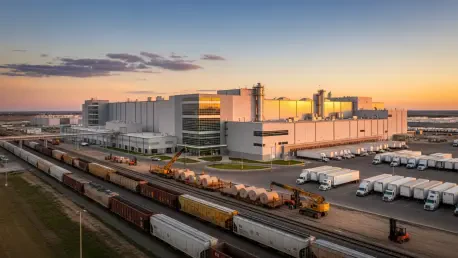
The decision to build in Waco was a masterstroke of logistical planning, rooted in maximizing both resource acquisition and distribution efficiency. The 119-acre greenfield site is strategically positioned within the Texas Central Park, the city’s largest industrial hub, at the geographic heart of the “Texas triangle.” This megaregion, encompassing Dallas, San Antonio, and Houston, places the facility within a 200-mile radius of nearly 80% of the state’s population. Such proximity to major urban centers is not merely a geographic convenience; it is the lifeblood of the operation, guaranteeing a consistent and voluminous supply of post-consumer recycled fiber, the essential raw material for the mill’s output. By situating the plant at the epicenter of a massive consumer base, Graphic Packaging has effectively shortened its supply chain, reducing transportation costs and the associated environmental footprint while securing a reliable source of feedstock to fuel its ambitious production targets. This location ensures the mill is integrated directly into the regional recycling ecosystem.
Furthermore, the site was selected for its exceptional logistical infrastructure, which is critical for an operation of this magnitude. With direct access to major transportation arteries, including Interstate 35 and Texas Highway 6, as well as established rail connections, the facility is perfectly poised for seamless inbound and outbound logistics. This network ensures that raw recycled materials can be efficiently transported to the mill and that the finished paperboard products can be rapidly distributed to customers across the United States. The location was also pre-equipped with the robust water, wastewater, and energy infrastructure required to support a large-scale industrial manufacturing process from day one. This turnkey readiness minimized development delays and allowed the company to focus its resources on installing the advanced production technologies that define the facility, creating a model of industrial efficiency where strategic location and operational readiness converge to create a competitive advantage in the national market.
Engineering for Efficiency and Innovation
Housed within a massive 640,000-square-foot structure, the Waco mill’s production capabilities are driven by some of the most advanced technology in the industry. The centerpiece of the operation is a state-of-the-art coated recycled paperboard machine supplied by Valmet, a global leader in industrial equipment. This sophisticated machine is engineered to produce an impressive 500,000 short tons of CRB grades annually, specifically white line chipboard, which is the foundational material for a vast array of everyday consumer packaging, from cereal boxes to pharmaceutical cartons. To maintain precise control and maximize output quality, the system incorporates an extensive process ventilation scope, advanced approach flow systems, and a comprehensive Valmet DNA automation package. This high level of automation and technological integration allows for unparalleled efficiency, ensuring that the mill can consistently meet the high-volume demands of its major consumer product clients while maintaining the strictest quality standards required for modern retail packaging.
Beyond its sheer production volume, the mill’s design incorporates groundbreaking solutions to address specific recycling challenges. A standout capability is its capacity to process and recycle the fiber from up to 15 million paper cups per day, a waste stream that has historically been difficult to manage and repurpose effectively. To handle this and other complex inputs, the German technology company Voith was contracted to install a complete pulping and wastewater pre-treatment system. This vital component includes multiple stock preparation lines and an integrated reject handling system, which are crucial for meticulously cleaning and separating diverse types of recyclable materials. This advanced sorting and purification process ensures the final paperboard product is free of contaminants and possesses the structural integrity and surface quality necessary for high-end consumer packaging, transforming a challenging waste problem into a high-value resource and setting a new standard for material recovery in the industry.
Beyond the Box a Commitment to Sustainability and Market Leadership
The Circular Economy in Action
The Waco facility was conceived not just as a production plant but as a working model of the circular economy. Its operational philosophy is built on eliminating waste and maximizing resource utilization at every stage. A cornerstone of this approach is a closed-loop system designed to internally recycle 100% of the paperboard side rolls and other trim waste generated during its own manufacturing process. This waste is immediately fed back into the production line, ensuring that no material is lost and that the facility’s output is maximized from a given amount of raw input. Moreover, the advanced pulping and cleaning systems enable the mill to process a more diverse range of post-consumer recyclable materials than many conventional facilities. This enhanced capability not only increases the overall utility of recycled paperboard but also contributes to a potential net decrease in the greenhouse gas emissions associated with the packaging lifecycle by diverting more materials from landfills and reducing the need for virgin fiber.
This profound commitment to sustainability is further reinforced by the facility’s intelligent energy management systems. A key installation is a high-efficiency gas turbine that co-generates electricity to power the mill’s extensive operations while also producing steam as a byproduct. This steam is then captured and repurposed for the energy-intensive paperboard drying process, creating a highly efficient integrated energy system that significantly reduces reliance on the external power grid and lowers the plant’s overall carbon footprint. This focus on resource optimization is a central element of Graphic Packaging’s broader corporate environmental strategy. The efficiencies gained from the Waco mill, combined with optimizations across the company’s entire network of facilities, were projected to contribute to an approximate 12% reduction in its absolute greenhouse gas emissions, demonstrating how targeted, large-scale investments in green technology can drive substantial progress toward corporate sustainability goals.
Solidifying a Global Leadership Role
Headquartered in Atlanta, Georgia, Graphic Packaging International operates as a titan in the global packaging industry, with 130 facilities and a workforce of over 24,000 employees worldwide. The company has built its reputation by providing innovative and sustainable fiber-based packaging solutions to many of the world’s most recognizable consumer product companies across the food, beverage, and foodservice sectors. As one of the largest producers of folding cartons and paper-based foodservice products in both the United States and Europe, the company holds a significant market position. The construction and commissioning of the Waco mill was a decisive strategic move to reinforce this standing, particularly as consumer and regulatory pressures for eco-friendly packaging alternatives continue to intensify. By investing heavily in cutting-edge recycling technology and strategically expanding its manufacturing footprint, Graphic Packaging positioned itself to not only meet but anticipate the evolving demands of the market.
The Waco mill ultimately became a cornerstone of the company’s long-term vision. It solidified its status as the premier producer of high-quality, sustainable paperboard in North America and demonstrated a profound commitment to leading the industry’s transition toward a more circular economy. The project did more than simply add production capacity; it established a new benchmark for what was possible in large-scale sustainable manufacturing. By successfully integrating advanced recycling technology, a strategic logistical framework, and a deep commitment to environmental stewardship, the facility provided a powerful blueprint for the future of industrial development. Its completion marked a pivotal moment where operational efficiency, economic growth, and ecological responsibility were no longer competing interests but were instead woven into the very fabric of a modern, forward-thinking enterprise that solidified its leadership in a rapidly changing global market.