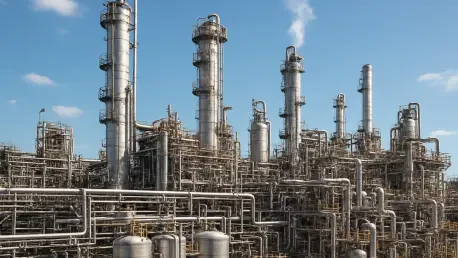

A cornerstone of Europe’s industrial sovereignty, the chemical manufacturing sector, is grappling with an existential threat that jeopardizes the continent’s entire economic ecosystem. For years, the industry has been hollowed out by crippling operational costs and a relentless onslaught of cheaper global imports, leading to widespread plant closures, significant job losses, and a dramatic collapse in new investment. In a stunning reversal of long-held laissez-faire trade policies, European political leaders are now mounting a robust defense, deploying a combination of aggressive trade tariffs and substantial financial support in a high-stakes bid to rescue this foundational industry from the brink of total collapse. The success or failure of this interventionist strategy will undoubtedly shape the future of European manufacturing for decades to come.
A Sector Under Siege
The statistical evidence of the chemical industry’s decline paints a grim picture of a sector in full-blown crisis. Data from the European Chemical Industry Council (Cefic) reveals a staggering loss of 37 million metric tons of annual production capacity since 2022, a figure that represents nearly 9% of the entire region’s output. This sharp contraction has directly led to the elimination of 20,000 jobs and has choked off the flow of capital, with new investments slowing to a near standstill. Marco Mensink, the director general of Cefic, has starkly described the sector as being “under severe stress and breaking,” underscoring the precarious situation with the observation that annual investments are now “half and close to zero.” This rapid deterioration is the direct result of an uncompetitive operating environment, where high energy prices and stringent regulations clash with the economic realities of competing against lower-cost international producers, creating a perfect storm that threatens to permanently cripple the industry.
The ramifications of this industrial decline extend far beyond the chemical sector itself, creating a significant strategic vulnerability for the continent’s broader manufacturing base. As a foundational “industry of industries,” European chemical producers supply essential materials for everything from automotive and construction to pharmaceuticals and electronics. The erosion of this domestic supply chain forces other sectors to become increasingly reliant on foreign imports, exposing them to geopolitical risks and supply disruptions. This perilous situation was allowed to develop over years of perceived political inaction, allowing the problem to metastasize. The gravity of the moment was aptly summarized by Paul Hodges of New Normal Consulting, who warned that European leaders face a critical juncture, stating, “There will be no ‘second chance’ if they now fail to act.” This sentiment highlights the immense pressure on policymakers to implement effective and immediate solutions before the damage becomes irreversible.
A Coordinated Political Response
After a prolonged period of apparent indifference, a powerful political consensus has finally emerged, signaling a dramatic shift toward active industrial protection. This new resolve was publicly showcased at the European Industry Summit in Antwerp, where European heads of state and European Commission President Ursula von der Leyen delivered a unified message of support. In her address, von der Leyen acknowledged the sector’s vital role, declaring, “Your industry is the industry of industries. So together we must secure your future in our continent.” This public pledge marked a clear departure from previous policy, moving away from free-market orthodoxy toward a more pragmatic and interventionist stance. The summit served as a critical turning point, articulating a clear political will to not only halt the industry’s decline but to actively foster an environment where it can once again thrive, recognizing its indispensable contribution to the European economy.
The new strategy is not merely rhetorical; it is backed by a concrete plan to alleviate the financial pressures on European companies. President von der Leyen outlined a multi-pronged approach designed to “slash regulatory costs” and enhance support for businesses investing in decarbonization technologies. A central component of this initiative involves reforming the Emissions Trading System (ETS), which charges producers for greenhouse gas emissions. The plan proposes redirecting a larger portion of the funds collected through the ETS back to the companies themselves. This innovative mechanism aims to transform what has been a punitive operational cost into a valuable source of capital for green innovation and modernization. By linking financial support to environmental goals, the policy seeks to achieve the dual objectives of bolstering industrial competitiveness while simultaneously accelerating the continent’s transition to a more sustainable manufacturing model.
Wielding the Tariff Hammer
The most immediate and forceful action taken to defend the industry has been the strategic imposition of significant antidumping duties on specific chemical imports. In a decisive move in February, the European Commission implemented tariffs ranging from 5.2% to 21.7% on acrylonitrile butadiene styrene (ABS) originating from South Korean and Taiwanese companies. The Commission justified this measure by stating that the dumping of low-cost ABS was causing “tangible injury” to EU manufacturers in Belgium, France, Germany, Italy, the Netherlands, and Spain, which collectively employ around 920 people in its production. This targeted action, along with an ongoing investigation into adipic acid imports from China, demonstrates a broader protective trend and a new willingness to use trade defense instruments robustly to shield domestic producers from what are deemed unfair competitive practices that undermine the stability of the European market.
Further underscoring this new protectionist resolve, the European Commission also introduced exceptionally high duties on 1,4-butanediol (BDO) imported from China, Saudi Arabia, and the United States. With tariffs ranging from a substantial 52.4% to an almost prohibitive 142.5%, this measure sent a clear and powerful signal that the EU will no longer tolerate trade practices that threaten its core industries. These tariffs are meticulously designed not as a blanket protectionist wall but as a precise tool to level the playing field, ensuring that European companies can compete on fair terms. The severity of the BDO duties in particular reflects the urgency of the situation and the Commission’s commitment to taking decisive action to prevent further erosion of its domestic chemical production capacity, safeguarding critical supply chains and industrial know-how within the continent.
A Glimmer of Renewed Confidence
The swift and decisive implementation of these protective policies yielded immediate and tangible results, signaling a potential turnaround for the beleaguered industry. In a direct reaction to the new tariffs on BDO, the chemical giant BASF announced its intention to expand BDO production capacity at its flagship site in Ludwigshafen, Germany. This move represented a significant vote of confidence in the viability of domestic manufacturing, suggesting that the new trade defenses were already restoring faith in the European market. Such a commitment to reinvestment from an industry leader like BASF provided a powerful early indicator that the government’s intervention was creating a more stable and predictable business environment, encouraging companies to commit to long-term growth within the region rather than continuing the trend of offshoring production and investment. This corporate optimism was a critical first step in reversing the sector’s downward spiral.