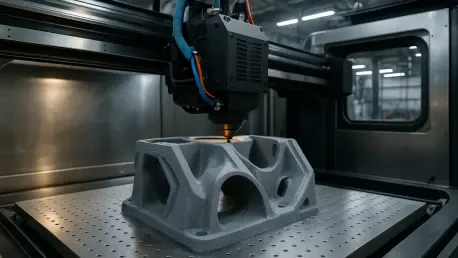

The rapid evolution of additive manufacturing has transitioned from a niche prototyping tool into a fundamental pillar of modern industrial strategy, reshaping how global supply chains operate in an increasingly volatile economic landscape. At the upcoming Hannover Messe, scheduled for April 20–24, 2026, EOS will demonstrate how three decades of expertise in laser-powered powder bed fusion are now being channeled into fully integrated, digital production ecosystems. This exhibition serves as a critical junction for manufacturers seeking to move beyond traditional subtractive methods, offering a glimpse into a manufacturing environment where the constraints of conventional tooling no longer dictate the pace of innovation. By blending advanced metallurgy and polymer science with sophisticated software, the organization aims to prove that 3D printing is no longer a secondary option but a primary driver for industrial resilience and agility. Attendees will witness how these technologies are actively de-risking production cycles by enabling decentralized manufacturing hubs that can respond to demand shifts in real-time, effectively insulating companies from the logistical bottlenecks that have historically plagued international commerce.
Economic Efficiency through Advanced Tooling and Engineering
Industrial tooling has long been a sector defined by high overheads and long lead times, yet the integration of additive manufacturing is fundamentally altering this cost-benefit analysis for modern machine shops. During the exhibition, specific focus will be placed on fiber-forming applications, where the implementation of EOS technology has demonstrated a remarkable 50% reduction in total production costs. This financial shift is primarily driven by the ability to consolidate multiple components into a single printed part, which eliminates the need for expensive assembly processes and reduces the inventory of spare parts. For manufacturers specializing in small-batch production, these advancements mean that projects previously deemed economically unfeasible due to high tooling costs are now highly profitable. The capacity to iterate designs rapidly without the penalty of physical mold changes allows for a level of design freedom that accelerates the entire product development lifecycle from months to mere weeks.
Beyond specialized tooling, the broader mechanical engineering sector is reaping substantial rewards from the adoption of 3D-printed components in everyday industrial machinery. A standout example involves the production of vibratory bowl feeders, which are essential for automated assembly lines but notoriously difficult to manufacture using traditional methods. By utilizing additive processes, engineers have successfully achieved a 30% reduction in costs while simultaneously slashing lead times by a staggering 90%. This leap in efficiency is complemented by the development of robotic grippers that utilize topology optimization to remove unnecessary material without sacrificing structural integrity. These grippers are not only 90% lighter than their conventional counterparts but also contribute to a significant reduction in CO2 emissions during the manufacturing process. Such high-performance engineering solutions highlight a shift toward sustainable production where lightweighting and energy efficiency are no longer optional features but core requirements for competitive industrial operations.
Adaptive Manufacturing and the Integration of Intelligence
The concept of adaptive manufacturing represents a sophisticated synergy between hardware and digital intelligence, marking a departure from static production lines toward more fluid, responsive systems. Through a collaborative initiative with Siemens, EOS is demonstrating how Industrial Artificial Intelligence can orchestrate complex workflows to achieve unprecedented levels of customization at scale. This partnership focuses on utilizing AI-driven software to manage the intricacies of the printing process, ensuring that every layer of a build is monitored and optimized in real-time. A practical application of this is found in the footwear industry, where sports shoe midsoles are tailored to the exact biomechanical data of individual athletes. By automating the design-to-print pipeline, manufacturers can offer bespoke products without the traditional cost penalties associated with custom work. This level of flexibility ensures that production environments remain versatile, capable of switching between different product lines with minimal downtime or reconfiguration.
This movement toward intelligent automation is redefining the role of the human operator within the factory setting, shifting the focus from manual oversight to high-level system management. As AI algorithms take over the task of detecting anomalies and optimizing parameter sets, the manufacturing process becomes more predictable and repeatable across different geographic locations. The integration of digital twins allows for the virtual simulation of entire production runs before a single grain of powder is melted, significantly reducing material waste and improving first-time yield rates. This data-centric approach to 3D printing ensures that the physical hardware is constantly fed with the most efficient instructions, creating a feedback loop where every successful build informs the next. The result is a manufacturing ecosystem that is not only self-correcting but also highly scalable, allowing companies to expand their production capacity rapidly by deploying standardized, AI-augmented printing cells across their global networks.
Strategic Defense Applications and Operational Readiness
In the high-stakes environment of national defense, the ability to produce safety-critical parts on-demand is becoming a cornerstone of strategic autonomy and operational readiness. EOS is taking a prominent role in the newly established Defense Production Area at Hannover Messe to showcase how additive manufacturing addresses the urgent need for rapid development and supply chain security. Traditional defense procurement often suffers from long lead times and a reliance on obsolete tooling for aging equipment, but 3D printing offers a way to bypass these hurdles by creating parts directly from digital CAD files. This capability is particularly vital for maintaining military systems in the field, where the rapid replacement of a broken component can mean the difference between a mission’s success or failure. By enabling the production of flight-certified or combat-ready parts at the point of need, additive technology effectively extends the lifespan of existing platforms while reducing the logistical burden of transporting massive stockpiles of spare parts.
The strategic application of these technologies goes beyond simple replacement parts, moving into the realm of rapid prototyping for next-generation defense systems that must respond to evolving security threats. Additive manufacturing allows for the creation of complex geometries in high-strength alloys that would be impossible to cast or machine, leading to superior performance in aerospace and ballistic applications. This agility is essential for modern defense organizations that must adapt to shifting geopolitical realities where traditional manufacturing bases may be compromised or inaccessible. By fostering a domestic capability for high-end additive production, nations can ensure that their industrial base remains resilient against external shocks. The presence of EOS in this sector underscores the transition of 3D printing from a prototyping novelty to a mission-critical technology that supports the sovereign requirements of modern defense infrastructure, ensuring that safety and performance standards are met even under the most demanding conditions.
Future Transitions Toward Scalable Industrial Automation
The transition from a pure hardware manufacturer to a holistic solution architect marks the beginning of a new chapter in the industrial journey of EOS and its partners. As leadership figures like Marie Langer and Nikolai Zaepernick engage in high-level discussions on robotics and AI, the emphasis is clearly shifting toward creating a unified digital thread that connects every stage of the manufacturing process. For stakeholders, the actionable next step involves moving away from isolated “islands of automation” and toward fully integrated systems where 3D printers communicate seamlessly with autonomous mobile robots and post-processing stations. Companies should prioritize the investment in digital infrastructure that supports this connectivity, as the ability to manage data will soon be as important as the ability to manage raw materials. The future of the industry lies in this convergence, where the physical constraints of production are mitigated by the limitless possibilities of software-driven design and execution.
Looking forward, the successful implementation of industrial 3D printing will require a fundamental shift in workforce training and organizational structure to fully capitalize on these technological leaps. Engineers and designers must be encouraged to think in terms of “design for additive manufacturing,” unlearning the restrictions of traditional milling and turning to unlock the true potential of the medium. Furthermore, businesses should look to establish strategic partnerships with technology providers to co-develop specialized materials and processes that are tailored to their specific market needs. As the exhibition at Hannover Messe concluded, it became evident that the path to a competitive and sustainable manufacturing future is paved with the integration of AI, robotics, and advanced additive techniques. The organizations that act now to integrate these elements into their core operations will be the ones to lead the next industrial revolution, turning the challenges of today’s market into the competitive advantages of tomorrow’s global economy.