
Kwame Zaire is a distinguished expert in biomanufacturing facility design and a thought leader in predictive maintenance and production management. With a specialized focus on the intersection of high-end electronics and large-scale pharmaceutical equipment, he has become a leading voice on how to harmonize quality and safety across international borders. His insights into the KojoX philosophy provide a roadmap for the future of global life sciences construction.
The KojoX philosophy utilizes a “design one, build many” model to replicate complex facilities across different continents. How did this approach specifically allow for a 70% reduction in design time, and what steps were taken to ensure that quality systems remained identical between the Danish and American sites?
The 70% reduction in design time was primarily achieved because we weren’t starting from a blank canvas in North Carolina; we had a proven foundation in Hillerød, Denmark. By treating the facility as a “clonable” asset, we bypassed the lengthy conceptual and schematic phases that typically stall large-scale projects. To keep quality systems identical, we harmonized everything from the specific stainless steel bioreactor configurations to the digital quality management software used at both sites. This ensures that a technology transfer from Europe to the U.S. is effortless, as the operational DNA of the two 1.5 million-square-foot campuses is essentially the same.
Engineers and subcontractors traveled extensively between Hillerød and Holly Springs to study cleanroom panel installation and equipment movement. What specific operational nuances did the teams learn from these on-site exchanges, and how did this shared knowledge directly improve construction efficiency on the new 150-acre campus?
The value of those transatlantic trips was found in the tactile, sensory details of construction that blueprints often miss. Our subcontractors didn’t just look at drawings; they physically watched how the Danish teams interlocked cleanroom panels to ensure airtight seals and practiced moving massive equipment through specific corridors. By observing these “logistical ballets” in Denmark, our North Carolina teams avoided the trial-and-error phase, significantly gaining efficiency during the installation of our first eight bioreactors. This shared tribal knowledge meant that when we broke ground on the 150-acre Holly Springs campus, we already had a playbook for exactly how to navigate the site’s footprint.
The current expansion involves doubling the facility’s capacity to sixteen 20,000L mammalian cell culture bioreactors. How does a modular footprint allow for such a massive increase in manufacturing space without disrupting existing operations, and what are the primary technical challenges when scaling up stainless steel bioreactor capacity?
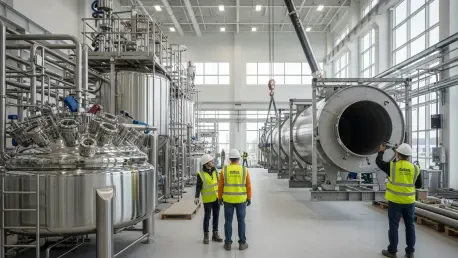
The modular KojoX approach allows us to add approximately 400,000 square feet of manufacturing space as a secondary “block” that integrates into the existing infrastructure. Because the design is decentralized, we can construct the new wing for the additional eight 20,000L bioreactors while the first phase remains in operational start-up mode. The primary challenge is “swallowing the whale”—managing the intense utility demands of sixteen total 20,000L tanks, such as high-volume purified water and steam, without causing pressure drops in the active half of the plant. It requires a precise synchronization of the facility’s “nervous system” to ensure that expansion and production coexist safely.
Prefabricating large skids off-site and shipping them to the construction location helps mitigate local workforce shortages and market risks. What criteria are used to determine which components are suitable for off-site fabrication, and how does this strategy enhance the overall agility of a global manufacturing network?
We look for components that are labor-intensive or require highly specialized welding and assembly, such as the complex piping skids that support our bioreactors. If the local workforce in a region like North Carolina is stretched thin, we can shift that technical labor to a fabrication shop in another part of the world where capacity is available. This strategy turns the physical asset into a kit of parts, allowing us to control market risks and material lead times. By shipping these pre-assembled modules to the site, we reduce the “stick-built” labor hours on the 150-acre campus, which drastically accelerates our speed to market.
Maintaining a “one team” mentality between technical service firms and internal management is often cited as a project cornerstone. Could you elaborate on the specific systems used to synchronize construction schedules with operational start-up modes, and how do these partnerships prevent delays when bringing complex bioproduction facilities online?
We bridged the gap between construction and operations by having our operations teams “walk” the Denmark facility to bring specific functional knowledge back to the North Carolina project. This allowed us to align the construction milestones with the actual systems needed to “turn the facility on,” such as environmental monitoring and utility validation. By working as one unit with our technical partners, we ensured that the building wasn’t just “finished” by construction standards, but “ready” by pharmaceutical standards. This partnership prevents the common 6-to-12-month lag often seen when a construction firm hands over a “dead” building to an operations team that isn’t prepared to breathe life into it.
Linking manufacturing hubs in Europe, Japan, and the United States creates a global ecosystem for local supply. How does this interconnected network provide flexible capacity for pharmaceutical customers, and what metrics are used to measure the success of cloning these facilities across different international regions?
This network allows a customer to start their process in Denmark and, as their market grows in North America, shift or split production to Holly Springs without any change in the product’s quality profile. We measure the success of this “cloning” through metrics like technology transfer speed, batch success rates, and the time it takes to reach full commercial capacity. Our goal is to ensure that the physical facility is as agile as the manufacturing process itself, providing a seamless global supply chain. This ecosystem is a game-changer for the next 10 to 15 years, as it provides a level of redundant, high-volume capacity that was previously impossible to coordinate across three continents.
What is your forecast for modular biomanufacturing?
I believe that over the next decade, the industry will move away from bespoke, “monolith” facilities and toward a reality where entire 20,000L plants are ordered as standardized products rather than designed as unique architectural projects. We will see the “design one, build many” philosophy become the global standard, allowing us to respond to pandemics or new drug discoveries in months rather than years. The physical asset will eventually be viewed as a flexible, evolving organism that can be scaled up or down with the same ease as a software update. As we perfect the clonability of these sites, the geographic location of a plant will matter less than the interconnected network it belongs to.