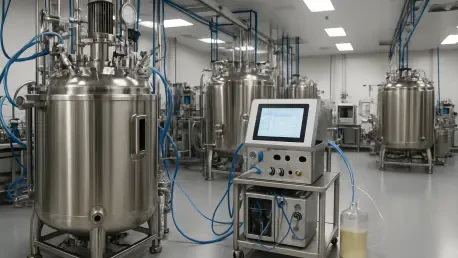

In an industry where the development of complex medicines is often hampered by logistical bottlenecks and fragmented supply chains, the inauguration of a massive new facility in Teesside represents a pivotal shift toward creating a more resilient and integrated global biomanufacturing ecosystem. Fujifilm Biotechnologies has officially opened what the company asserts is Britain’s largest single-use biopharmaceutical contract development and manufacturing organization (CDMO), marking the culmination of a £400 million investment designed to anchor the UK’s position in the global life sciences sector. This expansive site, now becoming operational, is not merely an addition of capacity but a cornerstone of a much broader strategy to redefine how advanced therapies are developed, produced, and delivered on a global scale. The facility is poised to address the escalating demand for small- and mid-scale antibody production, offering a sophisticated hub for partners seeking to navigate the complex journey from clinical development to commercial supply with greater speed, efficiency, and predictability.
A New Era of Advanced Biomanufacturing in the UK
Technological Prowess and Scalable Capacity
The newly operational 110,000-square-foot manufacturing facility in Teesside is engineered to set a new standard for flexibility and efficiency in biopharmaceutical production. At its core, the plant is equipped with state-of-the-art 2,000L and 5,000L single-use bioreactors, which collectively provide a substantial total capacity of up to 19,000L. This configuration is specifically tailored for the agile manufacturing of antibodies, a critical class of therapeutics. A key technological differentiator within the facility is the implementation of SymphonX, an internally developed and fully automated downstream purification system. This proprietary technology is engineered to streamline the traditionally complex and labor-intensive bioprocessing workflow, enhancing consistency and reducing the potential for human error. The integration of such advanced automation underscores a commitment to operational excellence and is expected to significantly accelerate production timelines for the company’s biopharmaceutical partners, allowing for more rapid progression from development to market.
The investment extends far beyond the production floor, fundamentally enhancing the site’s research and development capabilities through the establishment of the new Bioprocess Innovation Centre UK. This expansion doubles the facility’s existing laboratory footprint, creating what is now the largest multi-modality process development laboratory in the country. This center is designed to provide comprehensive, end-to-end support for clients, covering every stage from initial process development and optimization to full-scale commercial manufacturing. By co-locating world-class R&D with large-scale production, the Teesside site offers a seamless and integrated service model. This approach eliminates the logistical and communication challenges that can arise when development and manufacturing are handled at separate locations, thereby fostering a more collaborative and efficient pathway for bringing complex new medicines to patients. The center’s multi-modality focus also equips it to handle a diverse range of biologic products, positioning it as a versatile hub for innovation.
A Modular Blueprint for Global Production
The Teesside expansion is a central pillar of Fujifilm’s “KojoX” global network, an ambitious strategy built on a modular and highly standardized approach to biomanufacturing. The KojoX philosophy revolves around cloning facility designs, standardizing equipment platforms, and harmonizing quality and operational systems across all its major international locations. This meticulous standardization is the key to unlocking unprecedented levels of agility and predictability in a global manufacturing context. By creating facilities that are essentially operational replicas of one another, the company can facilitate remarkably fast production changeovers and seamless technology transfers between sites. For biopharmaceutical partners, this means their manufacturing processes can be scaled up or transferred across different regions with minimal friction, dramatically reducing timelines and de-risking the expansion of their supply chains.
This strategic model allows partners to grow their operations confidently, knowing that the processes validated at one KojoX site will perform identically at another, whether it be in Europe, Asia, or North America. The inherent flexibility of this network is designed to meet the dynamic needs of the biopharma industry, where demand can shift rapidly and the ability to pivot production is a significant competitive advantage. This standardized, modular blueprint moves away from the traditional, more rigid manufacturing paradigm, offering a forward-looking solution that prioritizes speed, consistency, and global scalability. The Teesside facility, therefore, functions not as an isolated plant but as a critical, interconnected node within a larger, intelligently designed manufacturing ecosystem, ready to support the next wave of biopharmaceutical innovation with a harmonized global footprint.
Forging a Resilient Global Supply Network
An Interconnected Ecosystem for Localized Supply
The overarching vision driving Fujifilm’s substantial global investment is the creation of a resilient, flexible, and fully integrated manufacturing ecosystem designed to weather the uncertainties of the modern world. By strategically linking its major facilities in Teesside, Toyama in Japan, Denmark, and Holly Springs in the United States, the company is building a powerful “local-for-local” supply chain. This model enables the production of medicines closer to the markets where they are needed, which significantly reduces logistical complexities, shortens delivery times, and strengthens supply chain security. This distributed network serves as a strategic hedge against the kind of supply chain volatility and geopolitical disruptions that have become increasingly common, ensuring that the production of essential medicines can continue uninterrupted. The ability to shift or duplicate production across this network provides an unparalleled level of operational resilience.
The Teesside facility is meticulously designed to operate in close alignment with the Toyama site, which serves as the company’s primary bio-CDMO hub in Asia. This deliberate synergy ensures rapid and efficient collaboration between the European and Asian nodes of the KojoX network, allowing for the swift transfer of projects and knowledge across continents. The extensive global investment, which has exceeded £5 billion in the last decade alone, highlights a profound and long-term commitment to revolutionizing the CDMO landscape. This forward-thinking strategy is not merely about adding capacity; it is about fundamentally re-architecting the global biomanufacturing infrastructure to be more responsive, robust, and capable of meeting the complex challenges of therapeutic development for the next 15 years and beyond.
Strategic Vision and Future Impact
The establishment of the Teesside facility and the broader KojoX network represented a calculated response to the evolving demands of the biopharmaceutical industry. The strategic decision to build a globally harmonized system was aimed at providing clients with a level of manufacturing predictability and scalability that was previously difficult to achieve. By standardizing everything from facility layouts to quality control protocols, the network was designed to eliminate the variables that often complicated technology transfers and scale-up activities. This approach was intended to empower partners, particularly emerging biotech firms, by giving them access to a global production infrastructure without requiring them to build their own. The interconnectedness of the sites in the UK, US, Japan, and Denmark created a robust framework that could absorb regional shocks and adapt to shifting market needs, ensuring a continuous supply of vital medicines.
This initiative ultimately reshaped the competitive landscape of the CDMO sector. The “local-for-local” production model not only enhanced supply chain resilience but also offered environmental and economic benefits by reducing the need for long-distance shipping of sensitive biological materials. The significant capital outlay underscored a deep confidence in the future of biologic therapies and a commitment to providing the foundational infrastructure necessary for their success. The Teesside facility, in concert with its global counterparts, successfully established a new paradigm for contract manufacturing—one defined by agility, global integration, and unwavering quality. This network became a critical enabler for the development and commercialization of next-generation therapies, cementing a legacy of innovation and reliability in the life sciences industry.