
The intricate, monolithic metal components powering rockets and deep-sea drilling rigs are often manufactured using methods that defy traditional assembly, raising the question of how such singular, complex structures are brought into existence. The answer lies not on a desktop or in a small workshop but on a factory floor, where additive manufacturing has evolved into a colossal industrial process. This technology moves beyond prototyping to become a primary production method for some of the world’s most demanding applications.
When 3D Printing Demands a Factory Floor
The transition from small-scale additive manufacturing to industrial production represents a fundamental shift in both scale and complexity. Unlike desktop printers, industrial systems are engineered to operate within a highly controlled manufacturing ecosystem, producing parts that must meet stringent certification standards for safety and performance. This level of production is necessary for creating single, massive metal parts that would otherwise require multiple smaller pieces to be welded together, a process that can introduce structural weaknesses.
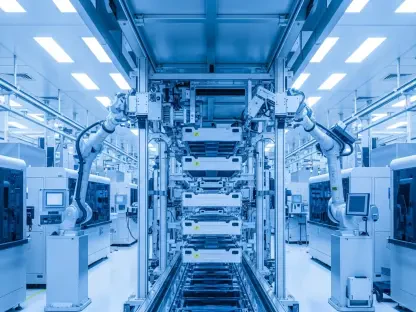
These industrial machines are not standalone units but the centerpiece of a comprehensive workflow. They require significant infrastructure for material handling, post-processing, and quality assurance. The goal is no longer just creating a physical object from a digital file; it is about establishing a repeatable, reliable, and scalable production line for mission-critical components, fundamentally changing how industries approach the fabrication of large, complex metal structures.
How Large-Format Metal Printing Is Reshaping Heavy Industry
The relentless drive to produce larger, stronger, and more intricate components is pushing traditional manufacturing to its operational limits. In response, key sectors like aerospace, oil and gas, and energy are increasingly turning toward large-format metal additive manufacturing. These industries require a faster, more cost-effective pathway to serial production for high-integrity parts, a need that conventional methods like casting or forging often cannot meet without significant time and tooling investments.
This technological adoption is reshaping supply chains and design possibilities. Additive manufacturing enables the creation of parts with complex internal geometries for improved performance, such as integrated cooling channels in rocket engine components or optimized flow paths in industrial valves. By consolidating multi-part assemblies into a single printed component, companies can reduce weight, eliminate potential points of failure, and streamline production, gaining a significant competitive advantage.
The Anatomy of a Metal Printing Titan
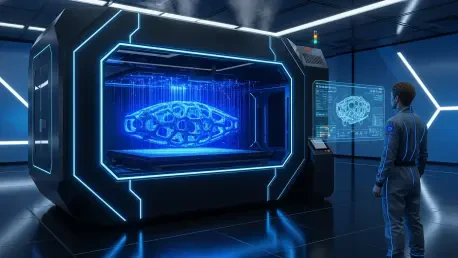
At the heart of this industrial shift are machines like Farsoon’s FS1211M, which exemplify the engineering required for large-scale production. Its immense build envelope, measuring 1,330 by 700 by 1,700 millimeters, is specifically designed to accommodate the large components needed in heavy industry. This volume allows for the creation of singular, massive parts without the need for assembly, preserving structural integrity and simplifying the manufacturing process for parts that can be meters in length.
Powering this production is a configurable system of up to sixteen 500-watt fiber lasers working in unison. This multi-laser array, guided by high-speed galvo systems, achieves production yields of up to 400 cubic centimeters per hour, transforming metal powder into dense, solid parts with remarkable speed. To overcome the common challenge of maintaining quality across such a large build area, the system employs an advanced chamber airflow system. Developed through extensive simulation, this feature creates a stable processing environment, ensuring consistent mechanical properties and high-quality surface finishes from one edge of the build plate to the other.
An Integrated Workflow Beyond the Print
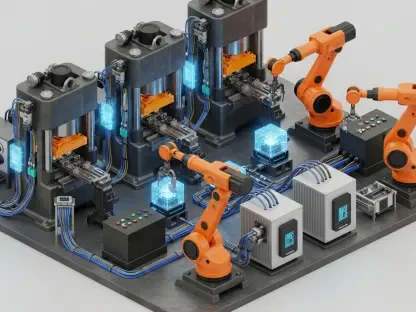
True industrial-scale production requires more than just a fast printer; it demands a seamless, integrated workflow from start to finish. The FS1211M is designed as a three-station production cell dedicated to building, part breakout, and powder extraction. An internal conveyor system automates the movement of builds between these stations, minimizing manual intervention and maximizing operational uptime, which is critical for a factory setting.
Material management is equally crucial for continuous operation. The system features a continuous powder supply that uses modular containers for loading, recycling, and sieving, all performed under the protection of an inert gas atmosphere to preserve material quality. This closed-loop process enhances efficiency and reduces waste. Furthermore, a permanent filtration system enables the long, uninterrupted build times necessary to produce massive parts, ensuring the machine can run for days on end without interruption, a prerequisite for industrial manufacturing.
The Advantage of an Open Platform
A defining characteristic of advanced systems like the FS1211M is the commitment to an open platform philosophy, which places control directly into the hands of the user. This approach contrasts with closed ecosystems that restrict users to proprietary materials and software. By providing an open architecture, manufacturers empower their customers to define their own success by fine-tuning every aspect of the manufacturing process.
This user-defined flexibility is critical for application-specific innovation. It grants engineers the freedom to tailor process parameters, experiment with a wide range of metal powders from different suppliers, and integrate third-party software to optimize their unique production needs. This empowerment accelerates development cycles and allows companies to develop proprietary processes that give them a distinct edge in their respective markets.
The development of integrated, large-format metal additive systems marked a significant turning point for heavy industry. It demonstrated that complex, monolithic components could be produced with unprecedented speed and design freedom, which fundamentally altered production strategies in critical sectors. This evolution moved the technology beyond the realm of possibility and established it as a practical, powerful tool that redefined the boundaries of modern manufacturing.