
The Unseen Epidemic: How Cybercrime Is Crippling Main Street
The digital landscape of 2025 was marked by an alarming trend: a staggering 45 percent surge in ransomware incidents, with a record-breaking spike during the holiday season. While major corporations often grab headlines, the data reveals a more insidious truth—the primary victims are the small and medium-sized businesses (SMBs) that form the backbone of the economy. These organizations are caught in the crosshairs of a sophisticated and relentless criminal ecosystem. This article will dissect why SMBs have become the preferred target for cybercriminals, exploring the specific vulnerabilities they face, the dynamics of the ever-evolving ransomware market, and the crucial defensive strategies they must adopt to survive this escalating threat.
From Niche Threat to Global Enterprise: The Evolution of Ransomware
To understand the current crisis, it is essential to recognize how ransomware has transformed from a fringe nuisance into a multi-billion-dollar criminal industry. Early ransomware attacks were often opportunistic and unsophisticated; however, the game changed with the advent of Ransomware-as-a-Service (RaaS). This model mirrors legitimate software-as-a-service platforms, where ransomware developers lease their malicious code to affiliates in exchange for a share of the profits. This development democratized cybercrime, lowering the barrier to entry and allowing less-skilled actors to launch sophisticated attacks at scale. The RaaS ecosystem created a competitive marketplace, driving innovation in attack methods and making it easier than ever for criminals to find and exploit vulnerable targets, a category that SMBs unfortunately dominate.
Anatomy of a Prime Target: The Factors Fueling SMB Attacks
The Perfect Storm: Limited Resources and High Stakes
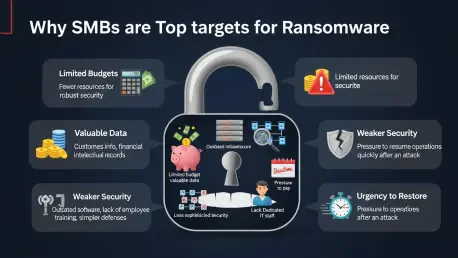
SMBs represent a “perfect” target for ransomware groups due to a dangerous combination of financial value and inadequate defense. Unlike large enterprises with dedicated security teams and multi-million-dollar budgets, most SMBs operate with limited IT resources and often lack any specialized cybersecurity staff. Their defenses typically consist of basic antivirus software and a firewall, leaving them exposed to modern, multi-stage attacks. Furthermore, they frequently run on outdated software and unpatched systems, creating easily exploitable entry points. Attackers know that a successful breach can be catastrophic for an SMB, paralyzing its operations. This creates immense pressure to pay the ransom quickly to avoid bankruptcy, making them a more reliable source of income for cybercriminals than a well-fortified corporation.
A Case Study in Vulnerability: Why the Manufacturing Sector Is in the Crosshairs
The manufacturing sector serves as a stark example of this vulnerability. According to 2025 data, manufacturers with up to 200 employees and $25 million in revenue were the most heavily targeted. This sub-sector strikes an ideal balance for attackers: it is large enough to afford a substantial ransom but too small to have implemented robust security protocols. The interconnected nature of modern manufacturing environments, where IT networks converge with operational technology (OT) systems that control physical machinery, creates a vast attack surface. A single compromise can spread laterally, shutting down an entire production line. The cost of this downtime is often far greater than the ransom demand, making these businesses exceptionally likely to pay for the decryption key to restore operations.
A Thriving Criminal Market: The Prolific Rise of RaaS Groups
The threat is amplified by a dynamic and highly competitive RaaS landscape. In 2025, the number of active ransomware groups grew by 30 percent, with 134 distinct organizations competing for victims. Groups like Qilin, whose activity soared by an astonishing 408 percent, and the resurgent Cl0p demonstrated the agility of this criminal market. When law enforcement successfully disrupted the once-dominant LockBit group, its affiliates simply migrated to other RaaS platforms offering better tools, support, and profit-sharing models. This fluid ecosystem ensures that even when one major player falls, dozens of others are ready to take its place, constantly hunting for the path of least resistance—which almost always leads to an unprepared SMB.
The Next Frontier: What the Future Holds for Ransomware Threats
The trends observed in 2025 signal a challenging future. The RaaS model will continue to mature, with attackers leveraging artificial intelligence to automate target discovery and craft more convincing phishing campaigns. As businesses further integrate digital technologies, the attack surface will only expand, presenting new opportunities for criminals. We can expect to see more specialized ransomware groups targeting specific industries with tailored malware. While law enforcement takedowns will cause temporary disruptions, the decentralized and resilient nature of the RaaS ecosystem means the overall threat will likely intensify, placing even greater pressure on SMBs to evolve their defensive posture or risk becoming another statistic.
Building a Digital Fortress: Actionable Strategies for SMBs
Despite the grim outlook, SMBs are not defenseless. The key to survival lies in shifting from a reactive to a proactive security posture. Implementing fundamental security hygiene is the most critical first step. This includes consistently patching and updating all software, enforcing strong and unique passwords, and enabling multi-factor authentication (MFA) across all accounts. Adopting a zero-trust mindset—where no user or device is trusted by default—can drastically limit an attacker’s ability to move laterally within a network. Furthermore, investing in proactive threat intelligence helps identify emerging threats and indicators of compromise before an attack succeeds. Finally, a well-rehearsed incident response plan, combined with regular, offline data backups, is essential for ensuring business continuity and minimizing damage if the worst happens.
The Bottom Line: Cybersecurity Is No Longer an Option, It’s a Necessity
The data is unequivocal: SMBs are the top target for ransomware because they are perceived as easy, profitable victims. Caught between possessing valuable data and lacking enterprise-grade defenses, they occupy a dangerous middle ground that cybercriminals are ruthlessly exploiting. The rise of the sophisticated RaaS ecosystem has industrialized this threat, making attacks more frequent and effective than ever. For small and medium-sized businesses, the message is clear: cybersecurity can no longer be treated as an IT expense but must be embraced as a core business function, essential for survival in the modern digital economy. The time to act is now, before the digital locks are engaged and the ransom demand arrives.