
In a striking display of counter-cyclical strategy, the EGGER Group is leveraging a period of global economic uncertainty and subdued market activity to aggressively fund its long-term growth and sustainability ambitions. The family-owned company reported a stable business development for the first half of the 2025/2026 financial year, achieving consolidated revenues of EUR 2.15 billion, a modest 2.6% increase over the previous year. While facing significant headwinds from weakened consumer spending and a sluggish construction sector, management has interpreted this stability not as a signal for caution but as a solid foundation for the future. Attributing this resilience to the commitment of its 12,000 employees, the company is moving forward with targeted, substantial investments, viewing the current challenging phase as an opportunity to build a stronger, more innovative, and sustainable enterprise poised to lead when the market inevitably recovers.
Navigating the Economic Headwinds
A Picture of Financial Resilience
A detailed examination of the company’s financial metrics reveals a strategy prioritizing long-term strength over short-term profitability. While revenues saw a slight increase, Earnings Before Interest, Taxes, Depreciation, and Amortization (EBITDA) decreased by 8.4% to EUR 293.3 million, resulting in an EBITDA margin of 13.7%. This pressure on profitability, however, is balanced by the company’s robust financial health, which is underscored by a high equity ratio of 41.5%. This strong financial footing is the bedrock of its capacity for continued investment, providing a critical buffer against market volatility and ensuring the availability of capital for strategic projects. This approach demonstrates a deliberate choice to absorb temporary margin compression in order to fund initiatives that will yield significant competitive advantages in the years to come, securing its position for future growth cycles.
The Group’s performance was not uniform across its global footprint, with regional diversification proving to be a key stabilizing factor. Markets in Eastern Europe and overseas delivered positive development, serving as a valuable counterbalance to the more difficult conditions encountered elsewhere. In stark contrast, the core markets of Western and Central Europe were defined by intense competition within a weakened economic environment. In these regions, the company had to rely heavily on its operational efficiency and innovative strength to maintain its market position and navigate the prevailing pressures. This geographical balance highlights the strategic benefit of a broad international presence, as stronger performing regions can help sustain the overall business and support continued investment across the entire group, even in areas experiencing a temporary downturn.
Facing Pressure Across Business Divisions
The company’s largest division, Decorative Products for Furniture and Interior Design, achieved unconsolidated revenues of EUR 1,907.8 million, reflecting the group’s overall growth with a 2.6% increase. This marginal rise was attributed to a balanced combination of modest volume and price increases distributed evenly across its operating regions. However, the division’s profitability, as measured by EBITDA, fell below the previous year’s figure. This decline was primarily linked to the weaker performance and heightened competitive pressures experienced in the mature Western European markets. The results from this segment illustrate the core challenge facing the company: converting top-line stability into bottom-line growth in an environment where intense competition erodes margins, reinforcing the need for continuous innovation and efficiency gains to protect profitability.
The Wood Construction and Flooring product area generated unconsolidated sales of EUR 365.1 million, posting a slightly stronger growth rate of 4.0% compared to the decorative division. Despite this increase in sales, the report explicitly states that the earnings situation in this segment remains “extremely tense.” The primary driver of this pressure was particularly weak demand in the flooring segment, which is closely tied to new construction activity. The significant downturn in new builds heavily impacted the division, and while the more stable renovation market provided some relief, it was not sufficient to fully offset the decline. This segment’s performance serves as a direct barometer for the health of the construction industry, demonstrating how macroeconomic trends can profoundly affect specific product areas, even when overall group revenue remains stable.
Building a Foundation for Future Growth
Doubling Down on Strategic Investments
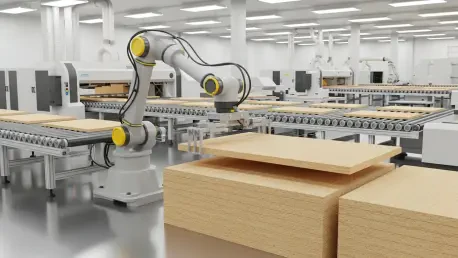
In a clear demonstration of its long-term vision, EGGER significantly increased its investment activities during the economic slowdown, with total investments reaching EUR 248.6 million in the first half of the year, a notable increase from EUR 218.4 million in the same period of the previous year. These funds were strategically directed toward both capacity expansion and critical sustainability projects. The flagship initiative is a major, multi-stage project at the Markt Bibart plant in Germany, which is described as one of the largest investment projects in the entire industry. The company is investing over EUR 200 million in this single facility for comprehensive sustainability upgrades and advanced automation, with completion slated for 2026. This massive capital expenditure during a challenging phase underscores a profound confidence in future market demand and a commitment to emerging from the downturn with a technologically superior and more efficient production base.
The project at Markt Bibart is already achieving key milestones that advance the company’s circular economy goals. In autumn 2025, the facility began the gradual commissioning of a new processing facility for recycled wood, a crucial step that will enable the use of post-consumer wood in particleboard production, thereby reducing reliance on virgin resources. This investment in circularity is complemented by an expansion of the plant’s upgrading capacities. A new short-cycle press is scheduled to begin producing laminated particleboard in early 2026, which will broaden the facility’s product offerings and enhance its value-add capabilities. These concurrent investments in both sustainability and production technology are designed to create a highly efficient, environmentally responsible manufacturing hub that will set new industry standards.
Expanding the Commitment to Sustainability
EGGER’s commitment to a sustainable future was not confined to a single flagship project but was evident in a series of coordinated investments across its network. The company expanded its Timberpak recycling collection sites, which are essential for sourcing the raw material needed for its circular production processes. Simultaneously, it enhanced recycled wood processing capabilities at several other plants, ensuring that the push toward greater use of recycled content is a group-wide effort. This distributed approach embeds sustainability into the core operations of multiple facilities rather than isolating it as a specialized initiative. By building a more robust and integrated recycling infrastructure, the company is systematically reducing its environmental footprint and strengthening its long-term resource security in a world of increasing material scarcity.
Further reinforcing its sustainability strategy, significant progress is being made on the construction of a second biomass power plant at the company’s headquarters in St. Johann in Tirol, Austria. This major energy project will substantially increase its supply of renewable energy derived from biogenic fuels, primarily residual wood from its own production processes. This investment serves a dual strategic purpose. Environmentally, it reduces the company’s carbon footprint and reliance on fossil fuels. Economically, it provides a crucial hedge against volatile energy markets by creating a self-sufficient, cost-stable power source. This move toward energy independence is a forward-thinking measure that will enhance operational resilience and provide a significant long-term competitive advantage.
A Strategic Position for the Next Upturn
Looking toward a market recovery, EGGER is proactively preparing to stimulate demand with the upcoming launch of its new EGGER Decorative Collection 26+ in February 2026. This updated collection is a central element of its strategy to provide added value to customers and re-energize the market. It will feature over 360 decor and texture combinations, alongside innovations in products and surfaces, all supported by a suite of enhanced digital services. The collection is designed to respond flexibly to current market trends and evolving customer needs while offering planning security through a globally standardized portfolio. This initiative shows that the company is not passively waiting for economic conditions to improve but is actively investing in product development to lead the industry and capture market share when demand returns.
Despite maintaining a reserved outlook for the second half of the fiscal year due to persistent price pressure and weak demand, the company’s strategic actions in the first six months established a formidable competitive position. The thoughtful balance of maintaining a solid financial foundation while simultaneously pursuing aggressive, future-oriented investments in sustainability and capacity laid the groundwork for long-term success. This counter-cyclical approach, combined with proactive product innovation, demonstrated a clear strategy that went beyond mere survival of the downturn. It ultimately placed the company in an ideal position to capitalize on the next economic upturn, equipped with modernized facilities, a secure renewable energy supply, and a compelling product portfolio.