
The boundary between large-scale architecture and the intimate objects we interact with daily is becoming increasingly blurred, a shift masterfully navigated by Zaha Hadid Architects (ZHA). Under the guidance of Patrik Schumacher, the firm has recently garnered significant acclaim, securing three prestigious 2025 Good Design Awards for its latest forays into indoor and outdoor furniture. This recognition is not merely for creating aesthetically pleasing objects, but for a deeper, more resonant achievement: the successful translation of nature’s complex, organic language into functional, sculptural pieces. In collaboration with leading European manufacturers, ZHA has demonstrated a unique ability to capture the essence of natural phenomena, from the gentle contours of a landscape to the powerful forces of erosion, and embed it within furniture that redefines modern living spaces. This approach, which marries avant-garde design with a profound respect for the natural world, is setting a new benchmark in the industry and answers the question of why their work continues to captivate award juries and consumers alike.
The Synthesis of Organic Form and Function
A core philosophy driving the success of ZHA’s product design is the seamless integration of natural inspiration with practical utility, a principle vividly embodied in the TOPOS collection for the Spanish brand iSiMAR. This outdoor furniture line, featuring chairs and a chaise-longue, draws its essence from the fluid, rolling landscapes of the Mediterranean. The design eschews rigid angles in favor of continuous, flowing lines that mimic the region’s organic contours, creating a sense of harmony between the object and its environment. Crafted from galvanized steel rods, the collection not only utilizes a fully recyclable material but also employs an eco-conscious production method that bypasses the need for molds, reducing waste and enhancing its sustainable credentials. This approach results in a timeless adaptability that feels both modern and elemental. In a similar vein, the Minera table, a collaboration with the Italian company Neutra, explores a different facet of nature. Carved from a single, monumental block of Carrara marble, the dining table is a testament to the intersection of natural erosion processes and the precision of contemporary manufacturing, resulting in a piece that functions as a gathering place for eight while standing as a powerful geological sculpture.
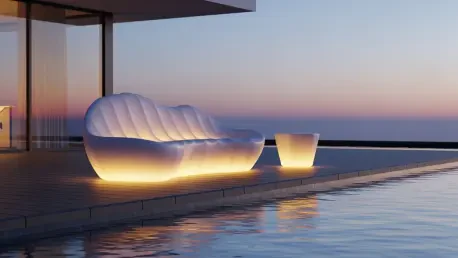
Further exemplifying this design ethos is the Ripple outdoor sofa and side table created for the Italian manufacturer Serralunga, a collection defined by its palpable sense of movement and fluidity. The ensemble’s undulating forms are directly inspired by the gentle, rhythmic motion of a wave reaching the shore, with the larger scale and energy of the sofa gracefully diminishing as it transitions into the more compact form of the accompanying side table. This creates a cohesive visual narrative that feels both dynamic and serene. The choice of material, a weather-resistant and recyclable polyethylene, ensures durability for outdoor use while allowing for the creation of its complex, flowing shape. A particularly innovative feature is the integrated lighting concealed within the sofa’s base, which transforms the piece after dark. This illumination enhances its sculptural quality, casting a soft glow that highlights its wavelike contours and turns a functional seating arrangement into a striking landscape feature. The design encourages versatile lounging configurations, further blurring the line between furniture and art by creating an interactive and visually engaging experience that adapts to its surroundings day and night.
A Commitment to Materiality and Sustainability
The acclaim for ZHA’s furniture is deeply rooted in a sophisticated and deliberate approach to materiality, where the choice of substance is as crucial as the form itself. Each award-winning collection showcases a unique material selected to enhance its specific design narrative and functional requirements while adhering to principles of sustainability. For the TOPOS collection, the use of galvanized steel rods provides the perfect medium for achieving its light, skeletal structure and flowing lines, all while being a durable and infinitely recyclable resource. In stark contrast, the Minera table’s use of solid Carrara marble lends it a sense of permanence and monumental beauty, celebrating the raw, unique character of natural stone. Meanwhile, the Ripple collection leverages the versatility of recyclable polyethylene, a material that allows for the creation of its complex, undulating forms and is robust enough to withstand the elements. This thoughtful curation of materials demonstrates that the firm’s commitment to nature extends beyond mere aesthetic imitation; it is about choosing resources that are sustainable, appropriate for their intended use, and integral to the story the final piece tells, a crucial consideration for contemporary design excellence.
Beyond the inherent qualities of the materials, the innovative manufacturing processes employed by ZHA are central to realizing their ambitious, nature-inspired visions. The firm consistently pushes the boundaries of fabrication to translate complex digital models into tangible, high-quality objects. The production of the TOPOS collection, for example, highlights a move away from traditional, wasteful methods by using precisely bent steel rods, which eliminates the need for energy-intensive molds. This technique not only aligns with sustainable practices but also enables the creation of its intricate, airy forms. Similarly, the Minera table represents a masterful fusion of natural material and advanced technology. The process of carving a single block of marble to achieve such a continuous, fluid form requires sophisticated digital milling and hand-finishing, a dialogue between machine precision and artisanal craft. This synthesis of cutting-edge technology and a deep understanding of material properties allows ZHA to achieve a level of formal complexity and refinement that was previously unattainable, elevating functional furniture into works of sculptural art that are both innovative and enduring.
The Enduring Legacy of Biophilic Design
The recognition bestowed upon these collections underscored a pivotal shift in contemporary design, where the principles of biophilia—humanity’s innate connection to nature—were no longer a niche interest but a central tenet of innovation. Zaha Hadid Architects’ work in furniture design served as a powerful case study in how abstract architectural concepts and organic forms could be successfully translated into objects of a more intimate, human scale. The success of the TOPOS, Minera, and Ripple collections was built on a foundation of three interconnected pillars: a deep-seated inspiration drawn from natural phenomena, a rigorous commitment to sustainable and thoughtfully chosen materials, and the application of advanced manufacturing techniques to realize forms of unprecedented complexity. These projects demonstrated that furniture could transcend mere functionality to become an artistic statement that enhances a user’s connection to the natural world, even within an urban or domestic setting. Ultimately, these award-winning designs left an indelible mark by proving that the future of design lay not in sterile minimalism, but in a rich, dynamic, and sustainable dialogue with nature itself.