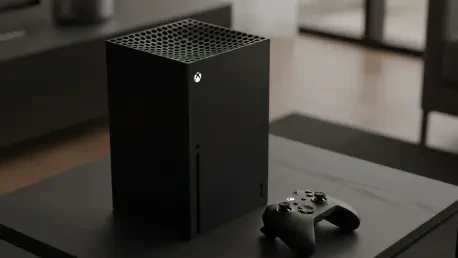

The European gaming landscape has been fundamentally altered by a sudden and dramatic shift in hardware pricing that contradicts decades of consumer electronics trends. For years, the industry operated on the reliable assumption that as a console generation matured, manufacturing efficiencies and technological scaling would lead to lower prices for the end user. However, Microsoft has upended this expectation by implementing substantial price increases for the Xbox Series X and Series S across the United Kingdom and the Eurozone. This departure from the traditional lifecycle model is not merely a reaction to regional inflation but a direct consequence of a global scramble for advanced silicon components. As technology giants pivot their focus toward large-scale machine learning and generative systems, the hardware required to render high-fidelity games is being diverted to data centers. This competition has created a bottleneck where the gaming community finds itself at odds with the most well-funded sectors of the global tech economy, signaling a new era of hardware scarcity.
Market Impact: The Rising Cost of Virtual Worlds
The scale of the recent price adjustments has left many potential buyers reconsidering their investment in the Microsoft ecosystem, particularly regarding the entry-level Xbox Series S. Originally marketed as an accessible portal to next-generation gaming, the 512GB version of the Series S has seen its retail price climb by over 43% in certain territories, now frequently listed near the €500 mark. This is a staggering increase for a device that was once celebrated for its sub-€300 price point during its initial years on the market. Similarly, the flagship Xbox Series X has seen its cost adjusted upward to levels that exceed the launch prices of nearly every major home console released in the last few decades. These changes represent more than just a minor adjustment; they reflect a total recalibration of how Microsoft values its hardware inventory in a market where every chip is precious. Such aggressive pricing risks alienating the very demographic that the Xbox brand spent years courting with value-driven subscriptions and hardware.
The primary driver behind these rising costs is a structural shift in the global semiconductor market, where traditional consumer electronics are being outbid by the burgeoning artificial intelligence sector. High-performance gaming consoles like the Xbox Series X rely on the same high-bandwidth GDDR6 memory and lightning-fast NVMe storage solutions that are currently in high demand for training advanced neural networks. Companies such as Nvidia and OpenAI are purchasing these components in massive quantities to fuel their expanding data center footprints, effectively creating a scarcity that drives up procurement costs for everyone else. Unlike legacy systems like the Nintendo Switch, which utilize older and more abundant hardware architectures, the Xbox series is built on cutting-edge silicon that is now a critical resource for the AI boom. Microsoft is essentially forced to pay a premium to secure the components necessary to keep its assembly lines moving, a cost that is inevitably passed down to the European consumer through these recent price hikes.
Strategic Consequences: Navigating a Resource-Constrained Era
This sharp rise in hardware pricing threatens to destabilize Microsoft’s long-term business strategy, which has historically utilized consoles as low-margin gateways to its lucrative Game Pass service. For years, the goal was to get an Xbox into as many homes as possible to ensure a steady stream of recurring subscription revenue and digital software sales. With the hardware now positioned as a premium luxury item rather than an affordable household appliance, the barrier to entry has become significantly higher for casual players and budget-conscious families. This friction could drive a significant portion of the audience toward alternative platforms, such as cloud gaming services that do not require dedicated local hardware. Furthermore, as the cost of ownership increases, the perceived value of a subscription-only model may begin to wane for users who can no longer justify the initial hardware investment. The era of the “loss-leader” console appears to be under threat as manufacturing costs collide with the reality of finite global production capacity.
The market eventually adjusted to these new realities as manufacturers sought alternative pathways to deliver high-quality experiences without relying on increasingly expensive local components. Microsoft and its competitors shifted their focus toward the expansion of robust cloud-based infrastructure and local optimization techniques to mitigate the need for the most expensive physical hardware. Investors and consumers alike recognized that the era of subsidized consoles required a new approach to sustainability, leading to the development of more modular and upgradeable systems that reduced long-term electronic waste. Microsoft focused on refining software efficiency to ensure that existing hardware could remain viable for longer periods, rather than pushing for frequent and costly hardware refreshes. This transition encouraged a more resilient gaming ecosystem where software innovation took precedence over the raw power of the underlying silicon. By prioritizing long-term hardware longevity, the industry successfully maintained accessibility for the broader gaming public.