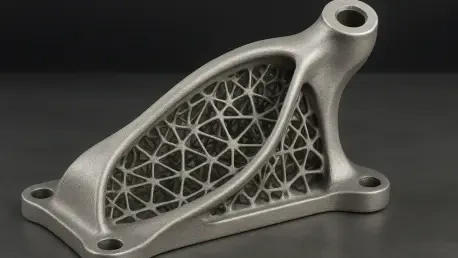

The economic benefits of using iron are substantial, as it provides a low-cost alternative to expensive alloying elements like vanadium and molybdenum. This shifts the strategic focus toward sustainable and accessible manufacturing for high-performance flight hardware in the modern era. In the high-stakes environment of aerospace engineering, the demand for materials that offer a superior strength-to-weight ratio is constant, especially for critical structural components like landing gear and airframe supports. Currently, the industry relies heavily on the near-beta titanium alloy Ti-5Al-5Mo-5V-3Cr, commonly known as Ti5553, because of its exceptional mechanical properties and toughness. However, as manufacturers increasingly adopt additive manufacturing techniques such as laser powder bed fusion to create complex geometries, they face significant metallurgical hurdles. The rapid cooling rates inherent in 3D printing often lead to internal inconsistencies that can compromise safety. Researchers are exploring how trace amounts of iron can act as a stabilizing agent to solve these issues.
Tackling Grain Growth and Structural Inconsistency
One of the most persistent issues in laser powder bed fusion is the formation of tall, columnar grains that align with the direction of the laser’s movement during the build process. This phenomenon leads to a condition called anisotropy, where the mechanical properties of the printed part vary depending on the direction of the applied load. For aerospace parts that experience multi-directional stress during takeoff and landing, this lack of structural uniformity presents a major barrier to wider adoption. Traditionally, engineers have relied on expensive post-processing techniques, such as hot isostatic pressing or complex thermal cycles, to break up these elongated grains and restore material isotropy. However, these methods add significant time and cost to production schedules. By introducing chemical modifications at the melt-pool level, the industry is seeking a more efficient way to ensure that printed titanium components possess the same reliability and predictable behavior as their forged counterparts, regardless of the build orientation.
Iron serves as an exceptionally potent growth restrictor during the rapid solidification of the melted titanium powder within the LPBF system. As the high-energy laser melts the metal, iron atoms naturally segregate at the advancing solidification front, creating a physical barrier that prevents the grains from growing into the long, column-like structures typically seen in standard Ti5553. Recent experimental data revealed that the addition of just 1.5% iron by weight could reduce the width of these internal grains by nearly half, shifting the microstructure from a vulnerable directional architecture to a more stable, equiaxed configuration. This refinement is crucial because finer grains provide a greater density of grain boundaries, which essentially serve as obstacles to dislocation movement. By controlling the microstructural evolution during the printing phase itself, engineers can produce parts with higher baseline integrity, reducing the reliance on secondary treatments and allowing for more complex, lightweight designs that were previously considered too risky.
Breaking the Traditional Strength-Ductility Trade-off
In the fundamental science of metallurgy, there is a well-known seesaw effect between a material’s strength and its ductility: usually, as a metal becomes harder, it also becomes more brittle and prone to cracking. This trade-off often limits the performance of 3D-printed alloys, as the internal stresses generated during the printing process can lead to failure if the material lacks sufficient stretch. However, the iron-modified Ti5553 alloy has demonstrated a remarkable ability to defy this conventional rule when examined in its as-built state. By significantly refining the grain size through chemical doping, iron creates a microscopic environment where the material can resist deformation more effectively without sacrificing its ability to undergo plastic deformation before breaking. This dual improvement is a rare achievement in additive manufacturing research, offering a pathway toward materials that are both incredibly tough and highly resilient under the extreme mechanical conditions found in modern aerospace applications.
Quantitative testing of the 1.5% iron-modified Ti5553 variant showed a dramatic jump in yield strength, rising from the standard 828 megapascals to an impressive 1000 megapascals in the as-printed condition. Remarkably, while the strength increased by nearly twenty percent, the elongation rate—a measure of how much the metal can stretch—remained remarkably high at approximately 19 percent. This balance is highly sought after by designers because it means that parts are less likely to experience catastrophic failure during the cooling phase of the manufacturing cycle or during early-stage handling. The 1.5% concentration appears to be an ideal “sweet spot” for chemical modification, providing the maximum mechanical boost while maintaining the ductility necessary for structural safety. This breakthrough allows for the production of titanium components that are not only stronger but also more reliable from the moment they are removed from the print bed, simplifying the logistics of manufacturing critical flight-ready hardware for commercial and defense use.
The Challenges of Heat Treatment and Brittleness
To achieve the extreme performance levels required for heavy-duty aerospace applications, titanium alloys usually must undergo a rigorous secondary process involving solution treatment and aging. This two-step heat treatment is designed to precipitate fine alpha-phase particles within the beta matrix, significantly hardening the metal and increasing its overall load-bearing capacity. When the iron-modified Ti5553 was subjected to these standard heat treatments, the results were both impressive and challenging. The alloy reached a staggering yield strength of over 1400 megapascals, significantly outperforming the base version of the material. However, this massive increase in strength came at a steep cost to the material’s ductility, which dropped significantly during the aging process. This discovery revealed that while iron is a powerful ally during the initial printing phase, its presence changes how the material reacts to high temperatures, requiring a new approach to post-print processing to prevent the titanium from becoming too brittle for safe use.
Microscopic analysis identified the primary cause of this increased brittleness as a phenomenon known as “grain-boundary alpha.” This refers to a soft phase of titanium that tends to form thin, continuous films along the boundaries between individual metal grains during the heat treatment process. Because the addition of iron creates a much finer grain structure with a higher total area of boundaries, it inadvertently provides more surface area for these soft alpha films to develop into a connected network. Under high stress, cracks can travel easily along these thin films, leading to premature failure despite the high overall strength of the metal matrix. This specific challenge highlights the complexity of alloy design, where solving one problem often creates another. Addressing this issue will require the development of specialized, non-standard heat treatment schedules that are specifically tuned to iron-doped titanium, ensuring that the strength gains are preserved while preventing the formation of these brittle boundary networks that could compromise the component’s long-term toughness.
Identifying the Limits of Chemical Modification
Although the benefits of iron are clear at low concentrations, there is a distinct limit to how much of this element can be safely integrated into the titanium powder before the quality of the final part begins to suffer. Researchers observed a “printability cliff” when the iron content was increased beyond the 1.5% threshold. At a concentration of 2.25%, the rate of defective parts skyrocketed to nearly 69%, a level that is completely unacceptable for industrial production. These failures were primarily driven by “lack-of-fusion” errors and hot cracking, which occur when the liquid metal pool does not bond correctly with the previous layer or when the material fractures during the cooling process. This suggests that too much iron fundamentally alters the thermal behavior of the melt pool, changing its viscosity or surface tension to a degree that makes the laser powder bed fusion process unstable. Consequently, precise control over the chemical composition of the initial powder is essential to avoid these catastrophic manufacturing defects.
The strengthening of the iron-modified Ti5553 is driven by two primary mechanisms: solid-solution strengthening and grain refinement. In solid-solution strengthening, the iron atoms dissolve directly into the titanium’s crystal lattice, creating localized distortions that make it much harder for dislocations to move through the material under pressure. Simultaneously, the refinement of the grain size—also known as the Hall-Petch effect—increases the number of barriers that prevent deformation across the entire structure. From an economic and industrial perspective, using iron as a primary dopant is highly attractive because it is significantly cheaper and more abundant than traditional stabilizers like vanadium or molybdenum. By replacing a portion of these more expensive elements with small, precise doses of iron, manufacturers could potentially lower the production costs of high-performance titanium powders while simultaneously achieving better mechanical properties. This transition would bring 3D-printed titanium closer to meeting the rigorous certification standards required by global aviation authorities for primary airframe structures.
Future Pathways for Aerospace Material Certification
The investigation into iron-modified Ti5553 provided a clear scientific framework for enhancing the performance of additive manufacturing in the aerospace sector. By identifying the specific concentration of 1.5% iron as the optimal balance for strength and ductility, the research established a baseline for future material development. Engineers realized that chemical modification could directly address the problem of anisotropy, making 3D-printed parts more predictable and reducing the need for expensive secondary processing. The study also highlighted the critical importance of tailoring heat treatments to the specific chemistry of the alloy, rather than relying on legacy protocols designed for forged materials. As the industry moved forward, the focus shifted toward optimizing these thermal cycles to mitigate the risks of brittleness caused by grain-boundary alpha phases. These findings suggested that a more nuanced approach to alloy design, combining chemical “doping” with customized post-processing, was the most viable path toward the large-scale adoption of 3D-printed titanium in safety-critical flight applications.