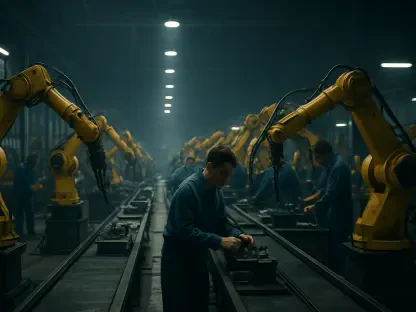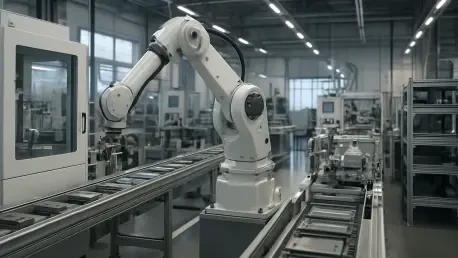

Autonomous manufacturing AI acts as the central brain of a facility by predicting outcomes and independently adjusting operating conditions to optimize overall performance. This technological evolution marks a definitive departure from the era of static automation, where machines merely followed rigid instructions without understanding the broader context of the production environment. Today, the focus has moved beyond simple robotic arms performing repetitive motions toward an intelligent infrastructure that can perceive, reason, and act. The modern factory is no longer just a collection of hardware; it is a living ecosystem where artificial intelligence analyzes streams of sensory data to make real-time decisions that were once the sole province of human engineers. By closing the loop between perception and action, manufacturers are achieving levels of efficiency and agility that were previously considered impossible, effectively turning the factory floor into a self-optimizing organism.
Bridging Fragmented Streams: The Challenge of Data Unification
The primary foundation for building a truly autonomous production environment lies in the successful integration of disparate data sources that have historically existed in isolation. In any modern industrial facility, information is generated by a vast array of systems, ranging from low-level physical sensors measuring vibration and temperature to high-level Enterprise Resource Planning platforms managing global supply chains. The difficulty arises because these systems rarely speak the same language or operate on the same time scales. While a sensor on a high-speed assembly line might generate data points every few milliseconds, a quality inspection report or an inventory update might only be recorded once every hour. To bridge this gap, engineers must implement sophisticated data alignment strategies that can synchronize these fragmented streams into a cohesive chronological narrative, allowing the AI to understand exactly how specific machine settings influenced the final characteristics of a product.
Achieving this level of synchronization requires more than just a common database; it demands a deep understanding of the physical processes occurring on the plant floor. For instance, in continuous manufacturing sectors like steel refining or chemical processing, materials move through various stages of production over extended periods, a concept known as dwell time. If an AI system is to learn from past performance, it must be able to accurately link the sensor readings from the beginning of the line with the quality metrics captured at the end, often hours later. Without precise temporal alignment and the ability to account for machine-to-machine clock discrepancies, the resulting AI models will suffer from correlation errors that lead to poor decision-making. By refining these data pipelines and filtering out the noise of abnormal measurements, manufacturers are creating a robust digital backbone that provides the AI with the clarity needed to manage complex industrial operations with surgical precision.
Codifying Experience: Capturing Human Intuition in Digital Form
A significant portion of what makes a manufacturing facility successful is the unwritten expertise and intuitive “feel” developed by veteran operators over decades of service. These workers often possess a deep understanding of their machinery that goes far beyond what is written in any technical manual, allowing them to make subtle adjustments to prevent defects before they occur. As the industry faces a shrinking pool of experienced personnel due to demographic shifts, the mission has become one of digitizing this tacit knowledge. Current industrial AI initiatives are focused on translating these human instincts into quantifiable data points by conducting extensive on-site interviews and monitoring how experts respond to specific production variables. By capturing the hard limits and safe ranges defined by human experience, developers are ensuring that autonomous systems do not just operate efficiently, but also respect the practical wisdom that has traditionally kept factories running smoothly.
This transition is particularly vital in sectors where raw materials are inherently variable, such as food processing or specialized textile manufacturing. In these environments, the properties of ingredients like flour, soybeans, or raw fibers can change daily based on environmental factors like humidity or the specific source of the supply. A skilled human operator knows instinctively when to raise the temperature of a dryer or increase the pressure of a press to compensate for these natural fluctuations. Autonomous AI systems are now being trained to replicate this adaptability by learning the relationship between raw material characteristics and the necessary process adjustments. By embedding this human-centric logic into the control algorithms, manufacturers are creating a more resilient production model that can maintain peak quality and consistency regardless of the variations in the input materials, effectively institutionalizing the expertise of their most valuable workers.
Virtual Laboratories: Optimization via High-Fidelity Digital Twins
The complexity of modern manufacturing is so high that testing every possible combination of operating conditions on live equipment is both physically impossible and economically reckless. To solve this problem, the industry has turned to high-fidelity digital twins, which serve as virtual replicas of the physical plant where AI agents can experiment without risk. These simulations are not just static models but are dynamic environments trained on massive datasets derived from actual factory performance. Within these virtual laboratories, an AI can run millions of scenarios to find the perfect balance between competing priorities, such as maximizing throughput while minimizing energy consumption. This capability allows manufacturers to move from a reactive posture to a predictive one, where the optimal settings for a specific production run are determined and validated long before the first piece of raw material ever enters the furnace or the assembly line.
In practical application, the use of digital twins enables a level of dynamic control that was once the stuff of science fiction. For example, at an electric vehicle battery plant, the AI can utilize its simulated experience to make split-second judgments when a sensor flags a potential defect. Instead of immediately shutting down the entire line—a costly event that disrupts the whole supply chain—the AI can re-verify the determination in real time. If the system judges that the part is within a safe tolerance or can be corrected by adjusting the torque of a subsequent robot, it can initiate those changes on the fly. This seamless interaction between the virtual and physical worlds ensures that every decision made by the autonomous controller is backed by rigorous simulation, providing a layer of operational certainty that protects both the equipment and the bottom line from the unpredictability of manual intervention.
Continuous Evolution: Implementing Robust MLOps Pipelines
Because industrial environments are constantly changing due to factors like mechanical wear, component aging, and seasonal shifts in ambient conditions, an AI model that is perfect today may become obsolete within months. This reality has led to the widespread adoption of Machine Learning Operations, or MLOps, which focuses on the continuous monitoring and retraining of industrial AI models. One of the most significant challenges in this area is the phenomenon of data drift, where the statistical properties of the incoming data change over time, leading to a decline in the AI’s predictive accuracy. By establishing automated pipelines that detect these shifts in real time, companies can ensure that their autonomous “brain” remains calibrated to the current state of the hardware. This proactive approach to model maintenance is essential for maintaining the reliability of autonomous systems in the face of the inevitable entropy that affects all physical machinery.
The retraining process itself must be handled with extreme care to avoid introducing errors into the production line. Before any new model is deployed to the factory floor, it undergoes a rigorous validation process where its performance is compared against the existing baseline using historical data and simulated stress tests. This ensures that the updated AI not only performs better in terms of productivity but also adheres to all safety and process constraints established by the engineering team. By treating the AI as a living part of the factory that requires regular updates and health checks, manufacturers are creating a sustainable cycle of improvement. This infrastructure allows the factory to evolve alongside the technology, ensuring that the autonomous control system becomes more intelligent and more robust with every day of operation, regardless of how the physical environment might change over the years.
Guardian Systems: Ensuring Safety and Human Oversight
The ultimate success of autonomous manufacturing depends entirely on the ability to maintain safety and build trust among the workforce that operates alongside these intelligent systems. To achieve this, developers are building multi-layered safeguards that prevent the AI from making decisions that could lead to equipment damage or workplace accidents. These safeguards often take the form of constraint mapping, where the AI’s control authority is strictly limited to a pre-defined “safe zone” that has been vetted by both human experts and mechanical engineers. If the AI proposes an adjustment that falls outside of these boundaries, the system is designed to automatically reject the command and revert to a known stable state. This layered approach ensures that even as the AI explores new ways to optimize production, it never compromises the fundamental safety protocols that protect the facility and its personnel.
A critical component of this safety architecture is the deliberate separation of the AI’s decision-making logic from the core safety systems of the plant, such as the hard-coded emergency stop protocols and physical interlocks. These traditional systems function independently of the AI, providing a fail-safe mechanism that remains operational even if the software encounters an unforeseen scenario. Furthermore, the “human-in-the-loop” philosophy remains a cornerstone of the autonomous shift, particularly when the system encounters edge cases that were not present in its training data. In these instances, the AI is programmed to recognize its own uncertainty and immediately revoke its authority, alerting a human supervisor to take control. By combining the speed and precision of artificial intelligence with the high-level judgment and safety-first mindset of human operators, manufacturers are creating a secure environment where technology and people work in harmony.
Strategic Foundations: Establishing the Autonomous Industrial Base
The transition toward autonomous control established a new standard for industrial excellence that required a fundamental rethinking of how factories were managed and scaled. Leaders in the sector recognized that the path to success was not found in a single software update, but in the long-term commitment to unifying data and digitizing human expertise. Early adopters discovered that by investing in robust data alignment and high-fidelity simulations, they could reduce operational waste and energy costs by significant margins while simultaneously improving product quality. These manufacturers focused on creating a resilient digital infrastructure that treated every piece of equipment as a data-generating node, eventually allowing them to move away from the rigid, pre-programmed automation of the past and toward a more responsive, intelligent production model that could adapt to market changes in real time.
Forward-thinking organizations identified that the true value of autonomous AI was realized when it was integrated into a comprehensive strategy that prioritized safety and continuous learning. They implemented advanced MLOps frameworks to manage the lifecycle of their models, ensuring that the factory’s “brain” stayed sharp as the physical assets aged and environmental conditions shifted. By keeping human operators at the center of the oversight process, these companies managed to bridge the trust gap, allowing for the widespread deployment of AI-driven control across multiple facilities. The result was a more agile manufacturing base that proved capable of handling complex variables and raw material fluctuations with ease. Ultimately, those who embraced this holistic approach to autonomy found themselves at the forefront of the industry, possessing the data-integrated ecosystems necessary to thrive in an increasingly competitive and unpredictable global landscape.