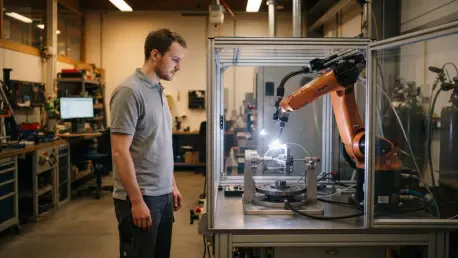

Video-based feature extraction allows for the precise monitoring of deposition geometries in real-time during high-speed metal 3D printing. Micro-plasma metal additive manufacturing (µ-PMAM) faces challenges with precision due to the intense physical interactions between the heat source and metal powders. Ensuring geometric consistency in layer height and bead width is vital for aerospace and medical components where structural integrity is non-negotiable. Traditional monitoring systems often struggle with the extreme brightness and rapid cooling rates of the plasma arc, leading to defects that are discovered only during post-process inspection. By integrating sophisticated computer vision and high-dynamic-range cameras, engineers can now observe the melt pool in detail, capturing every nuance of the solidification process. This wealth of visual data provides the foundation for artificial intelligence to step in, transforming raw video frames into actionable metrics that drive the next generation of automated fabrication systems.
Integrating Advanced Machine Learning Models
Refining Single-Layer Accuracy with Random Forest
The pursuit of dimensional accuracy begins with the single-layer deposition of alloys like Ti6Al4V, a material prized for its strength-to-weight ratio but notorious for its thermal sensitivity. Researchers turned to machine learning to bridge the gap between process parameters—such as arc current, travel speed, and gas flow—and the resulting bead geometry. Among the various algorithms tested, the Random Forest ensemble emerged as the superior choice for predicting height and width in these initial layers. This model excels because it aggregates the decisions of multiple decision trees to reduce overfitting, providing a robust prediction even when faced with the non-linear noise typical of plasma welding environments. By accurately forecasting the geometric outcome of a specific parameter set, manufacturers can preemptively adjust settings to ensure the first layer provides a stable, uniform foundation for subsequent builds. This predictive capability significantly reduces material waste and streamlines fabrication.
Optimizing Multi-Layer Complexity Using Deep Learning
While single-layer predictions are critical, the complexity of metal 3D printing increases exponentially during multi-layer builds of materials like SS 316L stainless steel. The thermal history of previous layers creates a cumulative effect, where heat buildup alters the solidification behavior of the current layer, often leading to undesirable swelling or thinning. To tackle this, researchers implemented a self-attention temporal convolutional network (TCN). Unlike standard neural networks, this deep learning architecture is specifically designed to recognize patterns across time-series data, allowing it to remember how previous layers influenced the melt pool. By analyzing the temporal relationships in the video data, the TCN predicts the shifting geometry of multi-layer structures with high fidelity. This approach ensures that the height of each new layer remains consistent, maintaining the structural integrity of the part throughout the entire additive process during construction.
Optimization and Real-Time Implementation
Genetic Algorithms for Geometric Optimization
Predicting outcomes is only half the battle; the ultimate goal is to find the perfect balance of parameters to achieve a specific design target. This is where the Non-dominated Sorting Genetic Algorithm II (NSGA-II) plays a pivotal role. By treating height, width, and aspect ratio as separate yet interconnected objectives, the NSGA-II explores a vast search space to identify the optimal configuration for a given print. It works by mimicking the process of natural selection, evolving a population of parameter combinations over several generations until the most efficient ones remain. This optimization framework minimizes the variance between the desired geometry and the predicted output, allowing for a level of precision that manual tuning could never reach. The integration of NSGA-II ensures that the printer does not just produce a part, but produces a part that adheres to strict engineering tolerances. This synergy between AI and evolution creates a powerful toolkit.
Moving Toward Closed-Loop Control and Digital Twins
The convergence of AI-driven prediction and genetic optimization established a clear path toward the realization of fully autonomous manufacturing systems. By maintaining an absolute geometric difference of less than ±0.1 millimeters for single layers and ±0.2 millimeters for multi-layer structures, these systems proved that AI could handle the physical complexities of metal 3D printing. The success of this methodology supported the broader implementation of digital twin technology, where a virtual replica of the printing process was updated in real-time based on sensor data. This allowed engineers to simulate various scenarios and predict potential failures before they occurred on the factory floor. Furthermore, the high precision achieved through these AI frameworks paved the way for closed-loop control systems, which automatically adjusted printing parameters mid-process to correct deviations. Industry leaders recognized that these advancements were essential for making 3D printing viable.