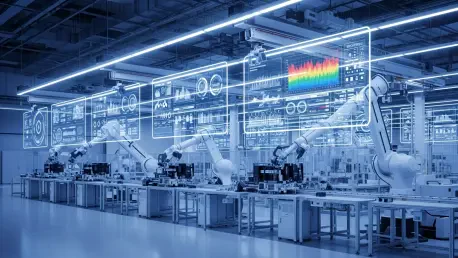

Modern manufacturing floors often resemble high-stakes arenas where technicians battle invisible inefficiencies that drain corporate profitability at an alarming rate every single day. While automation promised a golden age of efficiency, the reality for many remains a frustrating plateau of stagnation. This is where L2L Execution AI enters the frame, representing a pivotal shift in how factories handle their most precious resource: time. By moving away from reactive “firefighting,” this technology seeks to bridge the critical gap between high-level data and the actual work performed on the shop floor.
The Evolution of Intelligent Manufacturing Systems
The current industrial landscape faces a paradox where massive investments in the Internet of Things have not consistently translated into higher output. Since 2011, global industrial productivity has struggled to maintain an upward trajectory, often leaving plants stuck at a 60% effectiveness rate. This stagnation stems from a disconnect between the data gathered and the people who need it.
Intelligent systems have evolved to address this fragmentation by centralizing knowledge. Rather than requiring engineers to hunt through disparate databases, modern frameworks consolidate these insights. This transition marks the move from reactive maintenance to a predictive model that identifies risks before they disrupt the production cycle.
Core Pillars of the L2L Execution AI Framework
AI-Driven Solvers and Prescriptive Analytics
The defining feature of this technology is the implementation of “Solvers,” which function as specialized, pre-defined prompts. Unlike generic large language models that might offer vague advice, these solvers focus on specific machine behaviors and historical failure patterns. They essentially act as a digital consultant that bypasses the need for manual data correlation.
Cloud-Scale Integration and AWS Collaboration
The partnership with Amazon Web Services provides the necessary infrastructure to handle the immense data loads generated by modern manufacturing. Cloud scalability allows for real-time centralization of information across multiple global sites. This ensures that a lesson learned at one facility can be instantly applied to another, creating a unified operational intelligence.
Emerging Trends in AI-First Production Environments
We are witnessing a fundamental shift from passive data observation toward active, autonomous execution. In the past, manufacturing software served primarily as a digital record of what had already occurred. Today, the focus has shifted toward tools that actively direct the labor force, ensuring that human effort is always aligned with the most critical operational priorities.
Practical Applications and Performance Metrics
In real-world settings, these systems have been instrumental in reclaiming lost uptime for heavy industrial sectors. By stabilizing chronic failure patterns, manufacturers have seen notable improvements in their Overall Equipment Effectiveness. These metrics represent hours of production time saved through more efficient troubleshooting and maintenance scheduling.
Addressing Hurdles in Industrial AI Adoption
Despite the clear benefits, integrating these systems remains a challenge due to the prevalence of legacy hardware and siloed data structures. Overcoming this requires a concerted effort to standardize data inputs and ensure that the AI has a comprehensive view of the entire production ecosystem.
The Trajectory of Predictive Operational Execution
The industry is moving toward a future where manufacturing is entirely proactive. In this scenario, raw industrial data is no longer a byproduct of production but a primary competitive advantage. The focus will continue to intensify on turning these digital signals into measurable financial outcomes through even tighter integration between AI and human workflows.
Final Assessment of AI Manufacturing Execution
The transition from chaotic “firefighting” to structured, predictive improvement represented a major milestone for the industrial sector. By centralizing disparate data streams, the technology successfully provided a roadmap for closing the persistent productivity gap. The partnership between cloud providers and execution platforms proved that scalability was the key to practical results. Ultimately, the implementation of intelligent solvers shifted the focus toward permanent problem resolution. This approach not only stabilized operations but also empowered the workforce with the tools necessary for growth.