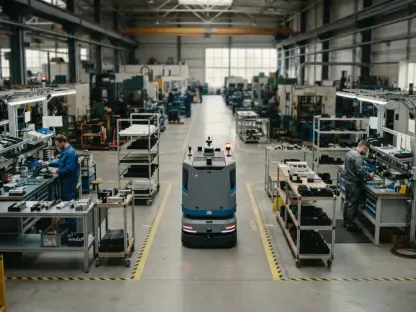

Walking across a high-tech factory floor today reveals a startling contradiction where cutting-edge automation operates alongside empty workstations that represent a growing global labor deficit. The global manufacturing sector is currently trapped in a tightening vise: production demands are skyrocketing while the available labor pool is shrinking at an alarming rate. In factories across the world, specialized robotic arms and autonomous carts handle high-speed tasks, yet a massive automation gap remains in the flexible, human-centric workflows that tie these systems together. This structural void has paved the way for a new contender in industrial technology—the bipedal humanoid robot—which is no longer a science-fiction concept but a strategic tool currently being deployed by industry giants like AGCO and Toyota to safeguard the future of production.
The Great Manufacturing Paradox: Modern Demand Meets a Vanishing Workforce
Industrial progress has traditionally relied on the steady availability of manual labor to fill the gaps left by specialized machinery. However, the current landscape reveals a stark reality where the speed of consumer demand has outpaced the human ability to sustain it. While software and logistics have become hyper-efficient, the physical act of moving materials between assembly stages remains a bottleneck. This paradox is most visible in facilities where million-dollar robotic installations sit idle because there are not enough workers to feed them raw materials or clear finished goods from the line.
The emergence of humanoid robotics serves as a direct response to this imbalance. Companies like AGCO and Toyota have recognized that the next frontier of efficiency is not found in faster machines, but in robots that can navigate the existing world. By deploying bipedal systems, these manufacturers are attempting to preserve their operational capacity without waiting for a societal shift in labor availability. These robots represent a bridge between the rigid automation of the past and the fluid, adaptable workforce required for the next decade of industrial growth.
Why the Manufacturing Labor Crisis Requires a Humanoid Solution
The manufacturing industry is facing a dual threat of systemic labor shortages and a mounting crisis in workplace ergonomics. By 2033, projections suggest nearly 1.9 million manufacturing jobs could go unfilled, leaving critical production lines stagnant and threatening the stability of global supply chains. Simultaneously, the physical toll on the existing workforce is reaching a breaking point; overexertion and repetitive motion injuries account for nearly one million workplace injury cases annually in the United States alone. This human cost translates into billions of dollars in lost productivity and healthcare expenses, making the status quo increasingly untenable for large-scale operations.
Traditional automation, while powerful, is often too rigid to solve these issues because it requires facilities to be rebuilt around the machines. Installing safety cages and dedicated tracks for conventional robots is a massive capital expenditure that many brownfield sites cannot accommodate. Humanoids offer a unique alternative because they are designed to fit into a world built for people, allowing companies to automate strenuous tasks without the prohibitive costs of a total factory redesign. This ability to operate in narrow aisles and interact with human-scale equipment makes the humanoid form factor an essential tool for modernizing aging infrastructure.
Bridging the Operational Gap Between Fixed Robots and Human Workers
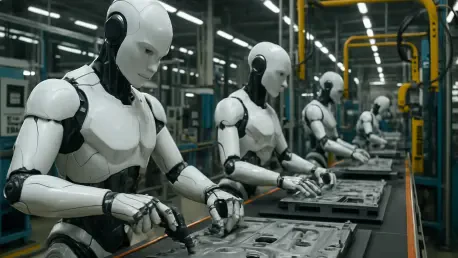
To understand the value of humanoids, one must look at the specific workflows that have historically resisted automation. While traditional robots excel at stationary assembly or simple floor transport, they struggle with middle-mile tasks that require both mobility and manipulation. Humanoid systems like Agility Robotics’ Digit are specifically designed to handle these disparate actions, such as retrieving a part from a shelf, navigating a crowded floor, and placing it into a specific workstation tote. This capability allows manufacturers to link existing automated platforms that otherwise cannot interact, creating a truly end-to-end automated environment.
At AGCO’s Hesston, Kansas facility, the deployment of humanoid technology focuses on three high-impact areas: sorting parts, stacking components, and managing storage totes. By integrating these bipedal robots into the workforce starting in 2027, the plant aims to absorb the most repetitive and physically draining roles. This shift allows human employees to transition into high-value positions that require judgment and experience, effectively turning the robot into a teammate rather than a replacement. The rise of sophisticated software backbones, such as cloud-based fleet management platforms, further enables this transition by allowing manufacturers to deploy and monitor robot fleets with minimal infrastructure upgrades.
Expert Perspectives on Industrial Viability and Performance
The transition from experimental prototypes to industrial tools depends on meeting rigorous performance metrics that experts believe will define the next decade of manufacturing. Industry leaders emphasize that the real measure of success for humanoids is no longer just the ability to walk or pick up an object, but the ability to do so with consistent uptime and throughput. Expert analysis suggests that for a humanoid to be viable, it must demonstrate safety alongside human workers, precision in sorting, and a clear return on investment that justifies the initial capital expenditure. This focus on reliability is what separates current pilot programs from the laboratory demonstrations of the previous decade.
Success stories from early adopters provide the necessary proof of concept to move the industry toward wider adoption. GXO Logistics has already utilized humanoid robots to move over 100,000 totes at its facilities, while Toyota has entered into Robots-as-a-Service agreements in 2026 to support assembly plants. These cases illustrate a growing industry consensus that the humanoid form factor is the most efficient way to scale labor in environments designed for humans. Furthermore, companies like Schaeffler are taking strategic stakes in robotics firms, indicating that the move toward bipedal automation is a long-term investment in the resilience of the global manufacturing floor.
Strategies for Integrating Humanoids into Existing Workflows
Organizations that successfully addressed labor gaps through robotics identified that a structured approach to integration was essential for operational stability. They prioritized the identification of ergonomic bottlenecks, specifically targeting tasks with the highest rates of employee turnover and injury. By transferring the most strenuous, dull, and dangerous jobs to machines, these companies saw an immediate improvement in workplace safety and employee morale. This strategic selection of roles ensured that the technology provided the highest possible value from the first day of deployment, rather than being treated as a generic experimental tool.
Effective manufacturers adopted a human-plus framework where humanoids augmented human capability instead of attempting a total replacement. This involved training existing staff to manage robot fleets and focusing human labor on quality control, maintenance, and complex problem-solving—areas where human intuition remained far superior to AI. These leaders scaled their operations through incremental pilots, starting with a targeted facility to test hardware reliability and software integration in a controlled environment. By utilizing data from these initial tests to refine performance metrics, they created a sustainable path for long-term deployment that supported both the physical health of the workforce and the financial health of the organization.