
The industrial landscape is currently witnessing a profound shift as the concept of “Valuefacturing” emerges as a primary driver for South Korea’s economic resilience and technological sovereignty. This paradigm, introduced by Professor Kim Joo-hyung, moves past the traditional fixation on raw productivity to prioritize the creation of broader social and economic value. As the nation maintains its status as the world leader in robot density, the transition toward Physical AI becomes a logical progression for maintaining a competitive edge in a saturated market. The core of this strategy involves moving beyond digital simulations and into the tangible world where machines can perceive, reason, and act with human-like precision. This evolution is not merely a technical upgrade but a fundamental reimagining of how manufacturing contributes to national wealth. By integrating advanced sensors and intelligent algorithms into factories, Korea aims to set a new global standard for industrial sophistication.
Bridging the Gap: The Transition From Digital to Physical Intelligence
Physical AI stands as the newest frontier in the robotics industry, serving as a critical bridge between the cognitive depth of digital models and the physical bodies of industrial machinery. Unlike Large Language Models that function within structured digital interfaces, Physical AI requires embodiment to interact effectively with the complex real world. The current technical challenge lies in the acquisition of high-fidelity ground-truth data, which encompasses precise logs of motion and sensory feedback during operation. This data bottleneck remains the primary obstacle to developing autonomous systems that can handle unscripted tasks or operate in dynamic environments without constant intervention. Without a massive repository of real-world interactions, even the most sophisticated neural networks remain grounded in theory rather than practice. For Korea, overcoming this hurdle means moving from general-purpose automation toward systems that understand the specific physics of their tasks.
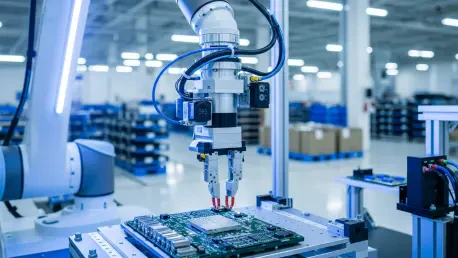
To address the persistent scarcity of high-quality data, researchers are utilizing teleoperation as a sophisticated method for data labeling and robot training. Systems such as the CHILD framework allow human operators to guide robots through intricate movements in a human-in-the-loop configuration. This methodology effectively teaches the machine the subtle mechanics of assembly or delicate part handling by recording the nuances of human touch and spatial awareness. These recorded episodes serve as foundational datasets that allow AI agents to learn from expert demonstrations rather than relying solely on trial and error. As these teleoperated sessions accumulate, they create a robust library of industrial movements that can be generalized across various platforms. This approach significantly accelerates the deployment of autonomous systems by providing the necessary context to navigate physical constraints. It transforms the role of the worker from a manual laborer to a mentor for machine intelligence.
National Sovereignty: Securing the Industrial Data Landscape
While global superpowers like China and the United States often dominate in raw data volume, South Korea’s strategic advantage is found in the extraordinary density and specialized nature of its manufacturing data. The nation’s leadership in sectors like semiconductors, automotive manufacturing, and shipbuilding provides a unique environment where high-precision datasets are generated every second. These datasets are incredibly valuable because they represent complex processes that are difficult for competitors to replicate in a laboratory. By focusing on industrial depth rather than general-purpose interactions, Korea can carve out a dominant niche in high-precision Physical AI applications. The goal is to leverage this niche to build localized AI models fine-tuned for specific industrial demands, ensuring the technology is purpose-built for the factory floor. This concentration on high-value data allows for a more targeted development cycle compared to broader, less specialized initiatives.
However, the long-term success of this industrial transformation depends heavily on maintaining strict data sovereignty and protecting intellectual property within domestic factories. Experts warn that manufacturers must be vigilant about retaining ownership of the data generated by their own machines rather than yielding control to third-party automation providers. If external service providers gain control over the operational knowledge of a factory, the original manufacturer risks becoming a mere hardware supplier with no control over its own intellectual assets. This loss of sovereignty could lead to a scenario where the intelligence of the factory belongs to a foreign entity, stripping the local company of its competitive relevance. Securing this data involves implementing decentralized architectures and robust legal frameworks that ensure the value created on the shop floor remains with the entity that owns the equipment. Protecting these digital assets is now just as important as protecting the physical machinery.
Global Leadership: Research Hubs and the Labor Evolution
The rising influence of South Korea in the global technological sphere is further validated by its role as a host for major international robotics events, such as the IEEE International Conference on Robotics and Automation. Such recognition highlights the country’s research prowess and its role as a central node for cross-border innovation and standard-setting in Physical AI. These gatherings provide a platform for researchers to share open-source tools and establish common protocols that facilitate the interoperability of various robotic systems. By fostering a collaborative environment, the nation ensures its local industries stay at the cutting edge of global trends while contributing to the international body of knowledge. This engagement prevents technological isolation and allows for the rapid adoption of emerging breakthroughs from around the world. The synergy between domestic expertise and international research accelerates the commercialization of new AI-driven robotics.
Beyond the technical and strategic layers, the introduction of Physical AI necessitates a fundamental reevaluation of human labor through the lens of the Productivity Paradox. Historically, the introduction of labor-saving technologies has often led to higher quality standards and increased output rather than a simple reduction in work hours. In the current industrial climate, AI tools are seen as an evolution of traditional engineering instruments that allow professionals to tackle more complex and nuanced tasks. Instead of viewing automation as a threat to job security, the focus is shifting toward how these tools can augment human capability to meet rising demands for precision and speed. Professionals who embrace these advancements can focus on high-level system design and oversight, leaving repetitive physical execution to their robotic counterparts. This transition requires a workforce that is skilled in managing the digital-physical interface that defines modern manufacturing.
Strategic Implementation: Practical Steps for Industrial Resilience
The transition toward Physical AI was solidified by the adoption of integrated data architectures that bridged the gap between shop-floor hardware and cloud-based intelligence. Industrial leaders prioritized the establishment of secure data pipelines that allowed for real-time feedback loops, ensuring every robotic movement contributed to a centralized learning model. This proactive approach facilitated a rapid move away from static automation and toward dynamic systems capable of responding to supply chain disruptions with minimal human intervention. By investing in hybrid training models that combined simulation with real-world teleoperation, companies successfully reduced the time required to deploy new robotic configurations by nearly half. These advancements demonstrated that the key to maintaining a competitive edge lay in the seamless integration of human expertise with machine learning capabilities. The successful implementation of these strategies provided a roadmap for other nations seeking to revitalize manufacturing.
To ensure long-term stability, organizations focused on developing internal talent capable of overseeing complex AI ecosystems rather than relying on external contractors for core operations. Legislative bodies supported this shift by enacting policies that protected data ownership for small enterprises, preventing the monopolization of industrial intelligence by a few large players. Moving forward, the emphasis shifted toward the creation of a unified standard for industrial communication, allowing diverse robotic platforms to collaborate across different factory environments. This collaborative framework allowed for a more resilient industrial base that could quickly pivot to meet market demands without requiring a total overhaul of existing infrastructure. By treating Physical AI as a sovereign asset, the industry ensured its growth was rooted in its own technological advancements rather than imported solutions. These actions established a sustainable model where innovation and production remained deeply intertwined.