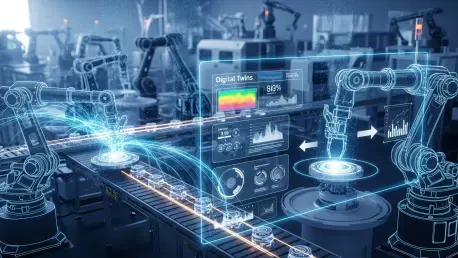

The rapid convergence of high-speed industrial networking, advanced sensor arrays, and massive cloud-based processing power has finally moved the digital twin from the realm of experimental pilot programs into the core of modern manufacturing operations. For decades, factory managers relied on historical logs and manual inspections to understand the health of their equipment, often reacting to failures only after production had already ground to a halt. Today, the landscape is fundamentally different as virtual replicas provide a continuous, high-fidelity window into the physical world, allowing for a level of transparency that was previously impossible. These systems do not just reflect what is happening; they use sophisticated algorithms to project what is likely to happen next, enabling a shift toward a truly proactive operational model. This transformation is driven by the realization that data is just as valuable as raw materials in the production cycle. As factories become increasingly complex, the ability to simulate entire environments becomes a competitive necessity rather than a luxury. By bridging the gap between the physical floor and digital insights, manufacturers are finding new ways to drive efficiency and maintain a higher standard of quality than ever before. This evolution marks a significant milestone in Industry 4.0, where the digital and physical realms are no longer separate entities but are instead two halves of a single, synchronized system.
The Living Virtual Model: Real-Time Data and Dynamic Mirroring
A common misunderstanding in the industrial sector is the tendency to conflate a digital twin with a traditional Computer-Aided Design (CAD) model, yet the differences between the two are profound. While a CAD file serves as a static blueprint that outlines the geometric intent of a part or machine, a digital twin is a dynamic, living entity that evolves alongside its physical counterpart in real time. This functionality is made possible by a constant influx of data harvested from the shop floor through an intricate network of Internet of Things (IoT) sensors and industrial software. These sensors monitor a vast array of parameters, such as thermal fluctuations, vibrational signatures, and mechanical loads, ensuring that the virtual model precisely mirrors the current state of the machinery. This bidirectional flow of information means that any change in the physical world is immediately reflected in the digital environment, providing engineers with an accurate representation of how components are wearing down. Instead of working with idealized versions of equipment, teams can now observe the specific operational realities of each individual asset on the line, leading to more nuanced and effective management strategies that account for the unique stress factors of a specific facility.
This constant stream of operational data fundamentally alters how facilities approach equipment maintenance and asset management. Historically, maintenance followed a binary path: either reactive, where parts were replaced after a failure, or preventative, where components were swapped out based on a rigid, often conservative schedule. Digital twins introduce the era of predictive maintenance, where Artificial Intelligence analyzes sensor telemetry to identify the earliest signs of degradation before they manifest as mechanical failures. By detecting subtle anomalies in vibration or heat that might escape human observation, the system can flag potential issues weeks in advance, allowing for repairs to be scheduled during planned downtime. This precision prevents the catastrophic cascading failures that often occur when one component breaks and damages others, thereby significantly extending the total lifecycle of expensive industrial assets. Furthermore, this approach reduces the logistical burden of maintaining massive inventories of spare parts, as companies can order exactly what is needed just in time. The result is a much leaner operation where the health of the factory is managed with the same level of detail as the production output itself, ensuring maximum uptime.
Precision and Connectivity: The Role of Metrology and the Digital Thread
Metrology, the science of measurement, has transitioned from being a final inspection step to becoming the very pulse of the digital twin ecosystem. In the past, quality control was often a post-production hurdle where finished parts were measured to ensure they met specifications, often resulting in expensive scrap if errors were detected too late. In modern manufacturing, high-precision laser scanners and automated coordinate measuring machines are integrated directly into the production cells, providing continuous feedback loops that inform the digital twin. This integration allows for real-time monitoring of process drift, where minute changes in tool wear or ambient temperature begin to push dimensions toward the edge of acceptable tolerances. Because the digital twin is constantly comparing the live measurement data against the original design intent, it can trigger automatic adjustments to the machinery to compensate for these variances. This proactive correction mechanism effectively stops defects before they are ever fully realized, moving the industry closer to the goal of zero-defect manufacturing. By embedding precision measurement into the digital workflow, companies can maintain tighter tolerances and ensure that even the most complex components are manufactured with absolute consistency.
Connecting these various stages of production is the concept of the digital thread, a seamless flow of information that maintains continuity across a product’s entire lifecycle. This thread breaks down the traditional silos that have long separated design engineers from the technicians on the factory floor, ensuring that every stakeholder has access to a single source of truth. When a design change is made in the virtual environment, that update propagates through the digital thread to the manufacturing execution systems and the digital twin, ensuring that production remains aligned with the latest engineering specifications. Conversely, performance data from the field can be fed back through the thread to inform future design iterations, creating a closed-loop system of continuous improvement. If a quality issue is discovered in a batch of products, the digital thread allows investigators to trace back the exact environmental conditions and raw material lots present at the moment of fabrication. This level of traceability is invaluable for high-stakes industries where regulatory compliance and safety are paramount, as it provides a comprehensive audit trail that is automatically generated and updated. Consequently, the digital thread acts as the nervous system of the modern enterprise, coordinating actions and insights across teams.
Production Optimization: Virtual Commissioning and Mass Customization
Virtual commissioning represents one of the most impactful applications of digital twin technology, allowing for the comprehensive testing of production setups before a single piece of hardware is installed. In traditional manufacturing, setting up a new assembly line or integrating a new robotic cell involved a lengthy process of trial and error on the factory floor, often leading to unexpected collisions or logic errors that delayed production for weeks. Today, engineers use digital twins to simulate the entire commissioning process in a risk-free virtual environment, where they can refine robot movement paths and optimize material flows without the danger of damaging expensive equipment. This simulation accounts for the physical properties of materials, the speed of conveyor belts, and the timing of control signals, ensuring that the digital logic is perfected before it is deployed to the physical machines. This shift-left approach to testing significantly compresses the time-to-market for new products, as the physical installation becomes a matter of simply mirroring the validated digital setup. By identifying bottlenecks and mechanical interferences in software, manufacturers can ensure that their physical assets are productive from the very first hour of operation, maximizing the return on investment.
The inherent flexibility of digital twins is also proving essential for addressing the modern consumer’s growing demand for mass customization and specialized product variants. Historically, high-volume manufacturing relied on long production runs of identical items to achieve economies of scale, making it difficult and costly to pivot for smaller, custom orders. Digital twins solve this problem by providing the agility needed to reconfigure production lines virtually before executing the change in reality. Operators can use the virtual model to test-run different machining settings or assembly sequences for a unique product variant, verifying that the new process will meet quality standards without disrupting the broader facility. This capability allows manufacturers to offer a wider variety of products in smaller batches while maintaining the efficiency of mass production, a concept often referred to as lot size one. Furthermore, the digital twin can automatically update the necessary regulatory documentation and quality certificates for these custom parts, streamlining the administrative side of specialized manufacturing. This level of responsiveness ensures that companies can react quickly to changing market trends and individual customer needs, maintaining a competitive edge in a global marketplace.
Advanced Intelligence: AI Integration and Environmental Sustainability
As the underlying technology matures, the integration of Artificial Intelligence is transforming digital twins from passive monitoring tools into active decision-support systems. While earlier iterations required specialized data scientists to interpret complex charts and graphs, modern digital twins utilize machine learning and Generative AI to provide actionable insights in natural language. A floor supervisor can now interact with the system directly, asking specific questions about why a particular assembly line is experiencing a drop in throughput or which machines are most likely to require maintenance. The AI processes millions of data points across the digital twin’s history to provide a clear, evidence-based answer, often suggesting specific adjustments to optimize performance. This democratization of data means that workers at every level of the organization can make informed, data-driven decisions without needing an advanced degree in analytics. Moreover, AI-driven digital twins can autonomously run thousands of what-if scenarios in the background, identifying optimization strategies that a human operator might never consider. This proactive intelligence helps to smooth out production spikes and minimize waste, ensuring that the factory operates at its maximum efficiency regardless of external variables.
Beyond the obvious economic benefits, digital twins have emerged as a critical tool for improving the environmental sustainability of industrial operations. By providing a granular view of energy consumption across the factory floor, these virtual models allow managers to identify energy-intensive processes that can be rescheduled or optimized to reduce the overall carbon footprint. For instance, a digital twin might reveal that certain machines are consuming excessive power because they are running at sub-optimal speeds or because their cooling systems are inefficient. Correcting these issues not only saves money but also aligns the facility with increasingly stringent global environmental regulations. Additionally, the ability to perform extensive virtual prototyping significantly reduces the amount of physical scrap and material waste generated during the development of new products. Instead of building and discarding multiple physical iterations, engineers can perfect a design digitally, ensuring that the first physical prototype is nearly final. This reduction in material usage, combined with the energy savings gained through predictive maintenance, positions the digital twin as a cornerstone of the modern green factory. As consumers demand more transparency regarding environmental impact, the data captured by the digital twin provides the verifiable evidence needed.
Strategic Integration: Navigating Challenges and Future Considerations
Transitioning to a digital-twin-centric model was not without its hurdles, as many organizations had to grapple with the complexities of integrating legacy infrastructure into a modern ecosystem. In many established factories, older analog machinery lacked the necessary connectivity or sensor ports to feed data into a virtual model, necessitating a significant phase of hardware retrofitting. This process often involved the installation of external sensor arrays and the development of custom gateways to translate legacy communication protocols into formats compatible with contemporary cloud platforms. Beyond the physical hardware, the rise of connected factories introduced new vulnerabilities, making cybersecurity a paramount concern for leadership teams. Protecting the integrity of the data flowing through the digital thread became essential, as any corruption of the virtual model could lead to incorrect physical adjustments and potential safety hazards. Manufacturers had to implement robust encryption, multi-layered authentication, and continuous network monitoring to safeguard their intellectual property and operational stability. These challenges required a strategic, phased approach to digital transformation, where companies prioritized high-value assets for initial integration while building a security framework.
Ultimately, the organizations that successfully navigated this transition realized that the true value of a digital twin lay in its ability to empower the human workforce rather than replace it. They invested heavily in upskilling programs to ensure that shop floor employees and engineers alike could interpret the sophisticated insights generated by these systems. This shift required a fundamental change in organizational culture, where data-driven experimentation was encouraged and the traditional boundaries between departments were permanently dismantled. Leaders focused on establishing a scalable data architecture that could grow alongside the business, ensuring that the digital twin was not a standalone project but a core component of the corporate strategy. By prioritizing interoperability and open standards, these companies avoided the trap of vendor lock-in and created a flexible ecosystem capable of incorporating future technological advancements. The resulting framework fostered a more resilient manufacturing sector, one that was capable of maintaining high production standards even in the face of global supply chain disruptions. Moving forward, the focus shifted toward expanding these models beyond the factory walls to encompass entire supply chains, creating a global network of interconnected twins.