
As a prominent leader in manufacturing technology and production management, Kwame Zaire has spent years refining the intersection of materials science and industrial efficiency. His work focuses on the evolution of high-performance alloys, particularly those destined for the most grueling thermal and mechanical environments. By moving beyond traditional processing limitations, he explores how advanced coating techniques can redefine the structural integrity of metal powders. Today, we delve into the sophisticated world of Oxide Dispersion Strengthened (ODS) alloys and the transformative role of fluidized bed reactors in creating the next generation of aerospace and energy materials.
Traditional ball-milling often introduces media contamination and limits nanoscale control. How does switching to a fluidized bed reactor specifically mitigate these impurities, and what does the step-by-step process of coating individual powder particles look like in an environment reaching 1,100°C?
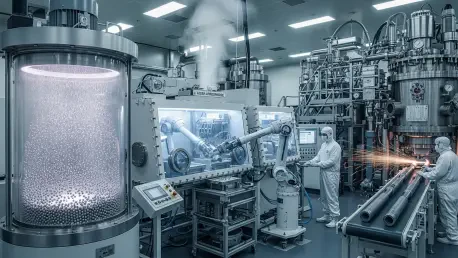
The shift to a fluidized bed reactor is a game-changer because it replaces the physical trauma of high-energy ball-milling with a sophisticated gas-phase interaction. In a traditional mill, the constant impact of grinding media inevitably leaves behind unwanted debris, but in our reactor, the metal powder is suspended in an upward-flowing gas stream, creating a fluid-like state where particles never touch a contaminating surface. The process begins by heating the chamber up to 1,100°C while the “fluidized” particles dance in the stream, ensuring every square micron of their surface is exposed. We then introduce an oxide precursor gas that reacts chemically at the particle surface, depositing a precise, molecular-level coating. This ensures that the resulting powder remains incredibly pure, as the only materials involved are the high-purity gas and the metal substrate itself.
Engineering materials often face failure through creep when operating near their melting points. How do oxide dispersions sized between 5 and 50 nanometers physically hinder dislocation motion, and what metrics demonstrate their stability when temperatures exceed 80% of the alloy’s melting point?
When you are operating at 0.8 or 0.9 of an alloy’s melting temperature, the metal is essentially screaming under the thermal stress, and that is where the 5 to 50-nanometer oxide particles save the structure. These tiny yttria dispersions act like microscopic anchors, physically pinning the dislocations and preventing them from gliding through the crystal lattice. Because these oxides are so fine and evenly distributed, they also suppress grain boundary sliding, which is a primary driver of creep failure. The most impressive metric is the alloy’s ability to maintain its structural form at these extreme ranges where conventional nickel or iron-based metals would simply lose their mechanical identity. This stability is a direct result of the nanoscale microstructure we engineer before the powder even reaches the consolidation phase.
Advanced reactors now allow for tailored chemistry through graded or multi-layer coatings on metal powders. What specific precursors are most effective for creating stable yttria layers, and how do you ensure these coatings remain uniform across a 75-kilogram batch of steel-density powder?
To achieve those stable yttria (Y₂O₃) layers, we utilize specific chemical precursors that can be vaporized and then decomposed or reacted onto the powder surface within the reactor. The secret to handling a massive 75-kilogram batch of steel-density powder lies in the fluidization dynamics, which ensure that every single grain is treated identically regardless of its position in the bed. By carefully controlling the gas flow rate and the concentration of the precursor, we can build up multi-layer or even graded coatings that transition from one chemistry to another. This level of precision is impossible with mechanical mixing, as the fluidized bed provides a perfectly homogenous environment for the chemical vapor deposition to occur. We monitor the process in real-time to ensure that the coating thickness is consistent across the entire volume, which is vital for the downstream performance of the alloy.
Many high-performance alloys struggle with consistency during Laser Beam Powder Bed Fusion. How does the in-situ formation of oxides during consolidation improve the build quality of powders, and what specific advantages does this provide for components produced via Directed Energy Deposition?
Consistency in Additive Manufacturing (AM) often boils down to how well the strengthening agents are integrated into the melt pool. By coating the powder beforehand and allowing the oxides to form in situ during the laser melting process, we achieve a much more uniform dispersion than if we had simply tossed in loose oxide particles. This uniformity prevents the “clumping” of oxides that often leads to crack initiation sites in Laser Beam Powder Bed Fusion (PBF-LB). For Directed Energy Deposition (DED), this method is particularly advantageous because it ensures the chemical composition remains stable even as the material is being blown through a nozzle and melted into a large-scale part. The result is a build with significantly reduced internal stresses and a much lower risk of component failure compared to parts made from mechanically alloyed powders.
Moving from laboratory experiments to industrial production requires high reproducibility and reduced risk of component failure. In what ways does fluidized bed CVD outperform mechanical alloying regarding scalability, and what long-term cost benefits do manufacturers see from reduced processing times?
Mechanical alloying is notoriously difficult to scale because as your drums get larger, the energy distribution becomes uneven, leading to inconsistent batches and high contamination risks. Fluidized bed CVD, on the other hand, is an established industrial process that naturally scales by increasing the reactor size while maintaining the same gas-to-powder contact principles. Manufacturers see a massive benefit in throughput; we can process large quantities of powder much faster than the days-long milling cycles required for mechanical alloying. Furthermore, the high reproducibility of the CVD process means fewer rejected batches and a lower overall risk of failure in the final mission-critical components. Over the long term, the combination of shorter processing times and the elimination of expensive milling media makes this a far more economically viable route for producing next-generation alloys.
Next-generation alloys like GRX-810 are designed for extreme environments that conventional nickel or iron-based metals cannot survive. What are the specific structural requirements for these materials, and how does the precursor coating thickness directly influence the final mechanical properties of the alloy?
For a material like GRX-810, the structural requirement is a perfect balance between a tough metallic matrix and a rigid, unyielding network of nanoscale oxides. The thickness of the precursor coating is the primary lever we pull to control this balance; if the coating is too thick, the material becomes brittle, but if it is too thin, you lose the creep resistance that defines the alloy. By fine-tuning that coating layer at the particle level, we directly dictate the inter-particle spacing of the oxides in the final consolidated part. This allows us to “dial in” the mechanical properties, such as tensile strength and fatigue life, to meet the specific demands of aerospace engines or nuclear reactors. It is truly a bottom-up approach to metallurgy where the performance of a massive component is decided at the nanometer scale.
What is your forecast for ODS alloys?
I believe we are entering a “Golden Age” for ODS alloys where they will transition from niche laboratory curiosities to the primary choice for any application exceeding 1,000°C. As fluidized bed CVD makes these materials more affordable and consistent, we will see them move beyond specialized aerospace components and into widespread use in high-efficiency power generation and carbon-neutral energy systems. The ability to 3D print these “super-alloys” with predictable results will fundamentally change how we design turbines and reactors, allowing for higher operating temperatures and, consequently, much greater thermal efficiency. In the next decade, the integration of CVD-coated powders and advanced additive manufacturing will make ODS alloys the backbone of our most extreme engineering feats.