
Kwame Zaire is a seasoned veteran in pharmaceutical manufacturing, known for his deep technical grasp of the equipment and processes that drive the life sciences sector. With an extensive background in production management and a sharp focus on predictive maintenance and safety, he has become a leading voice on the evolution of complex therapeutic modalities. In this conversation, we explore the intricate world of Antibody-Drug Conjugates (ADCs), focusing on the critical role of lyophilization, the strategic advantages of integrated manufacturing sites, and the specialized infrastructure required to handle high-potency payloads in a rapidly expanding global market.
The discussion delves into the technical necessity of freeze-drying for stabilizing bioconjugated molecules and the operational shifts required to manage cytotoxic risks. We also examine how consolidating payload and bioconjugation capabilities accelerates clinical timelines and the specific hardware, such as Hastelloy reactors, needed for cutting-edge chemistries.
The industry is moving toward complex molecules that require specialized stabilization. Why has commercial lyophilization become a non-negotiable requirement for modern bioconjugation platforms, and how do you manage the technical risks when handling cytotoxic payloads during the freeze-drying process? Please provide a detailed, step-by-step explanation.
Commercial lyophilization has become essential because the complexity of these drugs has intensified significantly over the last 12 to 24 months, making them more targeted but also more physically unstable in liquid forms. To manage this, we follow a rigorous isolation protocol where the payload and linker intermediates are safely contained before entering the freeze-drying cycle to ensure no operator exposure to these toxic substances. The process begins with the careful stabilization of the drug substance, moving through a controlled sublimation phase that removes moisture without compromising the delicate bond between the monoclonal antibody and its cytotoxic payload. By the time the multimillion-euro lyophilization units coming online in 2027 reach full capacity, they will provide the critical flexibility needed to handle 6 of the 14 currently approved commercial ADCs. This technical transition from a liquid to a stable solid state is what allows these life-saving therapies to be shipped and stored globally without losing their therapeutic potency.
Reducing technology transfer complexity is critical when trying to compress clinical timelines for the hundreds of drugs currently in development. What are the operational advantages of housing payload, linker, and bioconjugation capabilities on a single site, and how does this integration specifically help in meeting aggressive commercial deadlines?
Housing the entire production chain on a single site, like the facility in Le Mans, creates a seamless workflow that eliminates the logistical friction and “dead time” typically found in fragmented supply chains. When you have payload production, linker synthesis, and bioconjugation happening in the same location, you drastically reduce the risk of data loss or contamination during the transfer between different contract organizations. This integration is vital for the 600 ADCs currently in development, as it allows us to be incredibly fast to clinic by streamlining the associated analytical testing and quality control under one roof. By removing the need for trans-continental shipping of sensitive drug intermediates, we can compress timelines that used to take years into much tighter schedules, making the lives of pharmaceutical partners significantly easier. It is a rare capability—truly only available in a couple of places in Europe—that allows for a level of responsiveness that is mandatory in today’s competitive landscape.
Advanced payloads like auristatins and tecans require highly specialized containment and specific materials like Hastelloy reactors. How do you determine the appropriate reactor configurations for these specific chemistries, and what metrics do you use to evaluate the efficiency of a high-capacity GMP-compliant payload workshop?
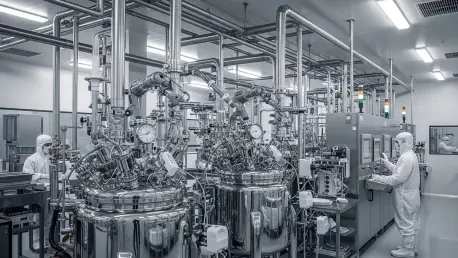
Selecting the right configuration begins with an assessment of the chemical compatibility and the potency of the payload, where materials like Hastelloy are chosen for their superior corrosion resistance against the aggressive solvents used in tecan or auristatin synthesis. We utilize three specific Hastelloy reactors in our GMP-compliant workshops to ensure that the environment remains pristine and that the high-potency molecules do not interact with the vessel surfaces. Efficiency is then measured by our analytical throughput and our ability to maintain strict containment levels while scaling up from research to commercial volumes. We look at the yield stability across our six dedicated workshops—including those focused on clinical payload-linker production and bioconjugation—to ensure that our 20 years of experience with emerging payload classes translates into a repeatable, high-quality output.
With the targeted therapeutics market projected to exceed $65 billion by 2031, the pressure to produce blockbuster drugs is immense. How does European manufacturing infrastructure currently compare to global demand, and what are the primary hurdles when scaling a program from early-stage clinical batches to high-volume production?
European infrastructure is currently in a state of rapid expansion to keep pace with a market growing at a compound annual rate of more than 25%, supported by initiatives like the France 2030 national program. While there are 11 products slated to reach blockbuster status this year alone, the hurdle remains the inherent scientific complexity of moving from small clinical batches to the massive volumes required for a global launch. Scaling up requires more than just bigger tanks; it requires high-performance chromatography purification lines that can handle the increased drug substance volume without losing the specificity of the molecule. The pressure is felt in the need for increased development speed, as we must service clinical pipelines efficiently while maintaining the flexibility to adapt to ever-changing molecular structures.
While oncology is the primary focus for these therapies, there is growing interest in applying this technology to other disease areas. How must the manufacturing and bioconjugation processes evolve to accommodate non-cancer indications, and what are the specific challenges in handling these ever-changing molecular structures?
As we move beyond oncology, the manufacturing process must become even more versatile to handle a wider variety of antibodies and novel payloads that may have different stability profiles than traditional cytotoxics. The evolution involves enhancing our bioconjugation workshops to be modular, allowing us to pivot between different disease indications without a total overhaul of the existing cleanroom infrastructure. The primary challenge lies in the “ever-changing” nature of these molecules; each new indication brings a unique linker-payload combination that requires a bespoke analytical approach to ensure safety and efficacy. We are constantly upgrading our testing capabilities to ensure that as these molecules become more complex and targeted, our isolation and handling protocols remain several steps ahead of the potential risks.
What is your forecast for the antibody-drug conjugate market?
I anticipate that the ADC market will continue its explosive trajectory, firmly hitting the $65.2 billion mark by 2031 as we see more of the 600 drugs in the pipeline transition to commercial reality. We will likely see a shift where the ability to provide an “all-in-one” manufacturing solution becomes the industry standard, as the costs of delays in these high-stakes programs are simply too high for developers to ignore. Success in this space will be defined by those who can marry specialized equipment, like advanced lyophilization and Hastelloy reactors, with the agility to move a drug from early-stage development to the patient’s bedside in record time. It is an era of precision, and the infrastructure must be as sophisticated as the molecules themselves.