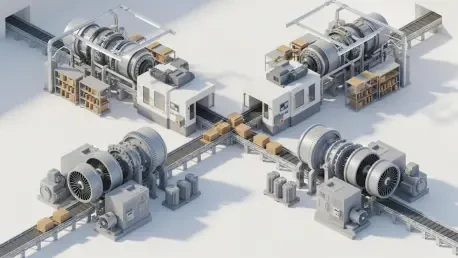

Kwame Zaire is a veteran manufacturing expert specializing in the intricate hardware of the aerospace and defense sectors. With his deep focus on production management and the integration of predictive maintenance, Zaire offers a unique perspective on how large-scale suppliers navigate the volatile intersection of global geopolitics and industrial expansion. In this discussion, we explore the operational realities of meeting a $9.7 billion revenue target, the impact of international conflicts on component demand, and the strategic diversification into industrial gas turbines that is currently insulating major players from localized economic shifts.
Annual revenue targets for aerospace suppliers are reaching nearly $9.7 billion amid record backlogs. How do you balance aggressive growth targets with the production schedules of major aircraft manufacturers, and what specific operational metrics indicate that a manufacturing ramp-up is sustainable rather than overextended?
Achieving a revenue target between $9.58 billion and $9.73 billion requires a meticulous alignment with the delivery schedules of giants like Boeing and Airbus. In the machine shops, you can feel the vibration of constant activity as we shift from a baseline of $9 billion to this new, more aggressive forecast. We look closely at the 19 percent revenue growth we achieved in the first quarter to ensure our workforce isn’t hitting a breaking point. A sustainable ramp-up is visible when our adjusted profit, which recently jumped 42 percent to $1.22 per share, keeps pace with volume, proving that we aren’t sacrificing efficiency for sheer output.
Global defense spending is rising significantly as international conflicts deplete missile stockpiles. How should companies prioritize urgent government defense contracts alongside commercial orders, and what steps are necessary to ensure the supply chain can handle these simultaneous demands without creating significant delivery bottlenecks?
The pressure to replenish missile stockpiles due to ongoing conflicts in Ukraine and Iran has created a dual-track demand that tests even the most robust facilities. We have to treat defense contracts with a sense of national urgency while maintaining the flow of parts for commercial engines that drive our daily global economy. It’s a delicate dance of logistics where we monitor the specific needs for engine spares that fluctuate with every geopolitical shift. To avoid bottlenecks, we are constantly refining our supply chain to manage the record backlogs that are currently a cornerstone of our market health.
Geopolitical instability in regions like the Middle East often drives up fuel costs and disrupts the transport of critical engine spares. How are industry leaders mitigating these rising operational expenses, and what long-term strategies are most effective for stabilizing logistics when traditional transport routes are compromised?
The shadow of the Iranian conflict and the broader US-Israeli tensions creates a volatile environment where fuel costs can spike overnight, eating into our operational margins. We see the impact directly in our logistics chain, where the transport of high-precision parts becomes a gauntlet of delays and rising surcharges. To mitigate this, we lean into our high-margin sectors, like the 42 percent increase in quarterly profit, to build a financial buffer against these external shocks. Long-term stability comes from diversifying our transit routes and ensuring that our production hubs are as close to our end-market assembly lines as possible to reduce our reliance on high-cost freight.
The industrial gas turbine market is currently seeing a major surge in activity alongside traditional aerospace components. What specific technical or financial advantages does this diversification provide for a parts manufacturer, and how do you manage the shared resource requirements between these two high-precision sectors?
Diversifying into industrial gas turbines is a strategic move because the technical requirements for these massive machines mirror the high-stress components found in jet engines. When the commercial aviation market feels the squeeze of supply chain limits, the very active gas turbine market provides a steady stream of revenue that keeps our precision casting and machining lines running at full capacity. This cross-pollination of technology allows us to justify investments in advanced manufacturing that benefit both sectors simultaneously. Financially, it’s a major reason why we could raise our annual revenue floor to $9.58 billion, as it de-risks our portfolio against a slowdown in any single transportation segment.
While commercial transportation shows signs of improvement, many executives remain cautious about the near-term outlook. What specific economic indicators would signal a full, risk-free recovery in this sector, and how should firms manage their inventory levels while waiting for more definitive market stability?
We are seeing the first green shoots of demand improvement in commercial transportation, but the air in the boardroom remains thick with caution. A full recovery would be signaled by a stabilization of fuel costs and a predictable rhythm in the delivery of engine spares, free from the disruptions currently caused by Middle Eastern conflicts. Until we see that stability, we are managing inventory with a lean philosophy, ensuring we have enough stock to meet the $2.31 billion quarterly revenue demand without bloating our balance sheet. We must remain agile, as the transition from a cautious stance to full-throttle production can happen rapidly, and being caught with empty shelves is a risk we cannot afford.
What is your forecast for the aerospace parts industry?
I expect the aerospace parts industry to experience a period of intense growth driven by a dual-engine of military necessity and a commercial aviation sector struggling to keep up with travel demand. We are looking at an environment where full-year revenue targets will likely stay near the $9.7 billion mark as backlogs continue to stretch out into the next decade. However, the true winners will be those who can navigate the Iranian conflict and other geopolitical hurdles while maintaining an adjusted profit midpoint around $4.94 per share. It will be a year of grinding through supply chain bottlenecks, but the financial rewards for those who can deliver on time will be unprecedented.