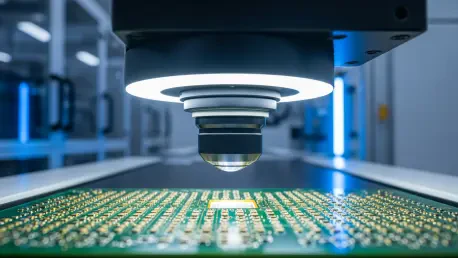

The sheer density of contemporary printed circuit boards has reached a point where traditional human oversight is no longer just difficult but physically impossible for the naked eye to verify. As semiconductor geometries shrink and multilayer designs become industry standards, the manufacturing floor faces a crisis of complexity paired with a dwindling pool of veteran technicians. This is where the intersection of artificial intelligence and high-precision optics steps in, transforming the production line from a reactive repair shop into a predictive, self-correcting ecosystem. The integration of advanced hardware and deep learning represents more than a simple upgrade; it is a fundamental shift in how hardware integrity is guaranteed.
Evolution of Automated Inspection Systems
The transition from traditional Automated Optical Inspection (AOI) to AI-driven systems was necessitated by the limitations of rule-based algorithms. Earlier systems relied on rigid parameters that often resulted in high false-call rates, requiring human operators to spend hours manually verifying non-existent defects. Modern AI-enhanced platforms, however, utilize deep learning to recognize patterns and anomalies with a degree of nuance that mimics human intuition but operates at a much higher speed.
By moving toward a “skillless” manufacturing model, the industry is effectively decoupling quality from individual expertise. This modernization allows factories to maintain peak operational standards even when faced with labor shortages. The shift focuses on empowering less-experienced personnel with tools that automate the most cognitively demanding tasks of the inspection process.
Technical Architecture and Core Components
Physics-Based Digital Twins and Thermal Simulation
A standout feature of the current technological wave is the use of physics-based digital twins, often developed on platforms like NVIDIA Omniverse. These high-fidelity replicas allow engineers to simulate the entire manufacturing environment, identifying potential mechanical failures before a single component is placed. Unlike competitors who focus solely on post-production imaging, this approach focuses on the thermal stresses that cause board warpage during the reflow process.
Integrated Vision and 3D-CT X-ray Analytics
The combination of surface-level vision data and internal 3D-CT X-ray imaging provides a diagnostic depth that was previously unattainable. This synergy allows the system to correlate external visual misalignments with internal structural issues, such as microscopic voids in solder joints. By synthesizing these diverse data streams, the AI provides a holistic assessment that ensures safety-critical components meet the most rigorous standards.
AI Agents and Natural Language Knowledge Repositories
To bridge the knowledge gap on the factory floor, manufacturers are deploying generative AI agents that serve as interactive support tools. These agents function as vast repositories of manufacturing wisdom, allowing operators to query complex data sets using natural language. Instead of navigating dense technical manuals, an operator can simply ask the system why a specific defect occurred, receiving an actionable explanation based on real-time and historical data.
Current Trends in Skillless Manufacturing
Recent developments indicate a strong push toward the use of synthetic data to train inspection models. This trend reduces the reliance on massive libraries of real-world defect images, which are often difficult and expensive to collect. By generating realistic digital failures, manufacturers can prepare their AI systems for rare but catastrophic defect scenarios that have not yet occurred on the physical line.
Industrial Applications and Deployment Scenarios
AI-driven inspection has become the gold standard in sectors where failure is not an option, such as the automotive and aerospace industries. In these environments, the technology stabilizes quality assurance for high-density circuits that power everything from autonomous driving sensors to flight control systems. The ability to maintain high throughput without compromising accuracy has made these systems indispensable for modern high-speed assembly.
Technical Hurdles and Market Constraints
Despite the clear benefits, the high computational cost of running physics-based simulations remains a significant barrier for smaller manufacturers. There are also valid concerns regarding the “hallucination” of AI-generated advice in high-precision settings. Furthermore, integrating these sophisticated software platforms with legacy manufacturing hardware requires substantial investment and technical coordination, which can slow the pace of adoption.
Future Outlook of AI-Enhanced Production
The trajectory of this technology points toward fully self-optimizing production lines that require minimal human intervention. Future breakthroughs will likely center on edge computing, where data is processed directly on the inspection hardware to eliminate latency. This will enable real-time adjustments to the manufacturing process, effectively eliminating the possibility of mass-producing defective units before the system can react.
Summary of Findings and Final Assessment
The evaluation of AI-driven inspection demonstrated that the technology successfully addressed the critical bottleneck of skilled labor in electronics manufacturing. By merging digital twins with interactive AI agents, the industry established a more resilient production framework. The transition provided a clear path toward higher yields and lowered the barrier to entry for new operators. This assessment suggested that future investments shifted toward decentralized data processing to ensure even greater agility across global supply chains.