
Kwame Zaire is a distinguished voice in the world of industrial technology, renowned for his ability to bridge the gap between high-level production management and the gritty realities of the factory floor. With a career rooted in the complexities of electronics and heavy equipment, he has spent years refining the art of predictive maintenance and safety protocols. As a thought leader in smart manufacturing, he has watched the industry evolve from basic automation to the sophisticated, AI-driven ecosystems we see today. His perspective is deeply informed by the need for quality and precision, particularly in environments where thousands of products move through a line every single minute.
The following discussion explores the revolutionary shift in quality inspection, focusing on how global leaders are finally cracking the code on scaling artificial intelligence. We delve into the mechanics of new visual inspection systems that outperform traditional methods, the strategic partnerships between tech giants and consumer goods manufacturers, and the broader economic impact of reducing material waste. Through this conversation, we uncover why the transition from localized pilot programs to global implementation remains the greatest challenge—and the greatest opportunity—for modern industry.
High-speed production lines often deal with delicate or textured materials that stretch and wrinkle during assembly, creating a nightmare for quality control. How does modern industrial AI manage to maintain accuracy when the physical state of the product is so unpredictable?
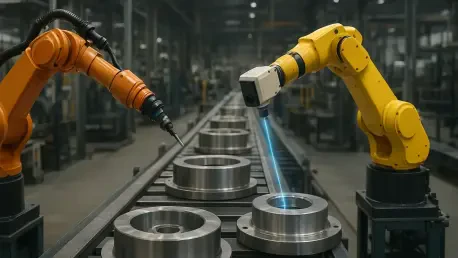
In the past, traditional vision systems were incredibly rigid; they essentially looked for a perfect “match” against a static template, and the moment a material like thin plastic or a textured fabric wrinkled or stretched under the tension of a high-speed line, the system would trigger a false positive. You can imagine the frustration of seeing thousands of perfectly functional products flagged as scrap just because the packaging shifted by a fraction of a millimeter. The breakthrough we are seeing now, specifically with systems like the Visual Inspection Cockpit, is the use of deep learning models that act more like a human eye than a simple sensor. These models are trained on P&G’s massive datasets to understand that a wrinkle is just a natural variation of the material, not a structural defect. By running these sophisticated algorithms on powerful NVIDIA GPUs right at the edge of the production line, the system can distinguish between a harmless texture change and a genuine low-contrast defect that could compromise the product. It is a sensory leap that allows for full inspection accuracy even when items are flying by at speeds that would make a human observer’s head spin.
The reduction of scrap by 10% to 20% is a significant achievement for any major manufacturer. What does this level of efficiency mean for the broader goals of a global supply chain, and how does it align with the latest industry benchmarks?
When a company of that scale manages to cut scrap by up to 20% on certain products, the ripple effect through the supply chain is monumental because you aren’t just saving the final product; you are saving all the raw materials, energy, and logistics that went into it. If we look at the World Economic Forum’s Global Lighthouse Network report from late 2025, we see that the most advanced sites are cutting material waste by an average of 30% through these digital solutions. This isn’t just about the bottom line; it’s about a fundamental shift toward sustainable production where “quality” and “sustainability” are two sides of the same coin. For a leader like Shailesh Jejurikar at P&G, this efficiency allows the company to maintain its competitive edge across brands like Pampers and Tide while meeting increasingly stringent environmental targets. It sets a new standard where high-volume manufacturing no longer has to accept high-waste as an unavoidable cost of doing business.
One of the biggest hurdles in smart manufacturing is the time it takes to set up new systems. Why is the claim that new deployments can be commissioned five to 10 times faster than traditional systems such a game-changer for the industry?
In the old paradigm, if you wanted to install a bespoke vision system, you were looking at months of manual configuration, specialized lighting setups, and tedious programming that was specific to only one line or one product. If you changed the packaging design or the lighting in the factory shifted, you often had to start the calibration process all over again. By utilizing a platform like Siemens Industrial Edge, companies can now treat their inspection software almost like an app that can be deployed across a global footprint with minimal local tweaking. This leap in speed—moving five to 10 times faster than before—means that a global rollout can happen in months rather than years, allowing a company to capture the return on investment almost immediately. It removes the “technical debt” of maintaining thousands of unique, disconnected systems and replaces it with a unified software architecture that learns and improves over time.
The collaboration between a consumer goods giant, an automation leader, and a semiconductor powerhouse seems like a complex marriage. How do the different roles of P&G, Siemens, and NVIDIA actually integrate on the factory floor to make “Industrial AI” a reality?
This is really a story of hardware meeting high-level software in a very practical way. P&G provides the “brain” of the operation—their proprietary deep learning models that are built on decades of manufacturing expertise and specific product knowledge. Siemens then provides the “nervous system” through their Industrial Edge platform and industrial PCs, which ensure that the AI isn’t just running in a cloud somewhere but is integrated directly into the physical machinery of the plant. Finally, NVIDIA provides the “muscle” with their GPUs, which perform the massive amount of real-time calculations required to process high-resolution images in milliseconds. When these three elements work together, the result is a system that can automatically trigger an alert or physically remove a defective item from the line without a human ever having to intervene. It’s a seamless loop of data, processing, and physical action that represents the true maturity of the “Smart Factory” concept.
Despite these success stories, reports from late 2025 suggest that only 2% of companies have AI fully embedded across their operations. What is preventing the other 98% from moving beyond the pilot phase and achieving this level of integration?
The McKinsey report “From Pilots to Performance” highlighted a very sobering reality: about two-thirds of the industry is still just dipping their toes in the water with targeted implementations. The primary barrier isn’t usually the AI itself, but the difficulty of building applications that are truly reusable and scalable across different sites with different legacy equipment. Many companies get stuck in “pilot purgatory” because they build a solution that works in one lab or on one specific line, but they lack the underlying infrastructure, like a standardized edge computing platform, to push that solution to a hundred different factories. There is also a significant cultural shift required; you need production teams to trust the data and use it for continuous improvement rather than just seeing it as another layer of monitoring. As Deloitte’s research pointed out, while 28% of large manufacturers now prioritize quality management in their budgets, the winners will be those who stop viewing AI as a series of isolated projects and start seeing it as a core operational capability.
What is your forecast for the evolution of quality management in high-speed manufacturing?
I believe we are moving toward a “zero-defect” reality where the distinction between production and inspection completely disappears because the machinery will be self-correcting in real-time. In the coming years, I expect the data gathered by systems like the Visual Inspection Cockpit to feed directly back into the upstream manufacturing process, automatically adjusting machine tensions or temperatures the moment a trend toward a defect is spotted. We will see the “2% club” of fully embedded AI companies grow rapidly as the cost of edge computing drops and the ease of deployment continues to improve. Ultimately, quality management will transition from a reactive “catch the mistake” department to a proactive “prevent the mistake” engine that defines the entire value chain. The companies that fail to adopt this integrated approach will find themselves buried under the costs of their own inefficiency, while the leaders will enjoy a level of precision and speed that was previously thought to be impossible.