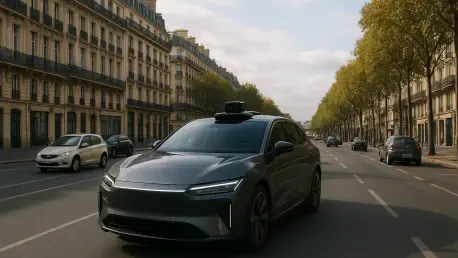

The absence of clear lane markings on the Champs-Élysées forced the vehicle’s AI to synthesize its own digital path through a dense thicket of urban traffic. This high-stakes demonstration in the heart of France serves as a litmus test for BYD’s advanced “God’s Eye” City Navigation on Driving Assistant (CNOA). Navigating the French capital is notoriously difficult for seasoned human drivers, particularly when facing the chaotic convergence of twelve major avenues at the Place Charles de Gaulle. The Denza Z9GT, an upmarket grand tourer boasting 1,582 horsepower, relies on a sophisticated array of hardware to handle these environments. With a sensor suite including LiDAR, 11 high-definition cameras, and 26 radar sensors, the vehicle attempts to replicate human spatial awareness. As the car moved toward the Arc de Triomphe, the software processed unpredictable patterns where traditional road rules often yield to a more aggressive, localized driving style.
Technical Architecture: The God’s Eye System
The hardware foundation of the CNOA system represents a significant leap in automotive sensor integration, moving beyond simple proximity alerts to a comprehensive environmental model. By utilizing triple-LiDAR configurations alongside a 360-degree camera network, the Z9GT creates a real-time digital twin of its surroundings. This data is processed by high-performance computing platforms capable of executing trillions of operations per second, allowing the vehicle to detect and track hundreds of individual objects simultaneously. Unlike older systems that relied heavily on pre-mapped data, this architecture emphasizes real-time perception to handle the fluid dynamics of European city centers. The integration of millimeter-wave radar provides a redundant layer of safety, ensuring that the vehicle can maintain its spatial orientation even in poor weather conditions or low-light scenarios. This multi-layered approach is essential for identifying small, fast-moving obstacles.
Beyond the physical sensors, the software logic must solve the complex problem of pathfinding in areas where paint on the asphalt is non-existent. The CNOA system utilizes deep learning algorithms to predict the flow of traffic by observing the behavior of other motorists rather than just following lines. On the wide boulevards leading to the Arc de Triomphe, the Z9GT successfully synthesized virtual lanes, maintaining a steady position while adapting to the irregular spacing of surrounding vehicles. This capability highlights a shift from reactive driving to a more predictive model that anticipates where a lane should naturally exist. However, the system also revealed the inherent difficulty of teaching a machine to interpret human intuition and social cues. While the technology can calculate the most efficient physical path, it must also learn to navigate the silent negotiations that occur between drivers at busy intersections where the traditional rules of the road fade.
Urban Navigation: Behavioral Realities and Logic
During the transit through the notorious roundabout at the Place Charles de Gaulle, the Z9GT encountered the limits of current Level 2+ autonomy. The AI demonstrated a cautious, almost submissive demeanor that occasionally conflicted with the assertive driving required to exit the circle safely. Because the “priority to the right” rule dominates French traffic logic, the vehicle’s software often hesitated when faced with aggressive merging from adjacent avenues. This hesitation illustrated a critical gap between mathematical safety and the practical reality of urban navigation, where being too polite can lead to traffic flow disruptions. Furthermore, the system struggled to anticipate the sudden maneuvers of a lead car that stopped abruptly to park. While the sensors detected the obstacle instantly, the AI lacked the predictive foresight to realize the driver’s intent before the brake lights appeared. These instances suggest that the technology still requires human supervision in complex cities.
The results of this Parisian test drive provided a clear roadmap for the evolution of autonomous systems over the next several years. Engineers observed that the transition from assisted driving to full autonomy required more than just increased sensor resolution; it demanded a deeper integration of behavioral psychology into the vehicle’s decision-making core. This experience highlighted the necessity for software updates that would allow the car to assert itself more effectively in crowded environments without compromising safety. Moving forward from 2026 to 2027, the focus shifted toward refining the “God’s Eye” system for a broader commercial release, with specific emphasis on handling non-standard traffic patterns. Stakeholders determined that future iterations must prioritize predictive intent analysis to better coexist with human-operated vehicles. The test demonstrated that while the Z9GT achieved technical milestones, the path to Level 5 autonomy remained a gradual process.