
Harvard Business School professor Meg Rithmire has argued that the United States and China are pursuing fundamentally different AI strategies, like rivals racing toward different planets. The US is often described as “frontier-first,” investing heavily in increasingly capable general-purpose models. China is often described as “diffusion-forward,” giving more weight to spreading existing AI tools through manufacturing and other physical industries. Neither label is absolute, and observers disagree about how deep the divide really is.
The difference has practical consequences for manufacturers. It affects which AI tools are available, what they cost, which suppliers can be relied on, and how competitors in other countries are modernizing their plants. The discussion below examines the AI race through a manufacturing lens. It begins with the strategic forces shaping the industry, namely security concerns, competition among technology suppliers, and industrial policy. It then turns to the factory floor, where the most useful test is whether a system solves a real production problem at a reasonable cost.
Security Concerns and the Manufacturing Supply Chain
The space-race comparison draws partly on a concept from strategic theory known as escalation dominance, the worry that a rival who reaches far more advanced AI first could gain a decisive advantage. The argument’s effects extend from AI labs into manufacturing. Security concerns have led to export controls on advanced chips and on the equipment used to make them, along with closer scrutiny of where industrial technology comes from. The Congressional Research Service notes that since 2018 the U.S. government has sought to restrict China’s access to advanced chips and its ability to produce them. The same controls aim to sustain U.S. leadership across related parts of the semiconductor supply chain.
For manufacturers, this can mean longer lead times for some components, higher compliance costs, and the need to check whether automation systems, sensors, or software depend on restricted parts. Some firms have responded by diversifying suppliers or moving production closer to home. Others question whether the risks justify the costs of reorganizing supply chains. The debate has no settled answer, and the right choice varies by sector. Manufacturers in defense-related or highly regulated industries are likely to face stronger pressure than those making general consumer goods.
Choosing AI Suppliers for the Factory
The competition over the global technology stack, meaning the chips, cloud platforms, models and applications that AI systems run on, shapes the choices open to manufacturers. US firms hold strong positions at the high end, especially in advanced chips. On models, the US lead has narrowed sharply. A United Nations University review of Stanford’s 2026 AI Index concludes that the U.S.-China AI model performance gap has effectively closed.
Chinese companies have also competed by offering cheaper and often open-weight models, along with low-cost automation hardware. Most factory uses don’t require the most advanced AI systems. Tasks such as defect detection, demand forecasting, or maintenance scheduling can often be handled by smaller, specialized models. For many manufacturers, especially mid-sized firms and those in emerging markets, price, reliability, local support, and ease of integration may matter more than top benchmark scores. Each choice involves trade-offs. Manufacturers have to weigh vendor lock-in, how production data is stored and who can access it, exposure to export controls, and the risk that geopolitical tensions disrupt support or updates for critical equipment.
Industrial Policy and the Manufacturing Workforce
China’s use of state-directed industrial policy in AI follows patterns seen in manufacturing sectors such as solar panels and electric vehicles. An IMF working paper estimates that the equivalent fiscal cost of China’s industrial policy, delivered through cash subsidies, tax benefits, subsidized credit and subsidized land for favored sectors, is about 4% of GDP per year. The same paper finds that the resulting misallocation reduces aggregate productivity by about 1.2%.
Government support encourages intense domestic competition, which can speed up automation adoption but also create overcapacity. Surplus production can push global prices down. Buyers benefit, while manufacturers in other countries may struggle to compete, adding to trade tensions and tariffs. Other governments have responded with their own programs to support domestic manufacturing and automation, with mixed results so far. Workforce effects are a central concern everywhere. Rapid automation can displace production workers before new roles emerge, and those new roles often require different skills, such as maintaining robots, managing data, or overseeing automated lines. How manufacturers and governments handle retraining, and how evenly they share productivity gains, may matter as much to long-term competitiveness as the technology itself.
Manufacturing Quality
Manufacturing, particularly automotive components, is often cited as a sector where AI and automation are being adopted in practical ways. Many manufacturers pursue very low defect rates, sometimes described as “zero defects,” and use automation to improve consistency and quality control. Results vary considerably, however. Successful projects usually depend as much on workforce training, management commitment and cooperation between engineers and operators as on the technology itself.
Poorly planned automation can raise costs, add complexity or simply move bottlenecks elsewhere. Industry recognition and awards can signal good practice, but they are not always independent assessments, and published case studies tend to favor successes over failures. Governments in several countries have linked manufacturing automation to broader goals of strengthening domestic production and supply-chain resilience. Whether these programs deliver lasting competitiveness, and how they affect employment, is still being studied.
Manufacturing Execution Systems
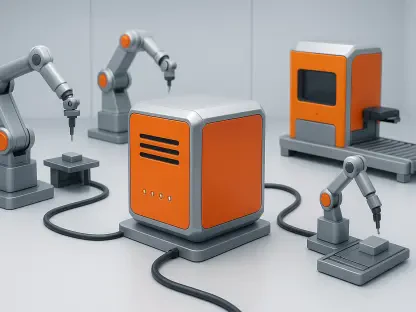
Manufacturing execution systems (MES) are software platforms that connect business planning with what actually happens on the factory floor. They typically cover areas such as production scheduling, materials tracking and quality management. Some vendors offer modular systems, which let manufacturers start with the area that most needs improvement and add others later. This can reduce up-front cost and risk.
A connected system can give managers a more accurate, real-time view of operations, and some platforms now add predictive analytics to warn of likely disruptions. Implementations can be difficult, though. Integrating new software with older equipment and existing enterprise systems is often costly and slow, and the benefits depend on the quality of the data going in. Buyers are generally advised to judge vendors’ claims about return on investment carefully, ask for references from comparable operations, and plan for the training and process changes these systems require.
Robotics and AI Vision on the Factory Floor
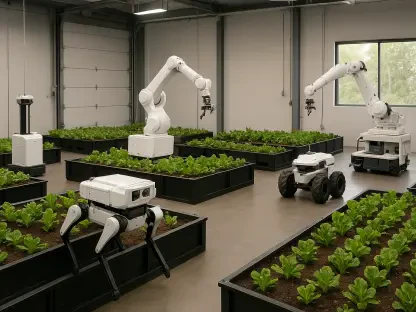
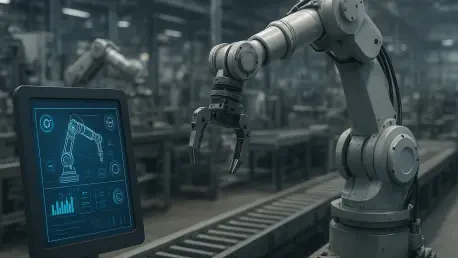
AI-based vision systems are among the more mature industrial uses of machine learning. They are trained to recognize specific parts and defects on a given production line, and they can perform tasks such as dimensional measurement and weld inspection. Their accuracy depends on good training data, and they may need retraining when products or conditions change. Robotics is also becoming more flexible. Collaborative robots, or “cobots,” are designed to work near people without traditional safety cages, and their safety depends on how they are applied.
The 2025 revision of the international robot safety standard ISO 10218 folds collaborative safety requirements into the core standard and treats collaboration as an application-specific property, so risk assessment covers the full setup. Autonomous mobile robots move materials around a facility using onboard mapping instead of fixed tracks, so layouts can change without major reconstruction. These tools can ease particular bottlenecks, but they are not a universal fix. Their value depends on fitting the specific problem, integrating with existing systems, and addressing workforce concerns, including retraining and job impacts.
Open Questions for Manufacturers
It is too early to say whether the frontier-first or diffusion-forward approach will do more for manufacturing, or whether the distinction will hold as both countries adapt. Advances in general-purpose AI may eventually make factory systems easier to program and more adaptable. Meanwhile, widespread adoption of simpler tools is already changing how many plants operate. The outcome for any given manufacturer may depend on factors such as access to components, energy costs, trade policy, financing, and the availability of skilled workers. The practical lesson is caution. Advanced technology is not valuable in itself. Its value depends on whether it solves a real production problem at a reasonable cost. Carefully assessing constraints, adopting in phases and measuring results honestly can reduce risk, but they do not remove it. How manufacturers handle these choices will shape not only their own competitiveness but also how the benefits and costs of industrial AI are shared among companies, workers and communities.