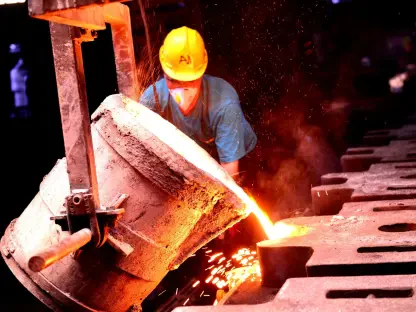

Significant capital expenditures for new pool kilns are deterring all but the largest industry leaders from attempting to expand their manufacturing footprint. This financial barrier arrives at a time when the global electronics sector is grappling with a radical transformation, fueled primarily by the insatiable appetite for artificial intelligence computing power and high-performance server architecture. Electronic fabric, often overshadowed by the high-profile semiconductor industry, has emerged as a critical bottleneck in the supply chain, serving as the fundamental insulating and structural backbone for the advanced Printed Circuit Boards (PCBs) that modern technology relies upon. As generative AI models grow in complexity, the hardware required to train and run them has become increasingly sophisticated, necessitating specialized materials that can handle higher thermal loads and provide superior signal integrity. This has pushed fiberglass fabric prices to levels not seen in over ten years, creating a volatile environment where supply security is now the primary concern for hardware developers. The current market state reflects a profound shift from a commodity-driven cycle to a technology-led surge, where the scarcity of high-end materials is dictating the pace of digital progress across the globe.
Analyzing Recent Market Volatility and Price Trends
The most immediate and visible indicator of the current market volatility is the aggressive upward trajectory of product costs across all categories of electronic fabric. Field observations reveal that standard 7628 thick fabric, long considered a baseline commodity with stable pricing, has seen its market value climb significantly, surpassing 15 yuan per meter in several key manufacturing hubs. This represents a nearly ten-year high, reflecting a market that has far exceeded the most optimistic projections established at the beginning of the current cycle. This price escalation is not merely a result of inflationary pressure but is a direct consequence of a fundamental mismatch between available production capacity and the massive volume of orders coming from the infrastructure side of the digital economy. As these baseline costs rise, the entire electronics manufacturing ecosystem is forced to re-evaluate procurement strategies to maintain margins amidst these soaring expenses.
While standard fabrics are rising, the mid-to-high-end segments are experiencing even more dramatic volatility that threatens to disrupt just-in-time manufacturing models. The 2116 thin fabric and 1080 ultra-thin fabric, which are essential for miniaturized consumer electronics and high-speed AI computing backplanes, have seen year-to-date price increases exceeding 140%. This extreme price pressure is compounded by historic inventory lows across the global supply chain, where major manufacturers report having only a single week of stock on hand for critical orders. The lack of a strategic buffer means that any slight uptick in demand or a minor disruption in the logistics chain results in immediate and sharp price adjustments. This “hand-to-mouth” operating environment has transformed the procurement process into a high-stakes competition, where smaller firms are increasingly priced out by larger players who can afford to secure long-term supply contracts at premium rates.
Factors Behind the Dual-Tight Supply Imbalance
The structural nature of this shortage is rooted in a “dual-tight” supply pattern that goes beyond simple demand outstripping supply. Leading enterprises have fundamentally pivoted their production priorities, repurposing manufacturing lines once dedicated to low-end “thick” fabrics to produce high-margin “thin” and “ultra-thin” materials used specifically in AI servers. This strategic realignment has created a paradoxical situation in the market: as the industry focuses on meeting the booming demand for specialized high-end goods, the supply of basic conventional fabrics has been passively reduced. Consequently, manufacturers find themselves in a position where they cannot easily revert to high-volume production of standard goods without sacrificing the lucrative returns offered by the AI sector. This internal competition for production time on existing looms has effectively throttled the total available output for the broader electronics industry.
On the demand side of the equation, three major sectors are fueling the persistent shortage with no signs of abatement in the near term. AI computing servers and high-end switches require high-speed, low-loss PCBs that must utilize fiberglass with specific dielectric properties to ensure data integrity at extreme speeds. Simultaneously, the automotive industry’s rapid transition to electric and autonomous vehicles has significantly increased the average PCB content per unit, placing a steady and heavy burden on the fabric supply chain. Furthermore, the rising complexity of integrated circuit (IC) packaging requires substrates that are both thinner and more thermally stable than previous generations of fiberglass. These converging demand streams from the server room, the road, and the mobile device have created a cumulative pressure that the existing global infrastructure was simply not designed to handle without massive and immediate expansion.
Technical and Economic Barriers to Entry
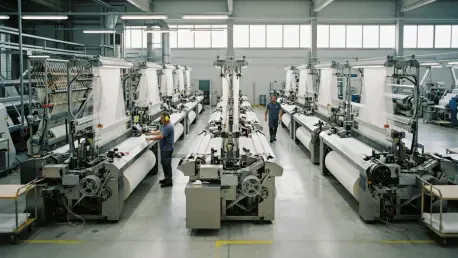
Expanding global production capacity for electronic fabric is an arduous and capital-intensive process that cannot be accelerated by financial investment alone. The primary hurdle remains the global monopoly on air-jet looms, with Toyota Industries Corporation controlling nearly 95% of the market for high-end weaving machines capable of producing 1080-type ultra-thin fabrics. Current lead times for this specialized equipment now span between 18 and 24 months due to a massive backlog of orders from established manufacturers. This means that even if a well-funded company decided to build a new factory today, they would be unable to produce a single meter of fabric for nearly two years. This temporal bottleneck ensures that the current supply shortage will persist regardless of how high prices climb, as the physical machines needed to increase output are simply not available for immediate deployment.
In addition to the machinery constraints, the manufacturing process itself involves the use of extremely expensive raw materials that present a high barrier to entry for new competitors. Producing the electronic yarn that is eventually woven into fabric requires the use of specialized “bushings” made from a platinum-rhodium alloy to withstand the corrosive nature of molten glass at high temperatures. The cost of these precious metals for a single production line can reach tens of millions of yuan, and their prices remain highly volatile on the global market. When combined with the rigorous and lengthy certification cycles required by downstream PCB manufacturers and end-users like server giants, the path to profitability for new capacity is exceptionally long. These rigid barriers protect the market share of incumbent leaders while simultaneously ensuring that the supply-demand mismatch remains a persistent feature of the industrial landscape through 2027 and 2028.
Assessing Potential Risks of Material Substitution
Amidst these supply constraints, rumors regarding potential material substitution have surfaced, suggesting that tech giants might be looking for alternatives to fiberglass. Specifically, speculation that major chip designers like NVIDIA might be testing computing backplanes that do not utilize traditional electronic fabric caused a temporary ripple of concern throughout the investment community. Analysts have examined the possibility of using pure organic or inorganic materials to achieve higher performance or lower costs in next-generation platforms like the “Rubin Ultra” series. However, market experts and specialized manufacturers remain skeptical about any large-scale displacement of fiberglass in the immediate future. While alternative materials are certainly being researched to push the boundaries of high-performance computing, these projects are currently confined to laboratories or initial concept verification stages rather than mass production.
From a technical and economic perspective, fiberglass fabric remains the most cost-effective and reliable reinforcement material for high-speed PCB applications. It offers a unique balance of thermal stability, mechanical strength, and dielectric performance that is difficult to replicate at scale with new, unproven materials. Industry insiders suggest that even if new technologies are successfully integrated into the supply chain, they will likely be reserved for small-volume, extreme-performance scenarios where cost is not a primary concern. For the vast majority of AI server infrastructure and consumer electronics, electronic fabric is expected to remain the core insulating material for the foreseeable future. The sheer scale of the existing fiberglass manufacturing infrastructure and the decades of institutional knowledge in its application provide a level of industrial inertia that makes a rapid transition to alternative materials highly unlikely.
Strategic Expansions Among Global Manufacturing Leaders
To mitigate these systemic risks and capitalize on current market conditions, major industry participants are aggressively positioning themselves to capture high-value segments. Sinoma Science & Technology is currently operating its production facilities at full capacity, with a strategic focus on low-dielectric fiber fabrics tailored for the most demanding AI applications. Similarly, the global leader China Jushi has continued to expand its manufacturing footprint in key regions, anticipating that the demand for specialized fabrics will continue to outpace supply from 2026 to 2028. These companies are not just adding volume; they are refining their technological capabilities to ensure they can produce the ultra-thin materials that command the highest premiums. This focus on the “special fabric” niche allows them to maximize profitability while the rest of the market struggles to find even basic materials.
Other significant players, such as International Composite Materials and Honghe Technology, are committing billions of yuan to high-performance electronic fiber projects and the development of specialized industrial parks. For example, some firms are focusing exclusively on the extra-thin fabric market, where technical barriers are highest and competition is most limited. Meanwhile, companies like Jin’an Guoji have recently brought new expansion projects into full production and are already planning subsequent phases to add hundreds of millions of meters of annual capacity. These multi-year investment plans highlight a collective industry conviction that current market tightness is a structural shift rather than a temporary spike. By securing the latest air-jet looms and investing in platinum-rhodium assets now, these leaders are ensuring that they will dominate the supply chain through the next decade of digital growth.
Moving Forward: Resilience and Long-Term Planning
The electronic fabric industry established a new baseline for value as stakeholders navigated one of the most significant supply-demand imbalances in history. To address these challenges, manufacturers and hardware developers shifted their focus toward long-term supply security rather than short-term price optimization. One critical step involved the formalization of multi-year procurement agreements that provided fabric weavers with the capital and certainty needed to invest in long-lead-time machinery. This proactive approach helped stabilize the supply chain by ensuring that the most critical AI and automotive projects received priority allocation of specialized thin and ultra-thin materials. By integrating deeper into the upstream supply chain, hardware companies gained a clearer view of potential bottlenecks, allowing them to adjust their product roadmaps well in advance of material shortages.
Building on these foundations, the industry also accelerated the development of more efficient manufacturing processes that reduced reliance on volatile raw materials. Engineers prioritized the optimization of bushing designs to extend the life of precious metal components, while also improving yield rates of ultra-thin weaving processes to maximize the output of existing looms. For organizations operating in this environment, the primary takeaway was the necessity of technological diversification and the avoidance of single-source dependencies for high-end glass yarn. As the market moves through 2027 and into 2028, successful players will be those who treated electronic fabric not as a simple commodity, but as a strategic asset. Strengthening partnerships between fiber producers, PCB laminators, and end-users remained the most effective method for insulating businesses against future volatility in the high-speed digital economy.