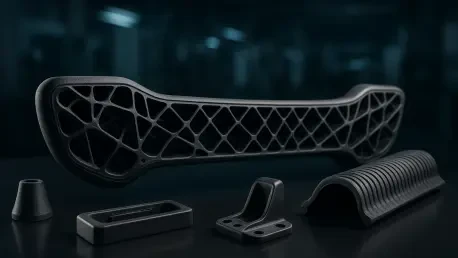

Modern materials science has reached a critical juncture where the traditional physical trade-off between a material’s ability to absorb high-energy shocks and its capacity to endure repeated mechanical fatigue is finally being dismantled through high-precision manufacturing. For decades, engineers had to choose between soft, energy-dissipating elastomers that failed quickly under repetitive use and rigid polymers that offered durability but lacked the flexibility to cushion sudden impacts effectively. This duality limited the development of safety gear, as parts either wore out too soon or provided insufficient protection. However, the emergence of advanced 3D-printing technologies allows for the creation of intricate, bio-inspired microstructures that redistribute mechanical energy across a complex internal lattice. These new rubber-like materials utilize geometric complexity to achieve properties that were previously thought to be mutually exclusive in a single substance. By integrating these advanced properties, the latest research indicates a shift toward materials that are significantly safer and more reliable.
Architectural Innovations in Polymer Engineering
Part 1: Precision Manufacturing with Multi-Material Systems
The primary innovation driving this shift lies in the deployment of mechanical metamaterials, which are structures where the physical response is determined by geometry rather than just the base polymer’s chemistry. By utilizing stereolithography and digital light processing, researchers can now print rubber-like lattices with varied beam thicknesses and nodal connections that act as tiny, integrated shock absorbers. This architectural precision ensures that when a force is applied, the material buckles and deforms in a predictable, non-destructive manner that preserves the integrity of the bulk structure.
These additive processes allow for the inclusion of sacrificial internal bonds that break to absorb energy during extreme impacts without compromising the overall shape of the component. This localized energy dissipation prevents the formation of large cracks, which is the primary cause of material failure in traditional rubber products. Controlling these microscopic features allows manufacturers to tune the material for various stresses, ensuring it cushions blows while maintaining functional shape. This approach ensures that industrial components can withstand both the rigors of heavy use and the sudden spikes of impact force encountered in high-intensity environments.
Part 2: Designing for Complex Energy Dissipation Pathways
Fatigue resistance in these 3D-printed elastomers is achieved by designing lattice structures that effectively eliminate high-stress concentrations at the joints of the material. Traditional rubber often fails because repetitive stretching and compression cause micro-cracks to form and migrate through the substance until a total rupture occurs. In contrast, the new hierarchical designs utilize a series of interlocking loops and specialized curvatures that spread the mechanical load evenly across thousands of individual struts. This prevents any single point from reaching its failure threshold, even after millions of cycles.
Recent testing protocols have demonstrated that these structured elastomers can survive ten times more cycles than standard industrial rubbers while maintaining their original elasticity. The key to this longevity is the material’s ability to return to equilibrium without retaining permanent deformation. By integrating self-reinforcing geometries, engineers have created a system where the physical shape of the lattice actively pushes back against structural degradation, effectively extending the operational lifespan of critical parts in vibrating machinery or high-cycle industrial applications. This advancement marks a new era in the long-term reliability of resilient systems.
Practical Implementations and Performance Metrics
Part 3: Enhancing Safety in High-Stakes Industrial Environments
The transition of these high-performance materials from laboratory settings to industrial production has significant implications for the automotive and aerospace sectors. In the automotive industry, bumpers and crumple zones are being redesigned to incorporate these 3D-printed lattices, allowing vehicles to absorb impact energy more efficiently while reducing the overall weight of the chassis. These components can be customized to match the specific safety requirements of different vehicle models, providing a level of protection that solid rubber or foam counterparts simply cannot replicate.
Aerospace engineering also benefits from these advancements, particularly in the creation of vibration-dampening seals and protective linings for sensitive electronic equipment. These materials provide a stable barrier against the extreme acoustic and mechanical vibrations encountered during flight, ensuring that delicate sensors remain functional throughout the mission. Because these structures can be printed on demand, aerospace firms are able to iterate designs quickly, leading to more efficient prototyping and faster market entry for safety innovations. This capability ensures that missions from 2026 to 2028 can deploy lighter and more durable hardware.
Part 4: Strategic Advancements for Next-Generation Infrastructure
The development of fatigue-resistant, shock-absorbent elastomers represented a fundamental shift in how engineers approached material selection for demanding environments. Researchers successfully proved that the integration of computational design and additive manufacturing could overcome the limitations of natural and synthetic rubbers. By focusing on the structural arrangement of the polymer rather than the chemical composition alone, the industry achieved a milestone in durability and safety. The projects completed throughout the recent development cycle confirmed that these materials outperformed traditional options in every critical metric.
Moving forward, the focus turned toward scaling these technologies for mass production and integrating them into everyday consumer products. The lessons learned from the initial prototyping phase provided a clear roadmap for implementing these metamaterials in athletic footwear, protective helmets, and medical devices. By adopting these resilient architectures, industries began to move away from disposable, failure-prone components toward long-lasting, high-performance solutions. This implementation set a new standard for reliability across the engineering landscape and fostered a culture of innovation focused on sustainable material longevity.