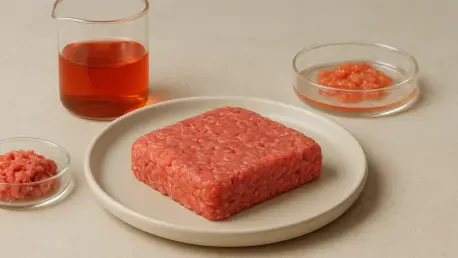

The integration of a plant-based scaffold into the bioreactor allows for the direct growth of structured tissue rather than a simple cell slurry. This fundamental shift in bioprocessing marks a departure from the traditional approach of maximizing cell counts to a more sophisticated model centered on metabolic efficiency and structural integrity. For years, the cultivated meat sector struggled with a production paradox where increasing the volume of bioreactors did not linearly translate to more meat on the table due to the physical stresses placed on living cells. By rethinking the relationship between the cell and its environment, Scotland-based Roslin Technologies and the food-tech innovator Ever After Foods have successfully dismantled this bottleneck. Their collaborative research reveals a staggering 19-fold increase in dry biomass and protein productivity compared to conventional stirred-tank benchmarks. This achievement suggests that the industry is finally moving toward a reality where cultivated proteins can compete directly with traditional livestock agriculture on both price and quality.
Shifting the Paradigm: From Cell Density to Cellular Output
The core of this breakthrough lies in a nuanced understanding of how cells behave when they are no longer subjected to the harsh conditions of industrial stirring. Historically, the pursuit of high cell density was seen as the primary metric for success in the cultivated meat industry, yet this often ignored the quality of the biomass produced. In the latest trials conducted by Ever After Foods, the data indicates that the massive gains were split between two critical factors. First, they achieved a fivefold increase in cell density, reaching levels exceeding 150 million cells per milliliter. Second, and perhaps more importantly, they realized a fourfold increase in the amount of protein and dry biomass synthesized by each individual cell. This dual-layered improvement ensures that every liter of bioreactor capacity is utilized to its absolute maximum potential. By allowing cells to spend less energy on survival and more on protein production, the process transforms into a highly efficient biological factory.
This evolution in biomanufacturing strategy addresses the long-standing issue of metabolic waste where cells in suspension systems frequently prioritize division over differentiation and protein deposition. When cells are floating in a turbulent liquid medium, they are often in a state of stress that limits their ability to produce the complex myofibrillar proteins associated with traditional muscle meat. However, by providing a stable and nutrient-rich microenvironment, the partnership between Roslin and Ever After Foods has flipped this script. The results suggest that the cells are now behaving more like they would in a living animal, focusing their biological resources on building tissue rather than just duplicating DNA. This transition is essential for the economic viability of the sector, as it reduces the amount of expensive growth media required to produce a kilogram of edible product. The increased efficiency effectively lowers the marginal cost of production, bringing the goal of price parity with conventional meat closer than ever.
Engineering Efficiency: The Edible Packed Bed System
Central to this technical leap is the Edible Packed Bed system, which replaces the high-shear mechanical agitation common in most industrial bioreactors. Traditional stirred-tank reactors rely on impellers to distribute oxygen and nutrients, but the resulting turbulence can be catastrophic for delicate animal cells, often stunting their growth or causing premature death. The system utilizes a low-energy environment where a nutrient-rich culture medium is continuously cycled through a stationary bed of cells and scaffolds. This method of continuous perfusion provides a steady supply of fresh nutrients while simultaneously removing metabolic waste products like lactic acid and ammonia without the need for complex filtration devices. Because the environment remains calm and stable, the cells can reach much higher concentrations without being physically crushed by the forces of fluid dynamics. This engineering solution provides the structural stability required for the cells to anchor and begin the process of tissue formation.
The physical architecture of this system is defined by the PlantriX scaffold, a proprietary three-dimensional environment that mimics the extracellular matrix of animal tissue. Unlike temporary carriers that must be removed before the meat is processed, this scaffold is fully edible and remains an integral part of the final food product. By providing a surface for the cells to latch onto, the scaffold triggers a series of biological signals that encourage the cells to organize into complex structures rather than remaining an unstructured mass. This organization is vital for replicating the mouthfeel and texture of real meat, which is inherently fibrous and layered. The scaffold itself accounts for less than two percent of the final product’s weight, ensuring that the consumer is eating almost entirely animal-derived protein. This integration simplifies the transition from the laboratory to the plate, as the harvested material already possesses the physical characteristics necessary for high-quality culinary applications.
Biological Stability: The Role of Pluripotent Stem Cells
While the engineering provides the framework, the biological engine of this process consists of porcine pluripotent stem cells developed by Roslin Technologies. These cells are fundamentally different from the primary cells used by many other startups, which have a limited lifespan and often lose their vigor after a few rounds of division. Pluripotent stem cells are characterized by their longevity and genetic stability, allowing them to divide indefinitely without losing their ability to turn into muscle or fat. This characteristic makes them ideal for long-duration industrial production cycles, as it eliminates the need for frequent and expensive re-sampling from live animals. In a commercial setting, this means a single cell line can fuel production for months or even years, ensuring a high level of consistency across different batches of meat. The predictability of these cells allows manufacturers to fine-tune their bioreactor settings, knowing that the biological inputs will remain constant and reliable.
The partnership between Roslin Technologies and Ever After Foods established a definitive blueprint for the next era of cellular agriculture. By prioritizing the metabolic output of individual cells and creating a low-stress engineering environment, they demonstrated that the scalability bottleneck was a solvable engineering problem rather than an insurmountable biological limit. For industry stakeholders, the path forward now involves the rapid deployment of these integrated platforms into commercial food systems to begin the replacement of traditional supply chains. Future considerations must focus on the localization of these facilities to reduce transportation emissions and ensure food security in regions with limited agricultural land. Producers who adopted this hybrid approach between advanced cell biology and edible structural scaffolds found themselves positioned to lead the market in both quality and cost-efficiency. This milestone served as a clear signal that the transition from science to a food pillar had begun.