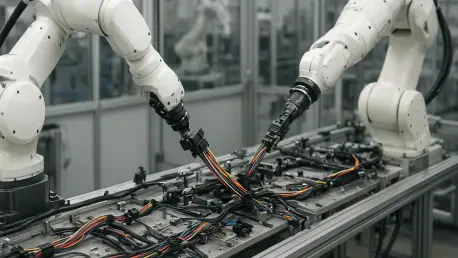

The integration of MVTec MERLIC software allows robots to see and adjust their movements in real time when handling flexible components. For decades, the automotive industry has faced a significant bottleneck where sophisticated assembly lines are frequently halted by the physical limitations of manual labor in wire harness production. While massive robotic arms can weld chassis with micron-level precision and high-speed machines can populate circuit boards in the blink of an eye, the wire harness has remained stubbornly resistant to mechanization. The fundamental problem lies in the inherent nature of cables themselves: they are flexible, unpredictable, and dimensionally unstable objects that do not hold a static shape. When a traditional robot attempts to grasp a wire, the component bends or shifts in ways that a “blind” machine cannot account for, leading to failed insertions or damaged connectors. This has forced the industry into a “migratory” pattern, constantly shifting production to regions with low labor costs to manage the high human-hour requirements. However, as global supply chains face increasing volatility and the push for local manufacturing gains momentum, the technological barrier that once protected manual assembly is finally beginning to crumble under the weight of sophisticated sensing and vision technologies that provide robots with near-human perception.
The Architecture: A Modular Robotic Ecosystem
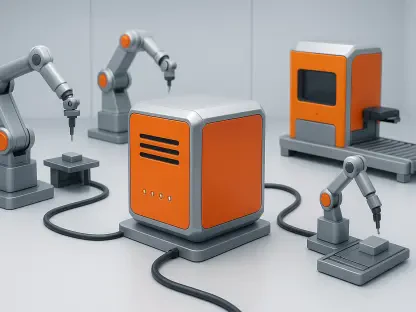
The innovation introduced by Cellios GmbH involves a modular ecosystem that deconstructs the once-manual assembly process into discrete, automated stages. In collaboration with TE Connectivity, they developed a system where specialized robot cells handle specific tasks such as connector singulation, cable preparation, and crimping. By breaking the process down, the system can manage the intricacies of cable routing and ultrasonic welding—tasks that previously demanded high levels of human concentration and physical flexibility. This modular approach allows for a level of scalability that was previously unattainable in custom wiring projects. Instead of a single, monolithic machine trying to perform every task, the distribution of labor among specialized cells ensures that each step is optimized for speed and accuracy. This setup also allows manufacturers to swap out or upgrade specific modules as new connector types or cable specifications are introduced, providing a future-proof solution for the rapidly evolving automotive landscape. The flexibility of the modular design reflects a shift in engineering philosophy, prioritizing adaptable automation over rigid, single-purpose machinery.
At the heart of this technological leap is the automation of contact insertion, a task with incredibly tight tolerances that has long been the primary obstacle to full automation. To successfully insert a tiny metal crimp into a connector cavity, the robot must operate with a precision of less than one-tenth of a millimeter. This level of accuracy is impossible with standard programming alone, especially when the component being handled is a flexible wire that can deviate from its expected position by several millimeters. The transition to a robotic system that can effectively “see” its environment and “feel” the components it is handling represents a departure from traditional industrial automation. By integrating high-resolution imaging and sophisticated processing algorithms, the system can identify the exact spatial orientation of a crimp before the insertion attempt begins. This capability effectively compensates for the physical unpredictability of the material, allowing the robot to mimic the nuanced adjustments a human technician would make instinctively. The result is a highly reliable process that maintains peak performance even when dealing with the most challenging component geometries found in modern vehicle electrical systems.
The Sensory Breakthrough: Combining Sight and Touch
To overcome the unpredictability of flexible cables, the Cellios system utilizes advanced machine vision powered by MVTec MERLIC software and high-precision 2D cameras. The process begins with component recognition, where a camera determines the exact position and angle of a crimp within the robot’s gripper. This visual check is essential because the crimp’s orientation in the gripper is never identical twice due to the wire’s flexibility. A second camera identifies the target location on the connector, allowing the software to calculate real-time spatial corrections that are sent directly to the robot’s control system. This visual guidance ensures that the robot can align components with sub-millimeter precision regardless of how the cable has shifted during the picking process. By using advanced matching technologies, the vision system can isolate the relevant features of the crimp and connector even in environments with varying light conditions or visual noise. This high level of visual acuity transforms the robot from a repetitive motion machine into an intelligent agent capable of reacting to its physical surroundings in real time.
Beyond the power of sight, the system incorporates critical haptic feedback through the use of force-torque sensors to mimic the human sense of touch. These sensors are integrated into the robot’s wrist and monitor the physical resistance encountered during the insertion process at a high frequency. If the robot detects a resistance profile that suggests a misalignment or a partial obstruction, it can dynamically adjust its movements or pause the operation to prevent damage to the delicate metal contacts. This combination of vision and touch allows the robot to handle flexible materials with a level of nuance previously reserved exclusively for human workers. The tactile data acts as a secondary verification layer, confirming that the crimp has been seated perfectly within the connector cavity. This multi-sensory approach not only increases the success rate of complex assemblies but also provides a safety mechanism that protects expensive components from mechanical stress. By merging these two sensory inputs, manufacturers can finally achieve the high-speed, high-reliability production required for complex automotive wire harnesses.
Operational Efficiency: The Role of Low-Code Software
A significant factor in the rapid development and deployment of this technology is the use of low-code machine vision software. Traditional vision programming is often a time-consuming and specialized skill that can significantly delay a product’s time to market, requiring extensive manual coding for every new component variant. By utilizing a graphical user interface with drag-and-drop tools, engineers can design complex vision applications without writing thousands of lines of code. This accessibility allowed the Cellios team to implement sophisticated matching technologies and communication protocols quickly, reducing the development cycle from months to weeks. The low-code environment also simplifies the process of training the system to recognize new parts, which is a common requirement in the automotive sector where harness designs change with every vehicle model year. This streamlined approach to software development ensures that the automation system remains agile and can be updated by on-site engineers rather than requiring a dedicated team of vision specialists for every minor adjustment.
The integration of these software solutions ensures that the vision system can communicate seamlessly with the rest of the factory’s digital infrastructure. By using standard industrial protocols such as MQTT and REST, the robots and cameras function as a cohesive unit within the broader manufacturing environment. This connectivity allows for the real-time collection of performance data, which can be used to optimize the assembly process and predict maintenance needs. The software’s ability to interface with various hardware components ensures that the vision system is not locked into a single vendor’s ecosystem, providing manufacturers with greater flexibility in their equipment choices. Furthermore, the intuitive nature of the software interface makes it easier for operators to monitor the status of the assembly cells and troubleshoot any issues that arise during production. This shift toward user-friendly, highly integrated software is a cornerstone of the modern smart factory, where the barrier between complex data processing and practical industrial application is increasingly transparent.
Global Manufacturing: Reshoring and Environmental Impact
The shift toward automated assembly has profound implications for the global manufacturing landscape, particularly regarding the reshoring of production to high-wage economies. By eliminating the heavy dependency on low-cost manual labor, companies can move production facilities closer to final assembly plants in regions like North America and Europe. This move reduces the risks associated with long-distance supply chains and helps stabilize the production schedules of major automotive manufacturers who have recently struggled with logistics delays. Localizing production also provides a buffer against geopolitical instability and fluctuating shipping costs, making the entire supply chain more resilient. When the labor cost advantage of offshore manufacturing is offset by the efficiency and precision of robotics, the economic argument for keeping production near the end-user becomes undeniable. This transition supports the growth of high-tech manufacturing clusters and creates a demand for skilled technicians who can operate and maintain these advanced robotic systems, further strengthening local industrial bases.
Furthermore, localizing production offers significant environmental benefits that align with global sustainability goals. Automating the assembly process near the end-user significantly shortens the distance that finished wire harnesses must travel, thereby reducing the overall carbon footprint associated with international shipping and heavy trucking. Additionally, the robotic system provides a digital birth certificate for every harness produced, logging every insertion and test performed during the assembly. This ensures 100% quality control and total traceability, which is a major upgrade over the manual processes of the past where errors could go undetected until the vehicle reached the final testing stage. By reducing waste and ensuring that only perfect components are shipped, the automated system contributes to a more sustainable and efficient manufacturing cycle. The ability to track the history of every single wire and connector also simplifies the recall process and improves long-term vehicle reliability, as manufacturers can pinpoint the exact batch and conditions under which a component was assembled.
Strategic Shifts: The Future of Autonomous Production
The transition toward automated wire harness assembly demonstrated that the historical barriers to industrial mechanization were no longer insurmountable. Project partners like Cellios and TE Connectivity validated that the synthesis of high-performance machine vision and tactile sensing could replicate the nuanced dexterity of human workers. By moving beyond the blind robotics of the past, the industry established a new standard for handling flexible materials in high-precision environments. This technological shift encouraged a broader move toward reshoring, as manufacturers prioritized local supply chain resilience and quality control over the pursuit of low-cost labor. The success of the prototype served as a clear indicator that the geography of manufacturing was changing, favoring innovation and high-tech clusters in developed economies. Ultimately, the project provided a scalable blueprint for the future of flexible component automation, ensuring that the electrical foundations of the next generation of vehicles would be built with unprecedented accuracy and efficiency.
Looking toward the upcoming market launch in 2027, the success of this modular approach indicated a permanent change in how industrial robots interacted with unstable materials. Researchers moved forward by exploring self-healing processes, where machine vision systems not only detected errors but also instructed robots on how to correct them autonomously without human intervention. This evolution suggested that the logic of cable routing and contact insertion would soon be applied to other complex fields, such as the wiring of industrial control cabinets and the assembly of consumer electronics. The shift toward low-code software and integrated sensors removed the technical complexity that once hindered rapid innovation, allowing smaller firms to compete with global giants. As these systems matured, the industry moved away from the migratory labor model and embraced a future defined by high-precision, localized automation. The final consensus among engineers was that the integration of sight and touch had finally unlocked the full potential of the robotic workforce, bridging the gap between mechanical power and human-like perception.