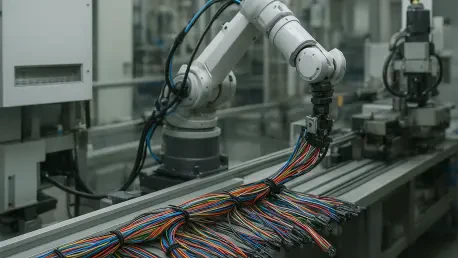

While the automotive body shop and paint facilities have seen massive robotic adoption, the assembly of the wire harness has remained a manual process until now. For decades, the intricate web of cables and connectors that constitutes a vehicle’s electrical backbone has been the final holdout against total automation due to the inherent unpredictability of flexible materials. This year, 2026, marks a definitive turning point as Cellios, a strategic spin-out from the Fraunhofer Institute for Manufacturing Engineering and Automation, has successfully introduced a revolutionary system in collaboration with industry giants TE Connectivity and MVTec Software. This partnership has yielded a technological leap that finally brings the central nervous system of the modern automobile into the robotic age. By integrating sophisticated computer vision with tactile sensory feedback, the partners have addressed the extreme dexterity challenges that previously necessitated thousands of human workers on assembly lines worldwide. The introduction of this system is not merely an incremental improvement but a fundamental reconfiguration of the automotive supply chain, promising to eliminate the traditional bottlenecks that have long hindered the transition to fully software-defined vehicle manufacturing. As car manufacturers push toward more complex electric vehicle architectures, the demand for high-precision, error-free wiring has never been higher, making this automation breakthrough a critical necessity for the next generation of industrial efficiency.
The Challenge: Managing Flexible and Unpredictable Materials
The primary obstacle to automating wire harness production has always been the non-rigid nature of cables. Unlike steel parts or engine components that remain in a fixed, predictable position, flexible wires shift, bend, and sag unpredictably when handled by robotic grippers. In traditional industrial engineering, robots rely on fixed coordinates and pre-programmed trajectories to perform tasks with high repetition. However, when a robot picks up a flexible cable, the exact position of the terminal end or the crimp changes with every micro-movement. This lack of structural integrity makes standard robotic programming virtually useless, as the machine cannot predict where the connector end will be at the moment of insertion. This physical unpredictability has effectively kept the wire harness assembly as a manual labor stronghold, where human fingers and eyes provide the constant real-time adjustments required to handle floppy materials. To bridge this gap, engineers had to move beyond rigid programming and develop a system capable of perceiving and reacting to the erratic behavior of these flexible components in real-time.
Historically, the difficulty of managing these materials turned wire harness assembly into a migratory industry that followed the global search for low labor costs. Production facilities were constantly moved to regions where human dexterity was affordable, as only human hands possessed the necessary visual acuity and tactile sensitivity to insert tiny terminals into complex connector housings. This reliance on manual labor created significant challenges for quality control and supply chain resilience, as the human element introduced variability and the geographical distance increased logistics risks. The Cellios system seeks to break this cycle by providing industrial robots with the sophisticated sensors needed to replicate human performance. By solving the physics problem of manipulating flexible objects, the industry can finally move away from a labor-dependent model toward a capital-intensive, high-tech manufacturing strategy. This shift is particularly vital as modern vehicles now contain miles of wiring and thousands of connection points, making the margin for human error increasingly narrow and the cost of defects increasingly high.
Visual Guidance: Implementing Advanced Machine Vision
To achieve successful automation in such a delicate environment, the Cellios system utilizes a sophisticated dual-camera 2D vision system that acts as the primary sensory organ for the robot. One camera is dedicated to identifying the exact position and orientation of the metallic terminal held by the robotic gripper, while a second camera locates the specific cavity on the plastic connector housing. This setup is powered by MVTec’s Merlic software, which processes visual data with extreme speed to allow the robot to make micro-corrective movements during the assembly process. This real-time adjustment ensures that the terminal is perfectly aligned with the target hole before any force is applied. Without this level of visual feedback, the robotic arm would likely crush the delicate plastic housings or bend the thin metallic pins, leading to immediate component failure. The software acts as a bridge between raw visual data and mechanical action, transforming a standard industrial robot into a machine capable of seeing and understanding its workspace with sub-millimeter precision.
The precision required for this task is immense, as connector cavities are often only a few millimeters wide, requiring an insertion accuracy threshold of 0.1mm. This feat was previously thought impossible for automated machinery dealing with non-rigid parts, but the integration of high-resolution cameras and low-code software platforms has changed the landscape. By utilizing low-code environments, the developers have made it significantly easier to scale the technology and adapt it to the vast variety of harness designs found in different vehicle models. This flexibility is crucial because a single vehicle may have dozens of different harness variants, each requiring unique terminal types and connector configurations. The ability to rapidly reprogram the vision system for new parts without needing deep expertise in image processing allows manufacturers to maintain high uptime even as vehicle designs evolve. This technological framework ensures that the robot can adapt to different wire gauges, colors, and terminal shapes, providing a level of versatility that was once the exclusive domain of human operators.
Tactile Sensitivity: Integrating Force-Torque Sensing
Beyond visual guidance, the system incorporates advanced force-torque sensors to provide the robot with a refined sense of touch. While vision gets the terminal to the entrance of the connector cavity, it cannot verify that the connection has been successfully locked into place. These sensors monitor the physical resistance encountered when a wire is pushed into a connector, providing a feedback loop that mimics human tactile perception. If the resistance profile does not match a pre-defined standard, the system immediately recognizes that the terminal has not properly clicked into place or that a component is being stressed beyond its limits. This capability prevents the common issue of “back-outs,” where a wire appears to be inserted but eventually vibrates loose because it was not fully seated. By providing this tactile verification, the system ensures that every single connection meets rigorous mechanical standards before the harness moves to the next stage of production.
This tactile feedback provides a level of quality control that far exceeds manual assembly capabilities. A human operator might miss a subtle click in a noisy factory environment or accidentally apply too much pressure, but a sensor-equipped robot maintains perfect consistency over thousands of repetitions. It ensures that every “click” is verified and logged, providing a digital paper trail for the entire assembly process. This is particularly important for safety-critical systems, such as airbag deployments or autonomous braking sensors, where a single loose wire could have catastrophic consequences. By combining high-speed vision with force sensing, the robot can handle delicate plastic housings and metallic terminals with the necessary finesse to guarantee both electrical continuity and mechanical stability. This dual-sensor approach effectively replicates the hand-eye coordination of a skilled technician, but with the added benefits of tireless precision and comprehensive data collection.
Scalability and Design: Modular Assembly and Zonal Architecture
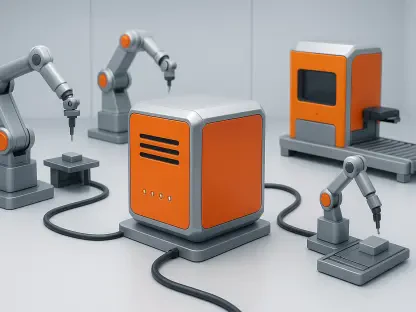
The Cellios system is designed as a series of modular cells rather than a single, monolithic machine, which is essential for modern factory integration. This modularity allows the production process to be broken down into discrete, manageable stages such as connector organization, cable preparation, and high-precision crimping. By isolating these tasks, the system can be customized or expanded based on the specific needs of the manufacturer or the complexity of the vehicle being produced. Each cell functions as an independent unit that communicates with the broader factory network, allowing for a seamless flow of materials and data. This structure also facilitates easier maintenance and the ability to update individual components or software modules without overhauling the entire production line. For a manufacturer, this means the system can grow in lockstep with production demands, moving from small-scale pilot programs to high-volume manufacturing with minimal disruption to existing operations.
A critical finding in the development of this system is that automation is most effective when the wire harness itself is designed to be robot-friendly. Industry experts have noted that the shift toward zonal architectures, which use shorter and more rigid wiring modules instead of a single massive harness, drastically increases the success rate of automated assembly. These zonal designs reduce the overall length of wiring by hundreds of meters and simplify the robot’s task by dealing with more manageable segments. Collaborations like the Next2OEM project have already demonstrated that redesigning harnesses for automation can boost assembly levels from 10 percent to as high as 90 percent. As automotive manufacturers transition to software-defined vehicles, they are increasingly adopting these streamlined electrical architectures to save weight and reduce complexity. This evolution in vehicle design creates a highly hospitable environment for the Cellios system to operate at peak efficiency, proving that the future of manufacturing lies in the simultaneous innovation of both the product and the process.
Strategic Benefits: Quality Assurance and Domestic Production
One of the most significant advantages of the Cellios system is its ability to provide total traceability for every connection made during the assembly process. Because every insertion is monitored by high-definition cameras and sensitive force sensors, the system creates a comprehensive digital record of the entire manufacturing journey. This moves quality assurance upstream, allowing errors to be identified and corrected the moment they occur rather than at the end of the production line where rework is much more expensive. This real-time monitoring significantly reduces the rate of defective parts and ensures that every finished harness meets the highest safety standards. For automotive manufacturers, this level of precision reduces the risk of costly recalls and improves overall brand reliability. The massive amount of data collected during assembly can also be fed into machine learning algorithms to further refine the manufacturing process, leading to continuous improvements in both speed and reliability over time.
The economic implications of this technology are profound, particularly regarding the geographical location of manufacturing facilities. By eliminating the heavy dependency on low-cost manual labor, the Cellios system makes it economically feasible to produce wire harnesses in high-wage regions like North America and Western Europe. This potential for reshoring allows manufacturers to place production facilities in close proximity to their main vehicle assembly plants, drastically reducing logistics costs and carbon footprints. Bringing harness production back to domestic markets also shortens supply chains, making them far more resilient to global trade disruptions or geopolitical shifts. It allows for tighter integration between the wiring supplier and the vehicle manufacturer, facilitating faster design changes and better communication during the development phase. This transition could revitalize manufacturing sectors in regions that previously lost these jobs to offshore competitors, creating a new class of high-tech employment opportunities focused on robotics and data management.
Future Outlook: Transforming the Manufacturing Philosophy
The shift to automated wire harness assembly represented a fundamental change in how the automotive industry approached its most complex components. The Cellios system provided a clear path forward by proving that even the most unpredictable industrial tasks could be solved through the clever integration of high-speed sensors and adaptive algorithms. Industry leaders recognized that the era of relying solely on human dexterity for flexible materials was coming to an end, replaced by a more stable and technology-driven model. This project established a blueprint for how robots could be taught to interact with delicate and non-rigid materials, opening the door for similar innovations in the aerospace and consumer electronics sectors. The successful deployment of this technology demonstrated that when hardware and software are perfectly synchronized, the barriers to total factory automation effectively disappear.
To capitalize on these advancements, manufacturers must now prioritize the redesign of their electrical architectures to align with robotic capabilities. The transition to zonal wiring and modular assembly cells proved to be the most effective way to maximize the return on investment for automated systems. Looking forward, the focus will likely shift toward increasing the parallel processing power of these robotic cells to further boost throughput beyond current targets. By mid-2027, the industry moved toward high-volume adoption, and by 2028, the speed optimizations had already surpassed the capabilities of manual labor by a significant margin. For companies looking to remain competitive, the next logical step involves integrating these automated lines with broader artificial intelligence systems to manage the enormous variety of harness variants. The wire harness, once the stubbornly manual outlier of the factory floor, has finally been fully integrated into the high-tech ecosystem of modern manufacturing.