
The successful completion of 36 units in Denmark provides a definitive roadmap for how industrial automation will influence the next generation of global housing projects. Situated in the town of Holstebro, the Skovsporet development marks a significant transition from experimental architectural showcases to scalable, functional residential communities. This project, which serves as the largest 3D-printed housing complex in Europe, addresses the immediate need for student accommodations while testing the limits of robotic construction in a Northern European climate. Spanning approximately 1,650 square meters, the six-building cluster demonstrates that additive manufacturing can move beyond the one-off prototype stage into a phase of high-volume production. By integrating cutting-edge software with robust hardware, the developers have managed to create a living space that balances modern aesthetic demands with the harsh realities of construction economics and strict regulatory frameworks.
Robotic Precision and Construction Efficiency
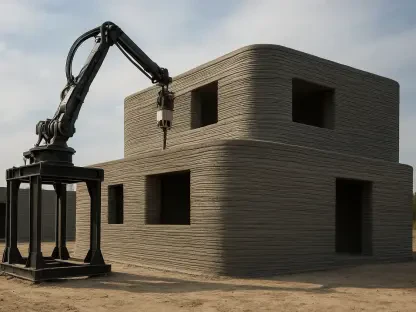
The technical execution of the Skovsporet project relied heavily on the BOD3 construction printer, a sophisticated robotic system designed to translate digital blueprints into physical structures with millimeter precision. Unlike traditional methods that require the manual transport and placement of thousands of individual bricks or heavy timber frames, this robotic motion system utilizes a specialized printhead to deposit layers of high-strength concrete. This process, often referred to as large-scale additive manufacturing, allows the structure to emerge directly from the ground up, following a programmed toolpath that ensures every wall is structurally sound and geometrically perfect. This shift toward digital fabrication effectively eliminates many of the measurement errors and material waste common in traditional masonry. Furthermore, the automation of the load-bearing walls provides a consistent baseline for quality that is independent of the varying skill levels found on building sites.
One of the most compelling advantages observed during the Holstebro project was the radical optimization of human labor. In an era where the global construction industry faces a critical shortage of skilled tradespeople, the ability to manage a 36-unit development with a skeletal crew of just three individuals is nothing short of revolutionary. This lean operational model was made possible by the efficiency of the robotic printer, which performed the most labor-intensive tasks with minimal supervision. For instance, a single building containing six separate apartments was printed in just five working days, a pace that manual labor crews would find nearly impossible to match. This speed does not merely accelerate the construction timeline; it fundamentally alters the financial feasibility of large-scale residential projects. By reducing the time and personnel required for the structural phase, developers can allocate resources toward higher-quality interior finishes and local infrastructure.
Economic Viability: Building within Statutory Budget Limits
A primary hurdle for new technologies in the building sector has always been the perception that innovation comes at a prohibitive cost. However, the Skovsporet development has successfully dismantled this narrative by operating within the strict statutory budget caps required for affordable housing in Denmark. Commissioned by NordVestBO, the project had to meet rigorous financial benchmarks to ensure it remained accessible to its target demographic of students. The final construction cost for the buildings was approximately €1,880 per square meter, a figure that includes the 3D-printed shells and the integration of traditional building components. This competitive pricing demonstrates that 3D printing is no longer a luxury experiment but a viable tool for social housing organizations looking to maximize their impact. The ability to deliver modern, durable housing under the same financial constraints as traditional brick-and-mortar builds suggests a major shift in the industry’s economic landscape.
The direct result of this financial discipline is a tangible benefit for the residents, with monthly rents for the apartments starting at less than €670. This affordability is crucial in a market where housing costs for students often outpace inflation and available subsidies. By leveraging robotic automation to lower the barrier to entry for high-quality construction, the project offers a dignified living environment that does not sacrifice comfort for cost-efficiency. Each unit, ranging from 38 to 50 square meters, provides a functional layout that feels spacious thanks to the architectural flexibility afforded by the printing process. This success story proves that the intersection of technology and social policy can create inclusive urban spaces. As more housing authorities observe the results in Holstebro, the pressure to adopt similar automated solutions will likely increase, driving further cost reductions as the technology achieves greater economies of scale.
Architectural Freedom and Sustainable Design
In the world of conventional construction, complexity is almost always synonymous with expense. Curved walls, organic shapes, and unique geometries require expensive custom formwork and specialized labor, making them rare in affordable housing. The Skovsporet project flipped this logic by utilizing the concept of complexity for free, where the robotic printer follows a curved path just as easily as a straight one. SAGA Space Architects utilized this capability to design buildings with rounded corners and flowing interiors that provide a more natural, human-centric living experience. These aesthetic choices do not just serve a visual purpose; they also improve the structural flow of the space and create a unique identity for the community. The ability to offer high-end architectural design at an affordable price point is perhaps the most disruptive aspect of 3D printing, as it democratizes access to beautiful, well-designed homes that were once reserved for the elite.
Sustainability was integrated into the core of the project through both material science and land-use strategy. The construction industry is a significant contributor to global carbon footprints, but the Skovsporet development utilized a specialized concrete mix that achieved a 30% reduction in CO2 emissions compared to standard formulations. Furthermore, the precision of the 3D printer allowed the construction team to work within a very tight site footprint, which was essential for preserving the natural environment. Remarkably, 90% of the original trees on the site were retained, allowing the new buildings to be woven into the existing forest landscape rather than replacing it. This low-intervention approach highlights how digital planning and robotic execution can minimize the environmental disruption typically associated with large-scale development. By combining lower-carbon materials with sensitive site management, the project provides a compelling model for future urban expansion.
The Road Ahead: Scaling the Mobile Factory Model
The successful completion of this residential village marks a critical milestone in the transition from prototypes to industrial-scale application. While individual 3D-printed houses have been built before, the repetition of the process across six distinct clusters allowed the engineering team to refine their techniques and streamline the integration of printed concrete with traditional building elements. The construction site essentially functioned as a mobile factory, where the robotic systems were deployed to automate the most repetitive and physically demanding tasks while human craftsmen focused on the complex finishing work, such as installing roofs, windows, and internal utilities. This hybrid construction model maximizes the strengths of both robotics and traditional trades, creating a workflow that is faster, safer, and more predictable than conventional methods. The data gathered from this project will serve as a foundation for future developments, allowing for even greater optimizations.
The successful completion of the Skovsporet village in Holstebro provided actionable insights into the long-term viability of automated building systems. Stakeholders discovered that the primary barrier to adoption was not technical capacity but rather the need for updated building codes that recognized 3D-printed structures as equivalent to traditional masonry. By demonstrating compliance with rigorous safety and thermal insulation standards, the project paved the way for broader regulatory acceptance across the European Union. Furthermore, the integration of on-site solar energy systems and high-performance insulation within the printed walls showed a clear path toward carbon-neutral living. The initiative encouraged a shift toward a design-for-manufacturing mindset, where architects optimized their digital models to reduce material usage without compromising structural strength. Ultimately, the development acted as a catalyst for a new era of decentralized, high-speed construction.