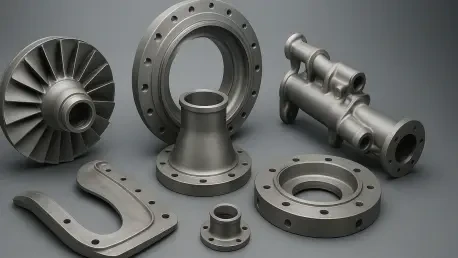

Institutional investors recently backed PTC Industries at a price of 21,060 rupees per share to fund the expansion of its Advanced Manufacturing and Technology Centre. This massive capital infusion signals a significant turning point for the domestic aerospace sector, especially as the company solidifies its partnership with Safran Aircraft Engines. Through its subsidiary, Aerolloy Technologies Limited, the firm is now positioned to develop and supply critical titanium cast components for the LEAP engine program. This agreement is far more than a routine commercial transaction; it represents a deep strategic alignment that underscores the rising technical prowess of high-precision manufacturing outside traditional Western hubs. As the aviation industry seeks to enhance efficiency and reduce weight, the demand for sophisticated titanium parts has skyrocketed. By successfully navigating the rigorous qualification processes required by global giants, the company has effectively demonstrated that it can compete at the highest level of aerospace engineering.
Advancing the Global Aerospace Supply Chain
The LEAP engine remains a cornerstone of modern commercial aviation, serving as the primary propulsion system for a vast number of narrow-body aircraft globally. Developed by CFM International, the joint venture between Safran and GE, this engine is celebrated for its fuel efficiency and reduced carbon footprint. To maintain such performance, the components must be crafted from advanced materials like titanium, which offers an exceptional strength-to-weight ratio. Aerolloy Technologies has stepped into a specialized tier of global suppliers capable of handling complex titanium casting, a process that requires immense technological sophistication and controlled environments. This move highlights a broader industry shift where original equipment manufacturers are actively diversifying their supply chains to build greater resilience against regional disruptions. By integrating Indian precision engineering into the core of the international propulsion supply chain, the partnership is set to redefine how high-tech components are sourced and manufactured between 2026 and 2030.
Beyond the immediate technical achievements, this contract provides PTC Industries with substantial multi-year manufacturing visibility, ensuring a stable and high-margin revenue stream as the global demand for single-aisle aircraft continues to scale. The aerospace industry operates on long lead times and even longer product lifecycles, making such agreements vital for sustainable corporate growth and capital planning. This partnership validates the company’s internal ecosystem, which encompasses the entire production cycle from raw material processing to final precision machining. Such vertical integration allows for better quality control and faster iteration cycles, which are essential when dealing with the stringent safety standards of the aviation world. Furthermore, the ability to produce these components domestically reduces logistical complexities and enhances the overall cost-competitiveness of the final product. As the industry moves forward, the focus will increasingly shift toward these integrated hubs that can offer end-to-end solutions for the world’s most demanding engineering challenges.
Strategic Resilience and Manufacturing Infrastructure
Supporting this industrial expansion is a robust financial strategy that has recently seen the company execute a highly successful Qualified Institutions Placement, raising approximately 1,800 crore. The issue was oversubscribed more than five times, reflecting immense confidence from the global investment community in the company’s specific growth trajectory and technical roadmap. This capital is being deployed to ramp up capacity at the Advanced Manufacturing and Technology Centre, a facility designed to meet the rigorous certification milestones mandated by global aerospace leaders. The investment enables the acquisition of state-of-the-art machinery and the implementation of advanced metallurgy techniques that are required for titanium processing. By securing the necessary funding ahead of the production ramp-up, the company has mitigated one of the most common risks in heavy industrial scaling. This financial stability allows the engineering teams to focus exclusively on meeting delivery timelines and maintaining the high-yield rates necessary for profitability in the aerospace sector.
The emergence of this specialized manufacturing hub offered a blueprint for how precision engineering firms could integrate into the global propulsion supply chain. Industry leaders recognized that the path forward necessitated a focus on material science and vertical integration to overcome the inherent volatility in raw titanium markets. Companies that prioritized the development of an internal ecosystem for strategic metals found themselves better equipped to handle the rigorous execution standards required for aerospace certification. It was essential for stakeholders to invest in advanced training and localized supply networks to maintain the momentum established during this period. Moving forward, organizations must evaluate their dependence on traditional manufacturing corridors and consider the benefits of decentralized, high-tech production centers. The success of this partnership highlighted the importance of aligning financial backing with specific technical milestones to ensure long-term viability. Future considerations should include the adoption of additive manufacturing to complement traditional casting.