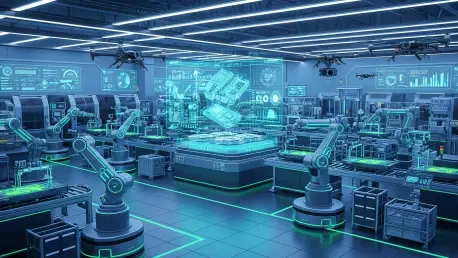

The global industrial landscape currently faces an unprecedented convergence of high energy costs and a critical shortage of skilled labor, forcing traditional manufacturers to rethink their core operational strategies. While many facilities have historically relied on retrospective data analysis to solve production bottlenecks, the recent shift toward AI-native architectures has fundamentally changed how industrial systems perceive and react to environmental variables. Shanghai Electric has introduced a suite of solutions designed to embed artificial intelligence directly into the physical hardware of the factory floor rather than treating it as an external software layer. This integration ensures that machines can self-optimize in real-time, drastically reducing the latency between anomaly detection and corrective action. By prioritizing native AI capabilities, manufacturers are moving away from the fragile connectivity of the past toward a model where intelligence is as fundamental to a machine as its motor or gears.
Integrating Intelligence within Industrial Infrastructure
The Shift Toward Embedded Cognitive Systems
Modern production lines are increasingly burdened by the sheer volume of telemetry data generated by thousands of sensors, often leading to information silos that hinder rapid decision-making. To address this, the current implementation of AI-native manufacturing focuses on decentralized processing, where computational power is located at the edge of the industrial network. This architectural choice allows for instantaneous processing of vibration, temperature, and acoustic data, enabling predictive maintenance models to identify potential failures before they result in costly downtime. Instead of sending massive datasets to a centralized cloud for analysis, these embedded systems utilize localized neural networks to manage complex workflows on the fly. This shift not only enhances the speed of operational adjustments but also fortifies data security by keeping sensitive intellectual property within the local facility. Consequently, the reliance on high-bandwidth external connections is minimized, ensuring stability.
Human-Machine Interaction via Large Language Models
Building on the foundation of edge-based processing, the development of specialized industrial large language models has enabled a more intuitive interaction between human operators and complex machinery. These models are specifically trained on vast repositories of engineering documentation and operational logs, allowing technicians to diagnose equipment issues through natural language queries rather than complex coding or manual data parsing. This democratized access to technical expertise mitigates the impact of the labor gap by empowering less experienced workers to perform high-level troubleshooting tasks. Furthermore, these AI systems continuously learn from every successful repair and adjustment, creating a living knowledge base that evolves alongside the physical factory assets. By bridging the gap between digital insights and physical execution, manufacturers are achieving a level of agility that was previously unattainable through traditional automation. This evolution represents a departure from static systems toward adaptive learning.
Optimizing Energy and Resource Efficiency
Sustainable Strategies for High-Output Manufacturing
Energy management has emerged as a primary driver for technological adoption in 2026, as industrial enterprises seek to balance high production targets with increasingly stringent environmental regulations. The deployment of AI-driven energy management systems allows for the granular monitoring of power consumption across every segment of a production facility. These systems use sophisticated algorithms to synchronize heavy-load operations with periods of high renewable energy availability or lower utility rates, effectively smoothing out demand peaks. In addition to cost savings, this intelligent load balancing significantly reduces the carbon footprint of manufacturing processes by optimizing the efficiency of thermal systems and motor drives. By integrating renewable energy sources such as solar and wind directly into the industrial microgrid, facilities can achieve a higher degree of energy independence. This proactive approach ensures that sustainability is not just a secondary goal but a core component of the strategy.
Strategic Pathways for Autonomous Production Growth
Looking ahead from the perspective of current industrial progress, the transition toward fully autonomous production environments required a total overhaul of legacy frameworks in favor of AI-native structures. Organizations that prioritized these integrated solutions found themselves better equipped to handle the fluctuations of global supply chains and shifting consumer demands. Moving forward, industrial leaders should focus on upgrading their existing sensor networks to support higher-fidelity data collection while simultaneously investing in workforce training programs that emphasize human-AI collaboration. The successful implementation of these technologies provided a clear path toward hyper-efficient, low-carbon manufacturing that remained resilient under pressure. By adopting a modular approach to AI integration, companies were able to scale their smart capabilities at a pace that matched their specific operational needs. Ultimately, the move toward native intelligence served as a vital bridge for the digital future of production.