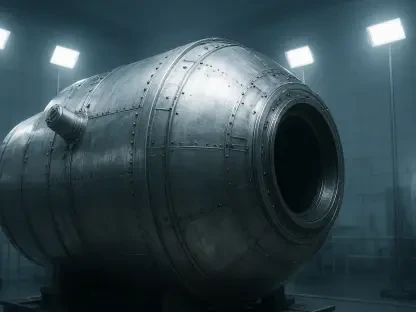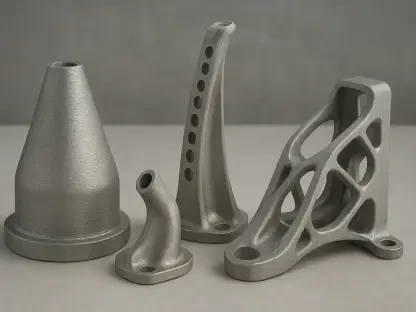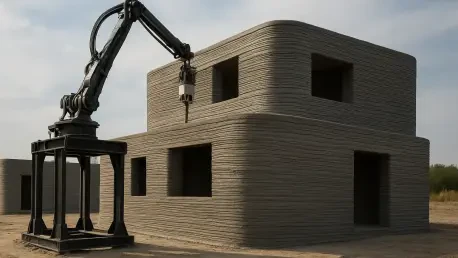

The military’s use of 3D printing for building retrofits can produce high-performance architectural components in 20 percent of the time required by manual methods. This staggering leap in efficiency marks a turning point for a sector that has historically lagged behind the digital revolutions seen in aerospace and electronics. For decades, the construction industry remained a bastion of manual labor and resource-heavy processes, often viewing additive manufacturing as a niche curiosity rather than a structural necessity. However, as the demands for rapid deployment and energy-efficient infrastructure have intensified, additive construction has emerged from the periphery. No longer the “black sheep” of the manufacturing world, these robotic extrusion systems are now being integrated into high-stakes projects that require precision beyond human capability. The transition from small-scale experimental prototypes to functional, large-scale components represents a fundamental shift in how civilization approaches the built environment.
Military Innovation: Redefining Structural Efficiency
The defense sector has emerged as a primary incubator for these technologies, recognizing that traditional building techniques are often too slow and logistically taxing for modern requirements. A prominent example of this shift is the ongoing work at the Detroit Arsenal, where the U.S. Army has implemented advanced overcladding techniques to revitalize aging infrastructure. This process involves the precision application of 3D-printed panels to the exteriors of existing buildings, effectively creating a high-performance thermal envelope without the need for costly and disruptive demolition. By utilizing the Environmental Security Technology Certification Program, the military is demonstrating that additive construction can solve immediate logistical challenges while simultaneously preparing for long-term operational resilience. This methodology allows for the rapid modernization of facilities, ensuring that critical defense installations remain functional while reducing total energy loads.
Strategic Gains: Energy Resilience and Customization
Beyond the immediate structural benefits, these military applications highlight a massive leap in productivity and resource management within the construction landscape. The direct digital fabrication process used for these custom panels requires a mere five percent of the material typically consumed by traditional renovation methods, drastically reducing the carbon footprint of structural upgrades. This efficiency does not come at the expense of aesthetic or functional design; the technology allows for complex architectural details, such as bas-relief imagery of historic armored vehicles, to be integrated directly into the functional components. Such bespoke work was previously prohibitively expensive, yet additive construction allows for mass customization at a fraction of the cost. By merging high-performance engineering with artistic flexibility, the Army is setting a new benchmark for how public and private entities might approach the rejuvenation of the existing built environment.
Cosmic Horizons: Material Science for Off-World Habitats
The ambition of additive construction extends far beyond terrestrial applications, as researchers look toward the Moon and Mars for the next frontier of human habitation. Because transporting heavy traditional building materials into space is prohibitively expensive, the scientific community is focusing on In-Situ Resource Utilization, which involves 3D printing with local materials such as lunar regolith. Recent experiments using simulated regolith mixed with recycled high-performance polymers have shown that these extraterrestrial soils can actually help stabilize the printing process by reducing common defects like warping and shrinkage during cooling. These findings are crucial for developing sustainable outposts where every gram of imported material must be accounted for. The ability to use the ground beneath a rover’s wheels to construct a shelter represents the ultimate form of localized manufacturing, turning hostile environments into viable sites for long-term exploration.
Circularity in Space: Recycled Polymers and Structural Integrity
Building in space presents unique technical hurdles that continue to drive innovation in material science and mechanical engineering. While regolith-based composites show great promise for structural stability and resource circularity, they also exhibit internal porosity that can lead to unexpected brittleness under vacuum conditions. Researchers at Concordia University have discovered that adding recycled polymers like polyether ketone ketone to the mix can enhance the binding properties of the lunar soil, yet the balance between weight and strength remains a delicate challenge. This research is vital not only for future space colonies but also for terrestrial applications, as the lessons learned in recycling high-performance polymers can be applied to create more sustainable building practices on Earth. By perfecting these complex composites, engineers are developing a toolkit for modular construction that can function in the most extreme environments, from the lunar surface to remote arctic regions.
Commercial Evolution: Scaling for the Residential Market
The transition of additive construction from the laboratory to the residential market is being spearheaded by innovators like ICON, which recently secured substantial private funding to scale its operations globally. With the introduction of multi-story robotic systems like the Titan and proprietary high-strength materials such as FormCrete, the industry is proving that it can compete with traditional homebuilding techniques. These advanced systems are designed to deliver high-quality homes at a significantly lower cost and in a much shorter timeframe than the national average, directly addressing the critical housing shortages facing many urban centers. The influx of capital from major investment firms suggests that the financial sector now views 3D-printed housing as a mature asset class rather than an experimental venture. This scaling of technology allows for the rapid deployment of entire communities, demonstrating that automation can provide a scalable solution to the housing crisis.
Industrial Strength: Climate Resilience and Economic Impact
Commercial viability is also being driven by the superior durability of printed structures compared to conventional wood-frame or brick construction. Modern 3D-printed materials are engineered to be exceptionally climate-resilient, capable of withstanding extreme fire ratings and hurricane-force winds exceeding 175 miles per hour. This resilience makes the technology particularly attractive for regions prone to natural disasters, where rebuilding efforts are often hampered by labor shortages and high material costs. Furthermore, the ability to print structures with continuous, monolithic walls eliminates many of the weak points found in traditional construction, such as joints and seams where water or heat can penetrate. As companies move past the initial proof of concept stage and complete hundreds of functional structures, the industry is demonstrating that additive construction is not just a faster way to build, but a way to build more enduring structures for the next generation.
Precision Engineering: Predictive Modeling for Hazard Mitigation
A less visible but equally critical application of additive construction is its role in civil engineering research, particularly regarding disaster simulation and infrastructure protection. By creating high-precision, 3D-printed topographical models, researchers at institutions like ETH Zurich can conduct sophisticated experiments on natural hazards like rock avalanches. These scale models, often printed at ratios such as 1:577, allow scientists to visualize how debris and geological materials move across specific landscapes with incredible accuracy. This data provides invaluable insights that help in the design of physical barriers and the assessment of risks to nearby settlements or critical transport corridors. By using additive manufacturing to replicate the exact roughness and curvature of a specific terrain, engineers can predict the behavior of natural forces in a controlled environment. This proactive approach to safety allows for the development of more effective mitigation strategies.
Industry Transformation: Long-Term Impacts on Global Infrastructure
The maturation of additive construction was defined by its transition from a fringe technological experiment to a central pillar of modern civil engineering. Stakeholders across the globe prioritized the standardization of material science to ensure that 3D-printed structures met the same rigorous safety benchmarks as traditional concrete and steel. These efforts led to the creation of universal building codes that specifically addressed the unique mechanical properties of layered materials. The industry successfully moved toward a hybrid model where automation handled complex geometries while human expertise focused on high-level systems integration and site management. By addressing the critical shortage of skilled labor and the rising costs of raw materials, additive construction provided a resilient framework for the next era of urban development. These advancements ensured that future projects were not only faster and cheaper but also significantly more adaptable to the evolving environmental pressures.